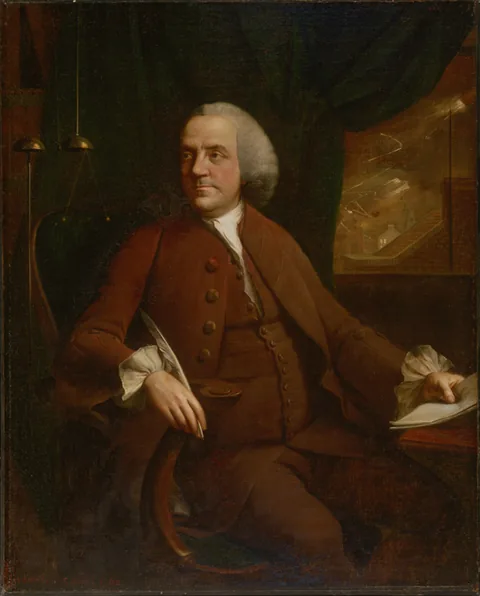

printer, writer, scientist, inventor, postmaster, diplomat, statesman
Benjamin Franklin
Also known as Richard Saunders (Poor Richard's pen name)
Born in Milk Street, Boston, Province of Massachusetts BayDied in Philadelphia, Pennsylvania
Benjamin Franklin (1706-1790) was a Boston-born printer, author, scientist, and statesman who helped draft the Declaration of Independence, secured French support for the American Revolution, and left a famous record of how he trained his own character.
Official and reference links
- WikipediaReference
- WikiquoteReference
- WikidataReference
- The Papers of Benjamin Franklin (Yale University and the American Philosophical Society)Archive
- Benjamin Franklin House, LondonMuseum
- The Franklin Institute, PhiladelphiaMuseum
- Wikimedia Commons categoryArchive
- Benjamin Franklin, a film by Ken Burns (PBS)Video
- The Autobiography of Benjamin Franklin (Standard Ebooks, free text)Other
Overview
Benjamin Franklin was born on Milk Street in Boston on January 17, 1706, the tenth and last son of Josiah Franklin.[1][2] He left Boston Latin School without graduating, was bound as his brother's apprentice at twelve, and at seventeen ran away to Philadelphia.[3][4][5]
In Philadelphia he formed a club for mutual improvement called the Junto, became the publisher of The Pennsylvania Gazette, and in 1732 began the almanac commonly called Poor Richard's Almanac, which he said sold near ten thousand copies a year.[6][7][8][9] He later retired from printing and devoted much of his time to studying electricity; the National Park Service dates his kite experiment to June 1752.[10][11][12]
His public career took him to the Pennsylvania Assembly, to London as a colonial agent, and to the committee that drafted the Declaration of Independence.[13][14][15] Congress sent him to France in 1776 to enlist its help; France signed a military alliance with America in February 1778, and as minister to France he helped negotiate and draft the 1783 Treaty of Paris.[16][17][18] He was a delegate to the Constitutional Convention in 1787, served as president of Pennsylvania's abolition society, and died in Philadelphia on April 17, 1790, at age 84.[19][20][21]
He also left a detailed record of his habits. He kept a little book with a page for each of thirteen virtues and began his days with a question about the good he would do,[22][23][24] and he recovered from setbacks that included reaching London in 1724 to find that the letters he carried were not the governor's, losing his Assembly seat in 1764, and being humiliated before the Privy Council in 1774.[25][26][27][28]
Life
1706–1723
Childhood and apprenticeship in Boston
Franklin was born on Milk Street in Boston on January 17, 1706; his birth records, kept under the older Julian calendar, give January 6, 1705.[1][29] He was the tenth and last son in his family, and he attended Boston Latin School but did not graduate, continuing his education through reading.[2][3] He began his memoir by noting that he had "emerged from the poverty and obscurity in which I was born and bred" to "a state of affluence and some degree of reputation in the world."[30]
He remembered being fond of reading from childhood and spending what little money came his way on books.[31] In 1717 his brother James came home from England with a press and letters to set up a printing business in Boston, and at twelve Benjamin signed indentures binding him to James as an apprentice.[32][4] Through booksellers' apprentices he could sometimes borrow a book, and he often sat up in his room reading through most of the night.[33]
To teach himself to write, he took essays from the Spectator, jotted short hints of what each sentence said, and a few days later, without looking at the book, tried to rewrite the essays from those hints.[34] He then compared his versions with the originals, found some of his faults, and corrected them.[35] At about sixteen, after reading a book by a writer named Tryon that recommended a vegetable diet, he decided to adopt it.[36]
James began printing a newspaper, the New England Courant, in 1720 or 1721, and Franklin described it as the second newspaper to appear in America.[37] Disguising his handwriting, Franklin slipped an anonymous essay under the printing-house door at night,[38] and his brother's writer friends read it and approved of it.[39] Franklin wrote that James, though his brother, considered himself his master and Benjamin his apprentice,[40] and that James was passionate and had often beaten him.[41] After an order of the House barred James from printing the Courant, the paper ran for several months under Benjamin's name.[42][43] Soon afterward Franklin left Boston secretly by ship for New York, "a boy of but seventeen."[44]
1723–1726
Philadelphia and London
In New York the printer William Bradford suggested that his son in Philadelphia might employ the young runaway; Philadelphia, Franklin noted, was "a hundred miles farther."[45] There the province's governor, Sir William Keith, took an interest in him and said that if Franklin set up in Philadelphia he would "procure me the public business."[46] Keith later told him, "I am resolved to have a good printer here, and I am sure you must succeed," with such an appearance of cordiality that Franklin had no doubt he meant it.[47]
Keith then suggested that Franklin go to England himself to choose the types and make acquaintances there,[48] and while he waited months for the annual ship, the Annis, Franklin kept working for the printer Keimer.[49] In London the letters he had expected from the governor turned out not to be Keith's, and the trip became a setback that is told in full below.[26] Franklin worked at Palmer's, then a famous printing house in Bartholomew Close, for nearly a year,[50] and then at Watts's, a still larger one, where he drank only water while the nearly fifty other workmen were "great guzzlers of beer."[51][52]
London also shows his athletic side. He recalled that he once "stripped and leaped into the river, and swam from near Chelsea to Blackfriar's."[53] Later the merchant Denham, about to return to Philadelphia with goods for a store, offered to take him over as his clerk,[54] and Franklin, tired of London, agreed to fifty pounds a year.[55] Before they sailed, Sir William Wyndham asked Franklin to teach his two sons to swim,[56] but Franklin could not undertake it, since the sons were not yet in town and his own stay was uncertain.[57] Franklin sailed from Gravesend on July 23, 1726.[58]
1726–1748
Printer, publisher, and civic builder
Back in Philadelphia, Franklin gathered "most of my ingenious acquaintance into a club of mutual improvement, which was called the 'Junto.'" It met on Friday evenings,[6] and under the rules he drew up each member in turn was to bring one or more queries on morals, politics, or natural philosophy for the group to discuss.[59]
In 1728 he set up a printing house in partnership with Hugh Meredith, and the following year he became the publisher of The Pennsylvania Gazette.[7] By Franklin's account, his former employer Keimer had started a paper and, after three quarters of a year with at most ninety subscribers, offered it to him "for a trifle."[60] Franklin took it in hand at once, and within a few years it proved extremely profitable.[61] He recorded his marriage as taking place on September 1, 1730.[62] To secure his credit and character as a tradesman, he chose to be industrious and frugal in fact and to avoid any appearance to the contrary.[63]
He called the subscription library his "first project of a public nature."[64] That library became the Library Company of Philadelphia, whose charter he composed in 1731.[65] In 1732 he first published his almanac under the name Richard Saunders; it was commonly called Poor Richard's Almanac,[8] and he wrote that it sold "near ten thousand" copies each year.[9]
In time Franklin stepped back from the press. In 1747 he retired from printing and went into other businesses, forming a partnership with his foreman, David Hall.[10]
1748–1757
Science and public service
Franklin wrote that when he "disengaged" himself from private business he expected to have leisure for philosophical studies,[66] and that he pursued his electrical experiments with great alacrity, but the public, seeing him as a man of leisure, "laid hold of me for their purposes."[67] He set on foot a subscription for opening and supporting an academy.[68] When his friend Dr. Thomas Bond conceived the idea of a hospital in Philadelphia in 1751, a design that Franklin noted was often ascribed to him but was Bond's,[69] Franklin subscribed himself and engaged heartily in raising subscriptions from others.[70] He was elected to the Pennsylvania Assembly in 1751.[13]
After he retired he devoted much of his time to studying electricity.[11] In 1751 his Experiments and Observations on Electricity, Made at Philadelphia in America was printed in London,[71] and the National Park Service dates his famous kite experiment to June 1752.[12] The Park Service also credits his charting of the Gulf Stream with helping ship captains sail within the current and shorten the long ocean crossing.[72]
In 1753 he was appointed deputy postmaster general of British North America.[73] In 1754 the Pennsylvania government appointed him a commissioner to the Albany Congress, which began on June 19.[74][75] On hearing of the Congress, his Pennsylvania Gazette printed the cartoon "Join or Die," which compared the colonies to pieces of a snake's body.[76] The plan failed: colonial governments, sensing that it would curb their own authority and territorial rights, either rejected it or chose not to act on it.[77]
In 1755 the Assembly was in a dispute with the governor because it wished to tax the Penn family's lands to pay for defense of the frontier.[78] Franklin is presumed to have written the Assembly's letter to the governor that contains the sentence about "essential Liberty" and "temporary Safety" for which he is still often quoted.[79]
1757–1775
Colonial agent in London
In 1757 the Pennsylvania Assembly sent Franklin to England as a colonial agent to protest the political influence of the Penn family, the colony's proprietors.[14] The years that followed brought a political defeat at home in 1764 and a public humiliation in 1774; both are covered under Setbacks and comebacks.[27][28]
Between them, in 1766, he testified in Parliament against the Stamp Act of 1765,[80] during the House of Commons proceedings that led to its repeal, and with this he emerged as the leading spokesman for American interests in England.[81]
Franklin anonymously received a packet of letters that Governor Thomas Hutchinson of Massachusetts had written to Thomas Whately,[82] and in December 1772 he sent them to Thomas Cushing, speaker of the Massachusetts assembly, insisting that they not be published or widely circulated.[83] The letters were published in the Boston Gazette in mid-June 1773 and caused a political firestorm in Massachusetts.[84]
1775–1785
Revolution and France
Franklin arrived back in Philadelphia on May 5, 1775, after open fighting had begun at Lexington and Concord,[85] and within two days his fellow Pennsylvanians unanimously chose him as their delegate to the Second Continental Congress.[86] In July 1775 Congress appointed him the first postmaster general of the United States, and in 1776 he sat on the committee that helped draft the Declaration of Independence.[87][88]
That same year Congress sent him to France to enlist its help in the war.[16] In February 1778 the French signed a military alliance with America, and as minister to France from 1778 Franklin helped negotiate and draft the 1783 Treaty of Paris, which ended the war.[17][18]
1785–1790
Elder statesman
In 1785 Franklin left France and returned to Philadelphia.[89] That October, special balloting unanimously elected him the sixth president of the Supreme Executive Council of Pennsylvania.[90] In 1787 he was a Pennsylvania delegate to the Constitutional Convention.[19]
On September 17, 1787, as the Convention closed, Franklin handed his written speech to his fellow Pennsylvania delegate James Wilson, who read it aloud.[91] In Madison's record, the speech began, "I confess that there are several parts of this constitution which I do not at present approve,"[92] and it closed by asking every delegate who still had objections to "doubt a little of his own Infallibility" and, "to make manifest our Unanimity, put his Name to this Instrument."[93]
From 1787 he served as president of the Pennsylvania Society for Promoting the Abolition of Slavery.[20] The petition he signed on February 3, 1790, asked Congress to "devise means for removing the Inconsistency from the Character of the American People."[94] The Senate took no action, and the House referred it to a select committee.[95] Franklin died in Philadelphia on April 17, 1790, at age 84.[21][96]
Habits and rituals
A written chart of thirteen virtues
Early manhood onward
Franklin recalled conceiving "the bold and arduous project of arriving at moral perfection,"[97] and he built a plan around thirteen virtues, each with a short precept: temperance, silence, order, resolution, frugality, industry, sincerity, justice, moderation, cleanliness, tranquility, chastity, and humility.[22] For temperance the precept was "Eat not to dullness; drink not to elevation."[98] He made a little book with a page for each virtue, ruled in red ink with seven columns, one for each day of the week,[23] and he marked each fault with a little black spot in the line for that virtue and the column for that day.[99]
He never claimed to have succeeded. He wrote that he "never arrived at the perfection" he had hoped for and "fell far short of it," yet was by the effort "a better and a happier man than I otherwise should have been,"[100] and he observed that even if he could believe he had completely overcome pride, "I should probably be proud of my humility."[101]
One virtue at a time, thirteen weeks per course
Early manhood onward
He resolved to give "a week's strict attention to each of the virtues successively."[102] A full course of the thirteen virtues took thirteen weeks, so he could complete four courses in a year.[103]
A daily schedule and two questions
Early manhood onward
His plan for the day opened with the morning question "What good shall I do this day?"[24] and closed in the evening with "What good have I done today?"[104] His "scheme of employment," kept on a page of his little book, began with rising, washing, and addressing "Powerful Goodness" before breakfast,[24] set aside the noon hour to read or overlook his accounts and dine,[105] and ended with putting things in their places, supper, music or diversion, and an examination of the day before sleep.[104] He tied the schedule to the virtue of order, which required that "every part of my business should have its allotted time."[106]
Reading and writing practice
1717 onward
As an apprentice he rewrote essays from the Spectator from short notes on each sentence, then compared his versions with the originals and corrected his faults.[34][35] As a young tradesman he said that reading was the only amusement he allowed himself.[107]
A standing club for mutual improvement
Late 1720s onward
The Junto brought together his "ingenious acquaintance" on Friday evenings,[6] and under his rules each member in turn was to produce one or more queries on any point of morals, politics, or natural philosophy.[59] Wikipedia dates its founding to 1727, when Franklin was 21.[108]
Industry, and the appearance of industry
Late 1720s onward
As a young printer he took care "not only to be in reality industrious and frugal, but to avoid all appearances to the contrary,"[63] and he recalled that he sometimes wheeled home paper he had bought at the stores through the streets on a wheelbarrow.[109] In "Advice to a Young Tradesman," dated July 21, 1748, he put the same thrift into a single line: "Remember that Time is Money."[110]
A plain diet
1722 onward
At about sixteen he took up a vegetable diet after reading a book by a writer named Tryon that recommended it.[36] Later, in London, at Watts's printing house, he drank only water while the nearly fifty other workmen were, in his words, "great guzzlers of beer."[51][52] Temperance, the first virtue on his list, carried the precept "Eat not to dullness; drink not to elevation."[98]
Swimming
From boyhood
Franklin wrote that he "had from a child been ever delighted with this exercise."[111] At eleven he invented swim fins that were worn on the hands,[112] and he remembered that he swam faster with them, "but they fatigued my wrists."[113] In London he swam from near Chelsea to Blackfriars,[53] and the International Swimming Hall of Fame inducted him in 1968 as a contributor.[114]
Setbacks and comebacks
In London without the promised letters 1724–1726
What happened
Franklin reached London on December 24, 1724, and delivered to a stationer a letter he believed came from Governor Keith.[25] The stationer said the letter was from a man named Riddlesden, whom he called "a complete rascal."[115] Franklin wrote that he was "surprised to find these were not the governor's letters; and, after recollecting and comparing circumstances, I began to doubt his sincerity."[26]
The cause
The cause was Governor Keith's habit of promising more than he delivered. Franklin later heard that it was Keith's "known character to be liberal of promises which he never meant to keep,"[116] and the merchant Denham told him there was not the least probability that Keith had written any letters for him, and that no one who knew the governor had the smallest dependence on him.[117] Franklin had taken a cordial official at his word.[47]
The comeback
On Denham's advice, Franklin looked for work in his own trade.[118] He worked at Palmer's printing house in Bartholomew Close for nearly a year, then at Watts's.[50][51] Denham later offered him a place as his clerk at fifty pounds a year, and Franklin sailed for Philadelphia from Gravesend on July 23, 1726.[54][55][58]
Losing his Assembly seat 1764–1766
What happened
Franklin lost his seat in the October 1764 Assembly elections, amid fears about his push for royal government and political attacks on his character.[27]
The cause
He had called for replacing the Penn family's proprietary government with royal government, a move Wikipedia calls "a rare political miscalculation," because Pennsylvanians worried that the change would endanger their political and religious freedoms.[119]
The comeback
The anti-proprietary party sent him to England again to continue the struggle against the Penn family proprietorship.[120] In 1766 he testified in Parliament against the Stamp Act,[80] and with that testimony he emerged as the leading spokesman for American interests in England.[81] Georgia, New Jersey, and Massachusetts also appointed him their agent.[121]
The Cockpit hearing and loss of the postmastership 1774–1775
What happened
On January 29, 1774, Franklin was ridiculed and humiliated before the Privy Council by Solicitor General Alexander Wedderburn,[28] and he stood silently while Wedderburn attacked his role in the Hutchinson letters affair.[122] According to HistoryNet, Wedderburn battered him for an hour and charged that he was "a common thief."[123] Within days he was dismissed as postmaster, and the petition for Hutchinson's removal was dismissed as "groundless" and "vexatious."[124][125]
The cause
The cause was the Hutchinson letters. Franklin anonymously received a packet of letters that Governor Thomas Hutchinson of Massachusetts had written to Thomas Whately,[82] and he sent them to Thomas Cushing in Massachusetts, insisting that they not be published or widely circulated.[83] They were published in the Boston Gazette in mid-June 1773.[84] At the hearing, Wedderburn lambasted Franklin for his role in the affair.[122]
The comeback
Franklin offered no defense at the hearing; he later wrote, "I made no justification of myself," but "held a cool, sullen silence."[126] He returned home, arriving in Philadelphia on May 5, 1775,[85] and within two days he was chosen as Pennsylvania's delegate to the Second Continental Congress.[86] In July 1775 Congress appointed him the first postmaster general of the United States, after the British had dismissed him in 1774 as joint postmaster general for the colonies,[87][127] and in 1776 he joined the committee that helped draft the Declaration of Independence.[88] Congress then sent him to France to enlist that nation's help in the war.[16]
In their own words
Having emerged from the poverty and obscurity in which I was born and bred ...[30]
The Autobiography (begun 1771), ch. I · Source From a child I was fond of reading, and all the little money that came into my hands was ever laid out in books.[31]
The Autobiography, ch. II · Source It was about this time I conceived the bold and arduous project of arriving at moral perfection.[97]
The Autobiography, continuation begun at Passy (1784) · Source Eat not to dullness; drink not to elevation.[98]
The Autobiography, continuation begun at Passy (1784) · Source What good shall I do this day?[24]
The Autobiography, ch. IX · Source I took care not only to be in reality industrious and frugal, but to avoid all appearances to the contrary.[63]
The Autobiography, ch. VIII · Source Reading was the only amusement I allowed myself.[107]
The Autobiography, ch. VIII · Source ... I was, by the endeavour, a better and a happier man than I otherwise should have been ...[100]
The Autobiography, ch. IX · Source I should probably be proud of my humility.[101]
The Autobiography, ch. IX · Source ... the most acceptable service of God was the doing good to man ...[128]
The Autobiography, ch. VIII · Source Remember that Time is Money.[110]
Advice to a Young Tradesman (July 21, 1748) · Source Those who would give up essential Liberty, to purchase a little temporary Safety, deserve neither Liberty nor Safety.[79]
Letter of the Pennsylvania Assembly to the governor (1755), presumed to be by Franklin · Source Freedom of speech is a principal pillar of a free government ...[129]
On Freedom of Speech and the Press, Pennsylvania Gazette (November 17, 1737) · Source Well done is better than well said.[130]
Poor Richard's Almanack (1737) · Source Love your Enemies, for they tell you your Faults.[131]
Poor Richard's Almanack (1756) · Source All Wars are Follies, very expensive & very mischievous ones.[132]
Letter to Mary Hewson (January 27, 1783) · Source There never was a good war or a bad peace.[133]
Letter to Josiah Quincy (September 11, 1783) · Source ... only a virtuous people are capable of freedom.[134]
Letter to the Abbés Chalut and Arnaud (April 17, 1787) · Source I confess that there are several parts of this constitution which I do not at present approve ...[92]
Speech at the close of the Federal Convention, as recorded in Madison's notes (September 17, 1787) · Source ... in this world nothing can be said to be certain, except death and taxes![135]
Letter to Jean-Baptiste Le Roy (November 13, 1789) · Source
Pictures
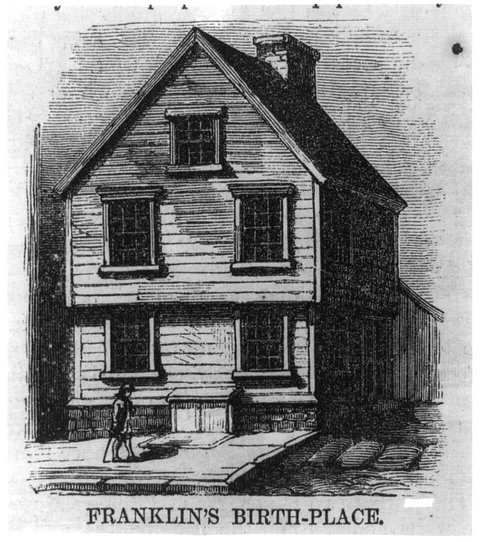
A wood engraving of the house in Boston identified as Franklin's birthplace.undatedPhoto: · Public domain (Nineteenth-century wood engraving held by the Library of Congress; Commons marks it public domain.) · Wikimedia Commons 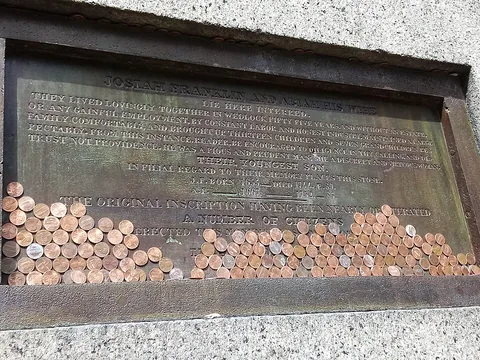
The monument marking the grave of Franklin's parents, Josiah and Abiah, in Boston, with coins left by visitors.2019-04-27Photo: · CC BY-SA 4.0 · Wikimedia Commons 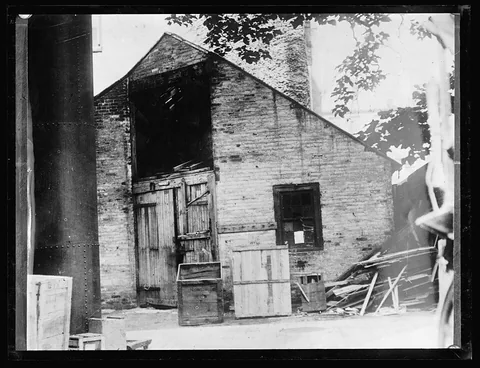
A photograph titled "Benjamin Franklin print shop," made between 1910 and 1920.1910-1920Photo: · Public domain (Glass negative made between 1910 and 1920 and released by the Library of Congress; Commons marks it public domain.) · Wikimedia Commons 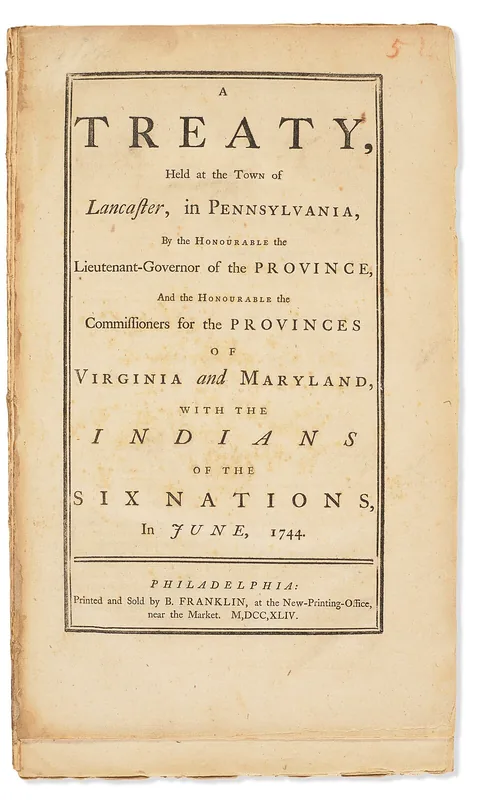
The title page of a treaty record that Franklin printed in 1744.1744Photo: · Public domain (Reproduction of a 1744 printed title page; the original work is long out of copyright.) · Wikimedia Commons 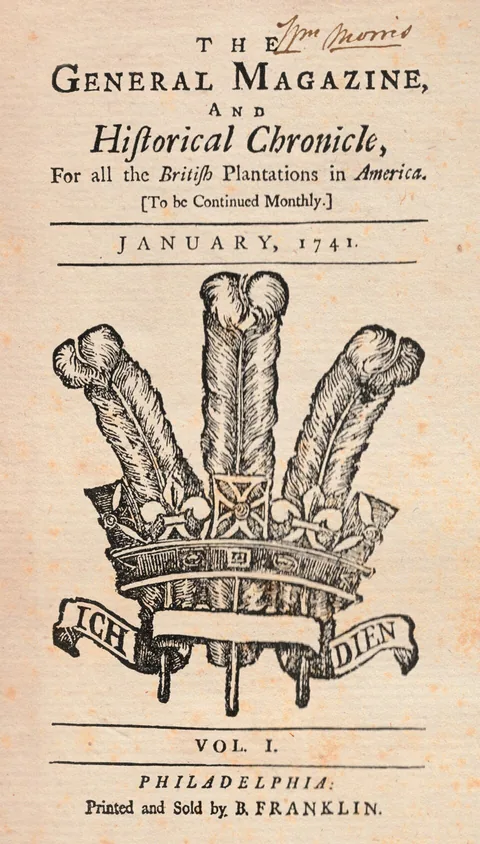
The first issue of The General Magazine, which Franklin printed in January 1741.1741Photo: · Public domain (Printed in 1741; the work is long out of copyright.) · Wikimedia Commons 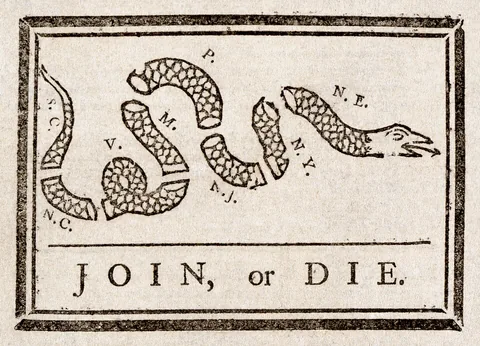
The "Join, or Die" cartoon, first printed in the Pennsylvania Gazette on May 9, 1754.1754-05-09Photo: · Public domain (Published on May 9, 1754; the work is long out of copyright.) · Wikimedia Commons Franklin in a 1762 portrait by Mason Chamberlin, painted during his first stay in London as a colonial agent.1762Photo: · Public domain (Painting from 1762; the artist died in 1787.) · Wikimedia Commons 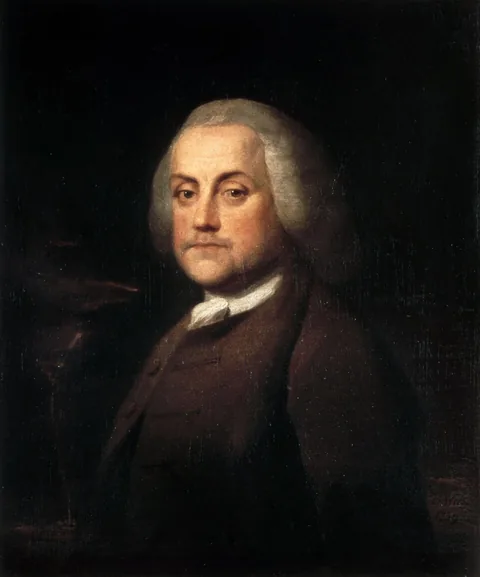
A portrait of Franklin by Benjamin Wilson, dated 1759.1759Photo: · Public domain (Painting from 1759; the artist died in 1788.) · Wikimedia Commons 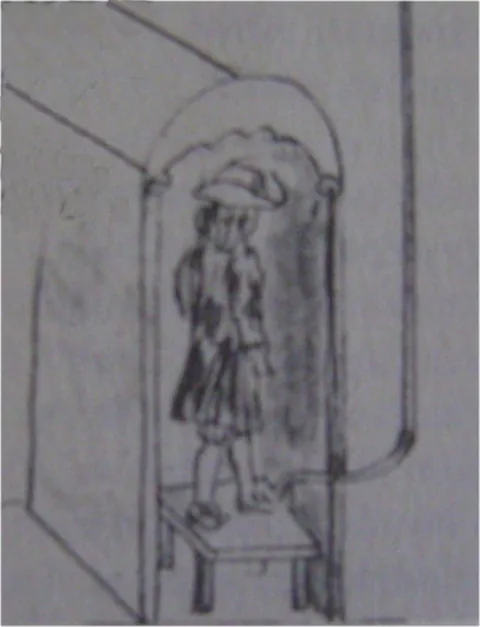
A drawing of Franklin's sentry-box experiment, reproduced from a manuscript.1750Photo: · Public domain (Eighteenth-century manuscript drawing of unknown authorship; Commons marks it public domain.) · Wikimedia Commons 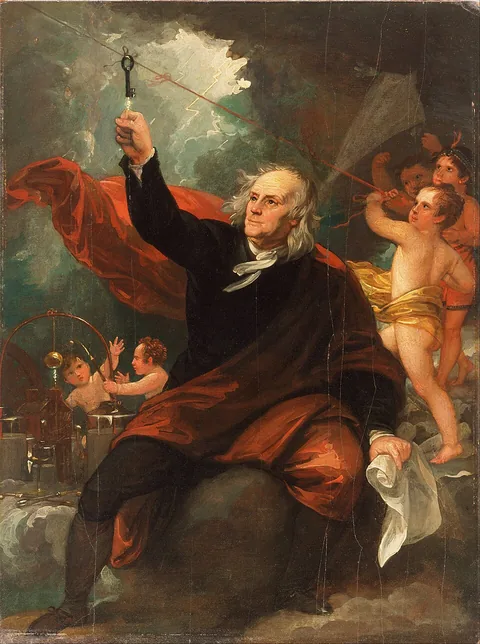
Benjamin West's painting of Franklin drawing electricity from the sky, from about 1816.circa 1816Photo: · Public domain (Painting from about 1816; the artist died in 1820.) · Wikimedia Commons 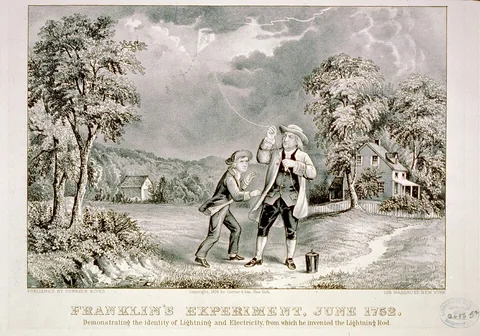
A Currier & Ives print of the June 1752 kite experiment.1876Photo: · Public domain (Lithograph published in 1876; the work is long out of copyright.) · Wikimedia Commons 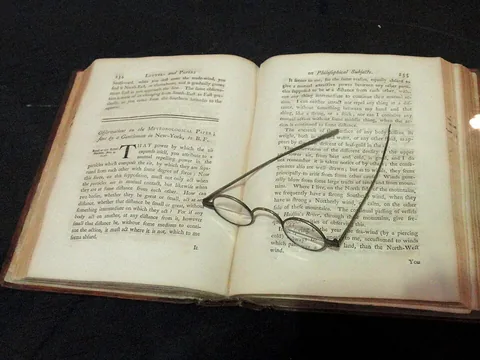
A pair of bifocals attributed to Franklin, on display at the Franklin Institute.2011-10-20Photo: · Public domain (Photograph released into the public domain by its author, Daderot.) · Wikimedia Commons 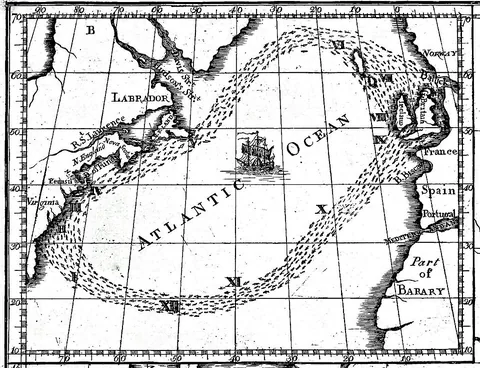
The 1786 chart of the Gulf Stream that Franklin helped publish.1786Photo: · Public domain (Chart published in 1786; the work is long out of copyright.) · Wikimedia Commons 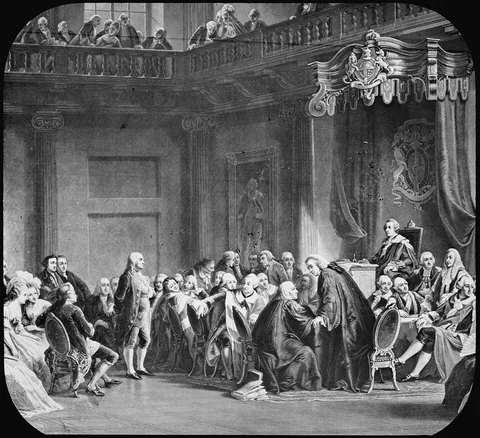
An engraving by Robert Whitechurch after a painting by Christian Schussele, titled on Commons "Benjamin Franklin at the Court of St. James."undated (19th century)Photo: · Public domain (Nineteenth-century engraving; the engraver died in 1880, and the National Archives holds the scan.) · Wikimedia Commons 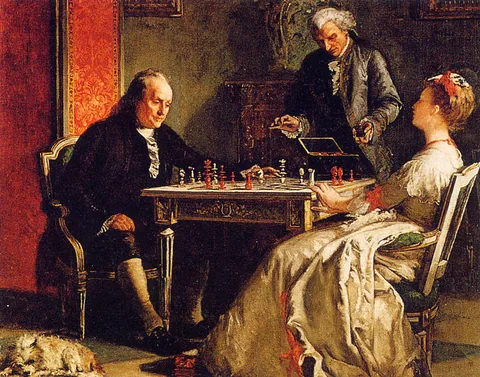
Edward Harrison May's 1867 painting of Franklin playing chess.1867Photo: · Public domain (Painting from 1867; the artist died in 1887.) · Wikimedia Commons 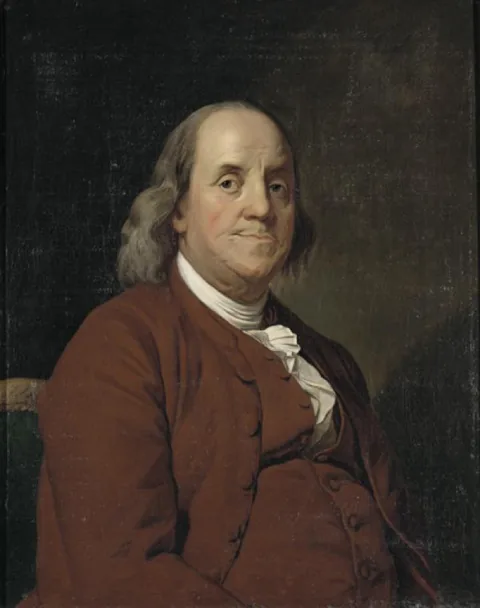
Joseph Wright's 1782 portrait of Franklin, now at the Pennsylvania Academy of the Fine Arts.1782Photo: · Public domain (Painting from 1782; the artist died in 1793.) · Wikimedia Commons 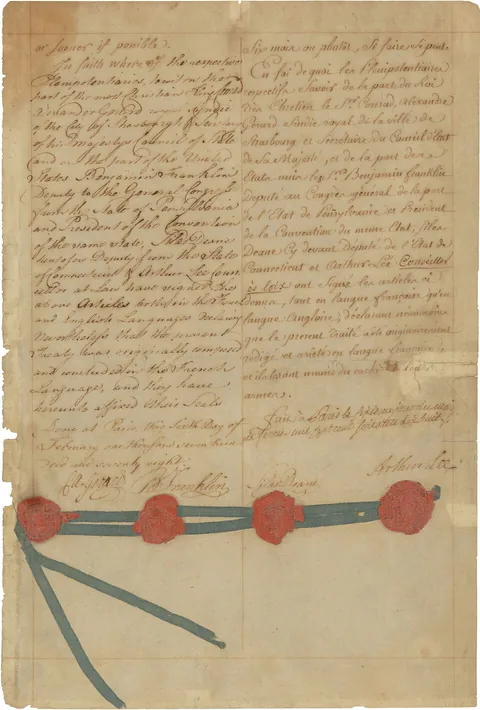
The signature page of the 1778 Treaty of Alliance between France and the United States.1778Photo: · Public domain (Signature page of an eighteenth-century treaty; Commons marks it public domain.) · Wikimedia Commons 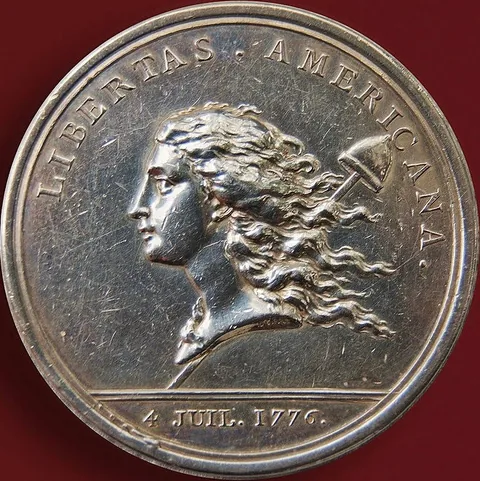
The front of the Libertas Americana medal, struck in Paris in 1783 at Franklin's request.1783Photo: · CC BY-SA 4.0 · Wikimedia Commons 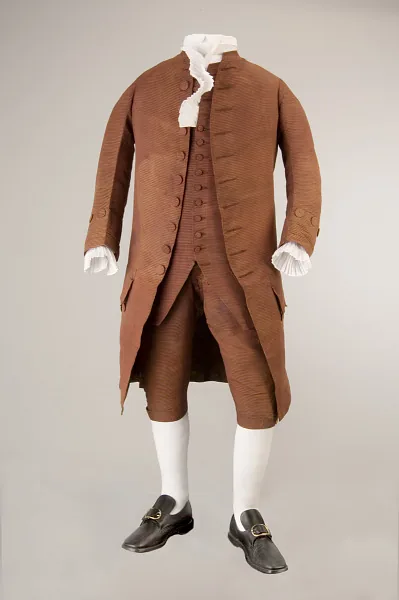
A three-piece silk suit that Franklin wore in 1778, held by the National Museum of American History.1778Photo: · Public domain (Photograph by a Smithsonian institution; Commons marks it public domain.) · Wikimedia Commons 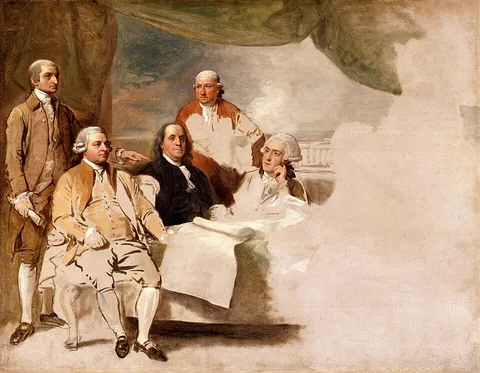
Benjamin West's unfinished painting of the American commissioners for the 1783 peace agreement with Britain.1783-1784Photo: · Public domain (Painting from 1783-1784; the artist died in 1820.) · Wikimedia Commons 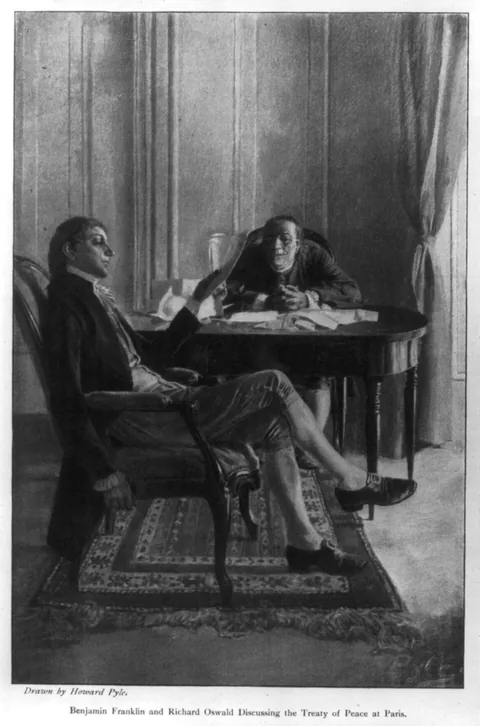
An 1898 print showing Franklin and the British negotiator Richard Oswald discussing the peace treaty in Paris.1898Photo: · Public domain (Print from 1898 held by the Library of Congress; Commons marks it public domain.) · Wikimedia Commons 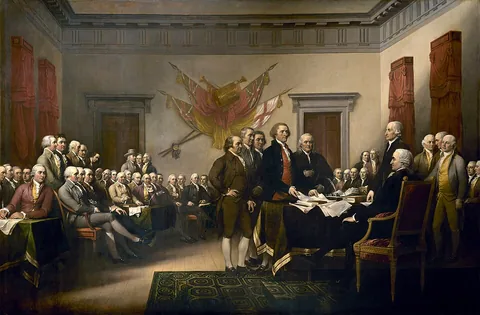
John Trumbull's painting of the five-man committee presenting its draft of the Declaration of Independence, with Franklin among them.1819Photo: · Public domain (Painting from 1819; the artist died in 1843.) · Wikimedia Commons 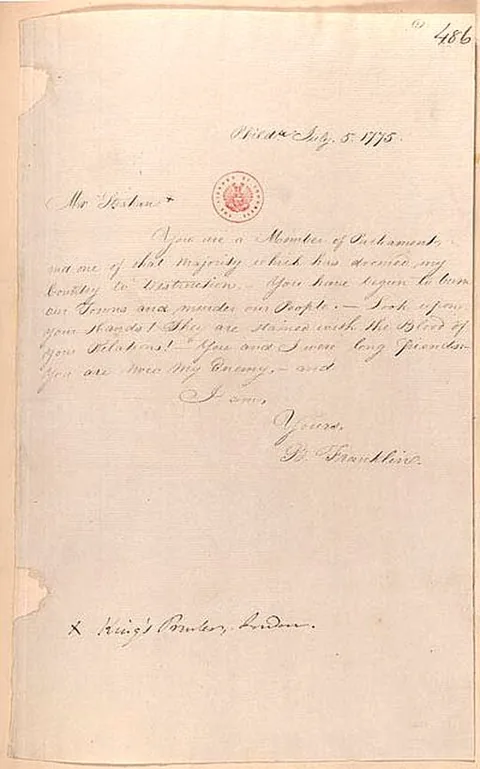
Franklin's handwritten letter to his old London friend William Strahan, dated July 5, 1775.1775-07-05Photo: · Public domain (Handwritten letter from 1775 by a person who died in 1790.) · Wikimedia Commons 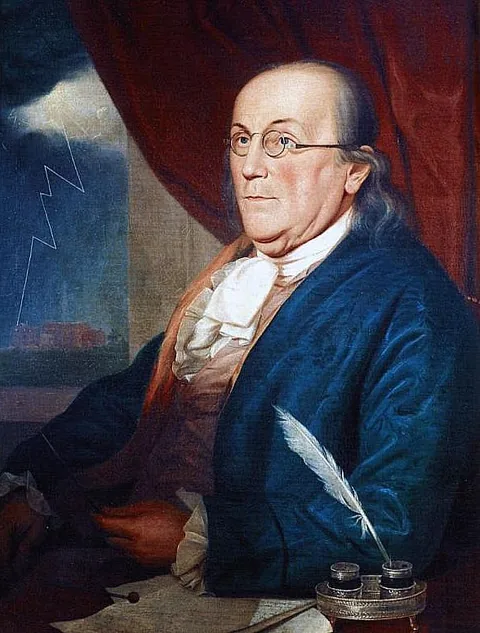
Charles Willson Peale's 1789 portrait of Franklin, painted a year before his death.1789Photo: · Public domain (Painting from 1789; the artist died in 1827.) · Wikimedia Commons 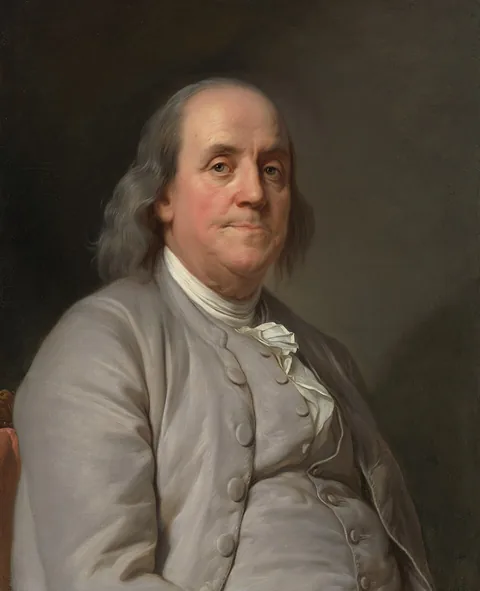
Joseph-Siffred Duplessis's portrait of Franklin from about 1785, painted in France.circa 1785Photo: · Public domain (Painting from about 1785; the artist died in 1802. Commons notes that some third parties have asserted copyright over reproductions in certain jurisdictions.) · Wikimedia Commons 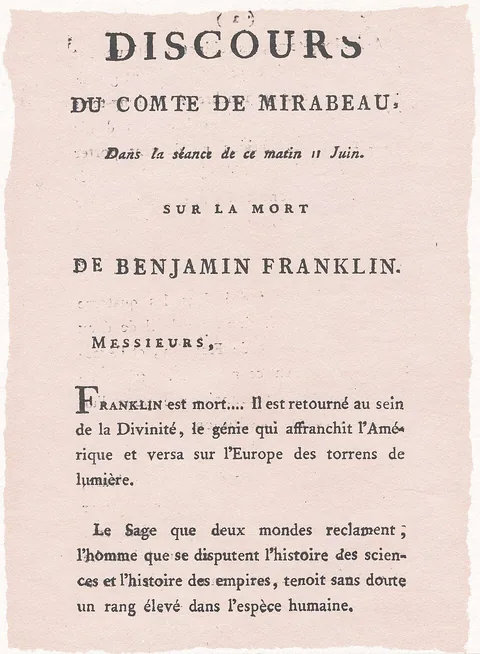
A French printed notice of Franklin's death, headed with a discourse by the Comte de Mirabeau.1790Photo: · Public domain (Printed French notice from 1790; Commons marks it public domain.) · Wikimedia Commons 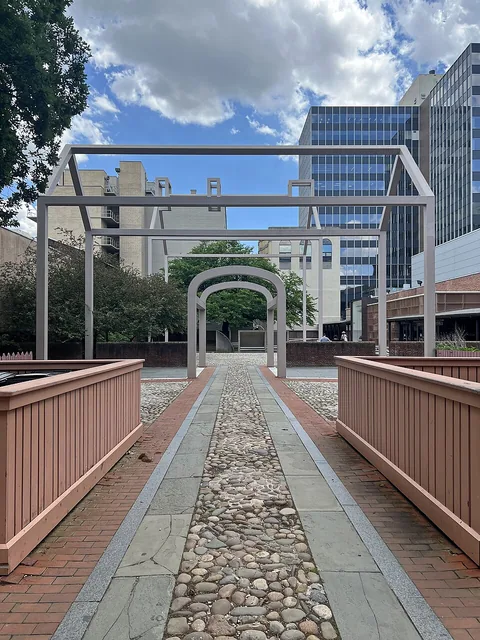
Franklin Court in Philadelphia, the site of Franklin's home and today's Benjamin Franklin Museum.2024-05-29Photo: · CC BY-SA 4.0 · Wikimedia Commons 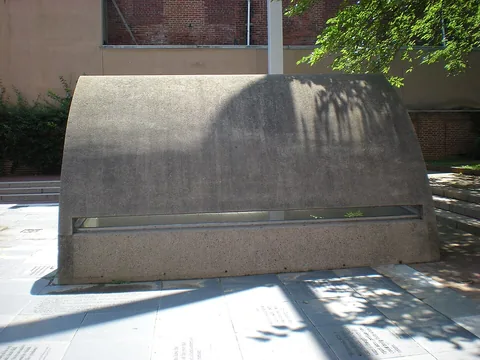
A structure at Franklin Court used for viewing the archaeological excavation, photographed in July 2009.2009-07-12Photo: · CC0 · Wikimedia Commons 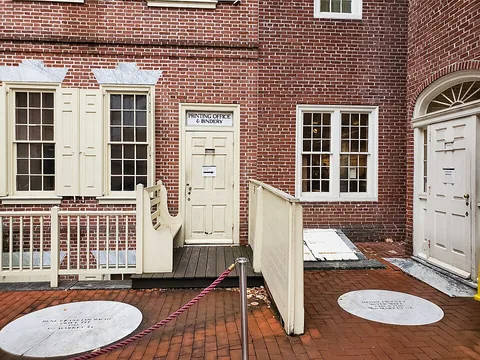
The entrance to the Printing Office and Bindery at Franklin Court.2020-01-03Photo: · CC BY-SA 4.0 · Wikimedia Commons 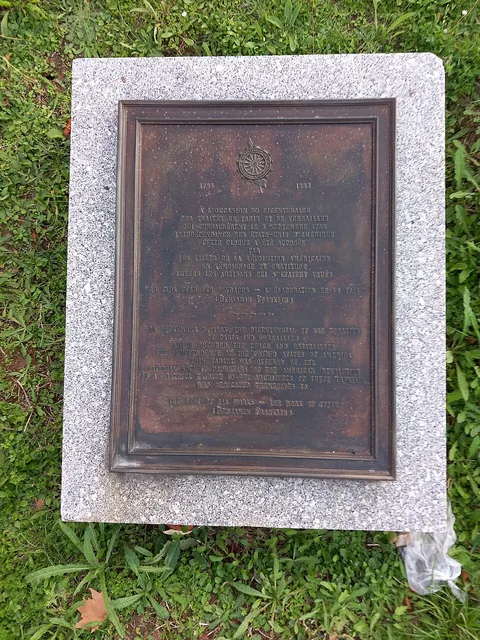
A commemorative plaque to Franklin in Paris, photographed in 2023.2023-09-08Photo: · CC0 · Wikimedia Commons


Watch and listen
- Benjamin Franklin, Episode 1: Join or Die (1706-1774)
- Benjamin Franklin, Episode 2: An American (1775-1790)
- Benjamin Franklin: Official Trailer
- Franklin Makes a Name for Himself as a Printer
- Franklin's Endlessly Quotable Poor Richard's Almanack
- Franklin's Observations and Experiments on Electricity
- Publicly Humiliated in London
- An American Celebrity in France
- Franklin and the Antislavery Movement
- Franklin and Writing (Conversations on Franklin panel)
- The Autobiography of Benjamin Franklin, read by Gary Gilberd (LibriVox, about 7 hours 30 minutes)
Read
By them
Notes
- "Benjamin Franklin," Wikipedia, accessed November 26, 2026, https://en.wikipedia.org/wiki/Benjamin_Franklin (birth on Milk Street, Boston, January 17, 1706).↩1↩2
- "Benjamin Franklin," Wikipedia, accessed November 26, 2026, https://en.wikipedia.org/wiki/Benjamin_Franklin (Josiah Franklin's tenth and final son).↩1↩2
- "Benjamin Franklin," Wikipedia, accessed November 26, 2026, https://en.wikipedia.org/wiki/Benjamin_Franklin (Boston Latin School; continued education through reading).↩1↩2
- Benjamin Franklin, The Autobiography of Benjamin Franklin, page 5 (ushistory.org edition), https://ushistory.org/historic-personages/franklin/autobiography/page05 (indentures signed at twelve).↩1↩2
- "Benjamin Franklin," Wikipedia, accessed November 26, 2026, https://en.wikipedia.org/wiki/Benjamin_Franklin (departure for Philadelphia at age 17).↩
- Benjamin Franklin, The Autobiography of Benjamin Franklin, ch. VII, "Beginning Business in Philadelphia" (Standard Ebooks edition), https://standardebooks.org/ebooks/benjamin-franklin/the-autobiography-of-benjamin-franklin/text/single-page (the Junto, meeting on Friday evenings).↩1↩2↩3
- "Benjamin Franklin," Wikipedia, accessed November 26, 2026, https://en.wikipedia.org/wiki/Benjamin_Franklin (printing house with Hugh Meredith, 1728; publisher of The Pennsylvania Gazette).↩1↩2
- Benjamin Franklin, The Autobiography of Benjamin Franklin, ch. X, "Poor Richard's Almanac and Other Activities" (Standard Ebooks edition), https://standardebooks.org/ebooks/benjamin-franklin/the-autobiography-of-benjamin-franklin/text/single-page (first published in 1732 under the name Richard Saunders).↩1↩2
- Benjamin Franklin, The Autobiography of Benjamin Franklin, ch. X, "Poor Richard's Almanac and Other Activities" (Standard Ebooks edition), https://standardebooks.org/ebooks/benjamin-franklin/the-autobiography-of-benjamin-franklin/text/single-page (sales of near ten thousand a year).↩1↩2
- "Benjamin Franklin," Wikipedia, accessed November 26, 2026, https://en.wikipedia.org/wiki/Benjamin_Franklin (retirement from printing in 1747 and partnership with David Hall).↩1↩2
- National Park Service, "Benjamin Franklin and Science," Independence National Historical Park, accessed November 26, 2026, https://www.nps.gov/inde/learn/historyculture/people-franklin-science.htm (studying electricity after he retired).↩1↩2
- National Park Service, "Benjamin Franklin and Science," Independence National Historical Park, accessed November 26, 2026, https://www.nps.gov/inde/learn/historyculture/people-franklin-science.htm (the kite experiment, June 1752).↩1↩2
- "Benjamin Franklin," Wikipedia, accessed November 26, 2026, https://en.wikipedia.org/wiki/Benjamin_Franklin (election to the Pennsylvania Assembly in 1751).↩1↩2
- "Benjamin Franklin," Wikipedia, accessed November 26, 2026, https://en.wikipedia.org/wiki/Benjamin_Franklin (1757 mission to England as colonial agent).↩1↩2
- "Benjamin Franklin," Wikipedia, accessed November 26, 2026, https://en.wikipedia.org/wiki/Benjamin_Franklin (Committee of Five that drafted the Declaration of Independence).↩
- History.com editors, "Benjamin Franklin," History.com, accessed November 26, 2026, https://www.history.com/topics/american-revolution/benjamin-franklin (sent to France in 1776).↩1↩2↩3
- History.com editors, "Benjamin Franklin," History.com, accessed November 26, 2026, https://www.history.com/topics/american-revolution/benjamin-franklin (French alliance, February 1778).↩1↩2
- History.com editors, "Benjamin Franklin," History.com, accessed November 26, 2026, https://www.history.com/topics/american-revolution/benjamin-franklin (minister to France; 1783 Treaty of Paris).↩1↩2
- History.com editors, "Benjamin Franklin," History.com, accessed November 26, 2026, https://www.history.com/topics/american-revolution/benjamin-franklin (1787 Constitutional Convention delegate).↩1↩2
- National Archives, Center for Legislative Archives, "Benjamin Franklin's Anti-Slavery Petitions to Congress," accessed November 26, 2026, https://www.archives.gov/legislative/features/franklin (presidency of the Pennsylvania abolition society).↩1↩2
- National Archives, Center for Legislative Archives, "Benjamin Franklin's Anti-Slavery Petitions to Congress," accessed November 26, 2026, https://www.archives.gov/legislative/features/franklin (death on April 17, 1790).↩1↩2
- Benjamin Franklin, The Autobiography of Benjamin Franklin, page 38 (ushistory.org edition), https://www.ushistory.org/franklin/autobiography/page38.htm (the thirteen virtues and their precepts).↩1↩2
- Benjamin Franklin, The Autobiography of Benjamin Franklin, page 38 (ushistory.org edition), https://www.ushistory.org/franklin/autobiography/page38.htm (the little book with a ruled page for each virtue).↩1↩2
- Benjamin Franklin, The Autobiography of Benjamin Franklin, ch. IX, "Plan for Attaining Moral Perfection" (Standard Ebooks edition), https://standardebooks.org/ebooks/benjamin-franklin/the-autobiography-of-benjamin-franklin/text/single-page (the morning question and the morning schedule).↩1↩2↩3↩4
- Benjamin Franklin, The Autobiography of Benjamin Franklin, ch. VI, "First Visit to London" (Standard Ebooks edition), https://standardebooks.org/ebooks/benjamin-franklin/the-autobiography-of-benjamin-franklin/text/single-page (arrival in London, December 24, 1724).↩1↩2
- Benjamin Franklin, The Autobiography of Benjamin Franklin, ch. VI, "First Visit to London" (Standard Ebooks edition), https://standardebooks.org/ebooks/benjamin-franklin/the-autobiography-of-benjamin-franklin/text/single-page (finding the letters were not the governor's).↩1↩2↩3
- "Benjamin Franklin," Wikipedia, accessed November 26, 2026, https://en.wikipedia.org/wiki/Benjamin_Franklin (loss of his Assembly seat, October 1764).↩1↩2↩3
- "Benjamin Franklin," Wikipedia, accessed November 26, 2026, https://en.wikipedia.org/wiki/Benjamin_Franklin (humiliation by Solicitor General Wedderburn before the Privy Council on January 29, 1774).↩1↩2↩3
- "Benjamin Franklin," Wikipedia, accessed November 26, 2026, https://en.wikipedia.org/wiki/Benjamin_Franklin (birth records under the Julian calendar give January 6, 1705).↩
- Benjamin Franklin, The Autobiography of Benjamin Franklin, ch. I, "Ancestry and Early Youth in Boston" (Standard Ebooks edition), https://standardebooks.org/ebooks/benjamin-franklin/the-autobiography-of-benjamin-franklin/text/single-page.↩1↩2
- Benjamin Franklin, The Autobiography of Benjamin Franklin, ch. II, "Beginning Life as a Printer" (Standard Ebooks edition), https://standardebooks.org/ebooks/benjamin-franklin/the-autobiography-of-benjamin-franklin/text/single-page.↩1↩2
- Benjamin Franklin, The Autobiography of Benjamin Franklin, page 5 (ushistory.org edition), https://ushistory.org/historic-personages/franklin/autobiography/page05 (James's press, 1717).↩
- Benjamin Franklin, The Autobiography of Benjamin Franklin, page 5 (ushistory.org edition), https://ushistory.org/historic-personages/franklin/autobiography/page05 (borrowed books and night reading).↩
- Benjamin Franklin, The Autobiography of Benjamin Franklin, page 6 (ushistory.org edition), https://ushistory.org/historic-personages/franklin/autobiography/page06 (rewriting the Spectator from hints).↩1↩2
- Benjamin Franklin, The Autobiography of Benjamin Franklin, page 6 (ushistory.org edition), https://ushistory.org/historic-personages/franklin/autobiography/page06 (comparing his versions with the original).↩1↩2
- Benjamin Franklin, The Autobiography of Benjamin Franklin, page 6 (ushistory.org edition), https://ushistory.org/historic-personages/franklin/autobiography/page06 (Tryon's book and the vegetable diet).↩1↩2
- Benjamin Franklin, The Autobiography of Benjamin Franklin, page 8 (ushistory.org edition), https://ushistory.org/historic-personages/franklin/autobiography/page08 (the New England Courant).↩
- Benjamin Franklin, The Autobiography of Benjamin Franklin, page 8 (ushistory.org edition), https://ushistory.org/historic-personages/franklin/autobiography/page08 (the anonymous essay).↩
- Benjamin Franklin, The Autobiography of Benjamin Franklin, page 8 (ushistory.org edition), https://ushistory.org/historic-personages/franklin/autobiography/page08 (the writers' approval).↩
- Benjamin Franklin, The Autobiography of Benjamin Franklin, page 9 (ushistory.org edition), https://ushistory.org/historic-personages/franklin/autobiography/page09 (James as master).↩
- Benjamin Franklin, The Autobiography of Benjamin Franklin, page 9 (ushistory.org edition), https://ushistory.org/historic-personages/franklin/autobiography/page09 (James's temper).↩
- Benjamin Franklin, The Autobiography of Benjamin Franklin, page 9 (ushistory.org edition), https://ushistory.org/historic-personages/franklin/autobiography/page09 (the order of the House).↩
- Benjamin Franklin, The Autobiography of Benjamin Franklin, page 9 (ushistory.org edition), https://ushistory.org/historic-personages/franklin/autobiography/page09 (the paper printed under Benjamin's name).↩
- Benjamin Franklin, The Autobiography of Benjamin Franklin, page 10 (ushistory.org edition), https://ushistory.org/historic-personages/franklin/autobiography/page10 (leaving Boston for New York).↩
- Benjamin Franklin, The Autobiography of Benjamin Franklin, page 10 (ushistory.org edition), https://ushistory.org/historic-personages/franklin/autobiography/page10 (William Bradford in New York).↩
- Benjamin Franklin, The Autobiography of Benjamin Franklin, page 14 (ushistory.org edition), https://ushistory.org/historic-personages/franklin/autobiography/page14 (Governor Keith's offer).↩
- Benjamin Franklin, The Autobiography of Benjamin Franklin, page 17 (ushistory.org edition), https://ushistory.org/historic-personages/franklin/autobiography/page17 (Keith's promise and its cordiality).↩1↩2
- Benjamin Franklin, The Autobiography of Benjamin Franklin, page 17 (ushistory.org edition), https://ushistory.org/historic-personages/franklin/autobiography/page17 (Keith's suggestion of a trip to England).↩
- Benjamin Franklin, The Autobiography of Benjamin Franklin, page 17 (ushistory.org edition), https://ushistory.org/historic-personages/franklin/autobiography/page17 (waiting for the Annis while working for Keimer).↩
- Benjamin Franklin, The Autobiography of Benjamin Franklin, ch. VI, "First Visit to London" (Standard Ebooks edition), https://standardebooks.org/ebooks/benjamin-franklin/the-autobiography-of-benjamin-franklin/text/single-page (work at Palmer's in Bartholomew Close).↩1↩2
- Benjamin Franklin, The Autobiography of Benjamin Franklin, ch. VI, "First Visit to London" (Standard Ebooks edition), https://standardebooks.org/ebooks/benjamin-franklin/the-autobiography-of-benjamin-franklin/text/single-page (move to Watts's).↩1↩2↩3
- Benjamin Franklin, The Autobiography of Benjamin Franklin, ch. VI, "First Visit to London" (Standard Ebooks edition), https://standardebooks.org/ebooks/benjamin-franklin/the-autobiography-of-benjamin-franklin/text/single-page (drinking only water at Watts's).↩1↩2
- Benjamin Franklin, The Autobiography of Benjamin Franklin, ch. VI, "First Visit to London" (Standard Ebooks edition), https://standardebooks.org/ebooks/benjamin-franklin/the-autobiography-of-benjamin-franklin/text/single-page (the swim from Chelsea to Blackfriars).↩1↩2
- Benjamin Franklin, The Autobiography of Benjamin Franklin, ch. VI, "First Visit to London" (Standard Ebooks edition), https://standardebooks.org/ebooks/benjamin-franklin/the-autobiography-of-benjamin-franklin/text/single-page (Denham's offer of a clerkship).↩1↩2
- Benjamin Franklin, The Autobiography of Benjamin Franklin, ch. VI, "First Visit to London" (Standard Ebooks edition), https://standardebooks.org/ebooks/benjamin-franklin/the-autobiography-of-benjamin-franklin/text/single-page (terms of fifty pounds a year).↩1↩2
- Benjamin Franklin, The Autobiography of Benjamin Franklin, ch. VI, "First Visit to London" (Standard Ebooks edition), https://standardebooks.org/ebooks/benjamin-franklin/the-autobiography-of-benjamin-franklin/text/single-page (Sir William Wyndham's request to teach his sons to swim).↩
- Benjamin Franklin, The Autobiography of Benjamin Franklin, ch. VI, "First Visit to London" (Standard Ebooks edition), https://standardebooks.org/ebooks/benjamin-franklin/the-autobiography-of-benjamin-franklin/text/single-page (why he could not undertake it).↩
- Benjamin Franklin, The Autobiography of Benjamin Franklin, ch. VII, "Beginning Business in Philadelphia" (Standard Ebooks edition), https://standardebooks.org/ebooks/benjamin-franklin/the-autobiography-of-benjamin-franklin/text/single-page (sailing from Gravesend, July 23, 1726).↩1↩2
- Benjamin Franklin, The Autobiography of Benjamin Franklin, ch. VII, "Beginning Business in Philadelphia" (Standard Ebooks edition), https://standardebooks.org/ebooks/benjamin-franklin/the-autobiography-of-benjamin-franklin/text/single-page (the Junto's rules on queries).↩1↩2
- Benjamin Franklin, The Autobiography of Benjamin Franklin, ch. VIII, "Business Success and First Public Service" (Standard Ebooks edition), https://standardebooks.org/ebooks/benjamin-franklin/the-autobiography-of-benjamin-franklin/text/single-page (Keimer's paper offered for a trifle).↩
- Benjamin Franklin, The Autobiography of Benjamin Franklin, ch. VIII, "Business Success and First Public Service" (Standard Ebooks edition), https://standardebooks.org/ebooks/benjamin-franklin/the-autobiography-of-benjamin-franklin/text/single-page (taking over the paper and its profits).↩
- Benjamin Franklin, The Autobiography of Benjamin Franklin, ch. VIII, "Business Success and First Public Service" (Standard Ebooks edition), https://standardebooks.org/ebooks/benjamin-franklin/the-autobiography-of-benjamin-franklin/text/single-page (marriage of September 1, 1730).↩
- Benjamin Franklin, The Autobiography of Benjamin Franklin, ch. VIII, "Business Success and First Public Service" (Standard Ebooks edition), https://standardebooks.org/ebooks/benjamin-franklin/the-autobiography-of-benjamin-franklin/text/single-page (industry, frugality, and their appearance).↩1↩2↩3
- Benjamin Franklin, The Autobiography of Benjamin Franklin, ch. VIII, "Business Success and First Public Service" (Standard Ebooks edition), https://standardebooks.org/ebooks/benjamin-franklin/the-autobiography-of-benjamin-franklin/text/single-page (the subscription library).↩
- "Benjamin Franklin," Wikipedia, accessed November 26, 2026, https://en.wikipedia.org/wiki/Benjamin_Franklin (Library Company of Philadelphia, charter composed in 1731).↩
- Benjamin Franklin, The Autobiography of Benjamin Franklin, ch. XIII, "Public Services and Duties (1749-1753)" (Standard Ebooks edition), https://standardebooks.org/ebooks/benjamin-franklin/the-autobiography-of-benjamin-franklin/text/single-page (leaving private business).↩
- Benjamin Franklin, The Autobiography of Benjamin Franklin, ch. XIII, "Public Services and Duties (1749-1753)" (Standard Ebooks edition), https://standardebooks.org/ebooks/benjamin-franklin/the-autobiography-of-benjamin-franklin/text/single-page (electrical experiments and public duties).↩
- Benjamin Franklin, The Autobiography of Benjamin Franklin, ch. XIII, "Public Services and Duties (1749-1753)" (Standard Ebooks edition), https://standardebooks.org/ebooks/benjamin-franklin/the-autobiography-of-benjamin-franklin/text/single-page (the academy subscription).↩
- Benjamin Franklin, The Autobiography of Benjamin Franklin, ch. XIII, "Public Services and Duties (1749-1753)" (Standard Ebooks edition), https://standardebooks.org/ebooks/benjamin-franklin/the-autobiography-of-benjamin-franklin/text/single-page (Dr. Thomas Bond's hospital design, 1751).↩
- Benjamin Franklin, The Autobiography of Benjamin Franklin, ch. XIII, "Public Services and Duties (1749-1753)" (Standard Ebooks edition), https://standardebooks.org/ebooks/benjamin-franklin/the-autobiography-of-benjamin-franklin/text/single-page (raising subscriptions for the hospital).↩
- Benjamin Franklin, Experiments and Observations on Electricity, Made at Philadelphia in America (London: E. Cave, 1751), Internet Archive record, https://archive.org/details/experimentsobser00fran.↩
- National Park Service, "Benjamin Franklin and Science," Independence National Historical Park, accessed November 26, 2026, https://www.nps.gov/inde/learn/historyculture/people-franklin-science.htm (charting the Gulf Stream).↩
- "Benjamin Franklin," Wikipedia, accessed November 26, 2026, https://en.wikipedia.org/wiki/Benjamin_Franklin (appointment as deputy postmaster general of British North America, August 10, 1753).↩
- Office of the Historian, U.S. Department of State, "Albany Plan of Union, 1754," Milestones: 1750-1775, https://www.history.state.gov/milestones/1750-1775/albany-plan (Franklin as Pennsylvania's commissioner).↩
- Office of the Historian, U.S. Department of State, "Albany Plan of Union, 1754," Milestones: 1750-1775, https://www.history.state.gov/milestones/1750-1775/albany-plan (the Congress began June 19, 1754).↩
- Office of the Historian, U.S. Department of State, "Albany Plan of Union, 1754," Milestones: 1750-1775, https://www.history.state.gov/milestones/1750-1775/albany-plan (the "Join or Die" cartoon).↩
- Office of the Historian, U.S. Department of State, "Albany Plan of Union, 1754," Milestones: 1750-1775, https://www.history.state.gov/milestones/1750-1775/albany-plan (why the colonies did not adopt the plan).↩
- Eugene Volokh, "Liberty, Safety, and Benjamin Franklin," The Volokh Conspiracy (Reason), November 11, 2014, https://reason.com/2014/11/11/liberty-safety-and-benjamin-fr/ (the dispute over taxing the Penn lands for defense).↩
- Eugene Volokh, "Liberty, Safety, and Benjamin Franklin," The Volokh Conspiracy (Reason), November 11, 2014, https://reason.com/2014/11/11/liberty-safety-and-benjamin-fr/ (the 1755 letter and its presumed authorship).↩1↩2
- History.com editors, "Benjamin Franklin," History.com, accessed November 26, 2026, https://www.history.com/topics/american-revolution/benjamin-franklin (1766 testimony against the Stamp Act).↩1↩2
- "Benjamin Franklin," Wikipedia, accessed November 26, 2026, https://en.wikipedia.org/wiki/Benjamin_Franklin (testimony in the House of Commons proceedings that led to the Stamp Act's repeal).↩1↩2
- Brett F. Woods, "Stolen Letters: Benjamin Franklin and the Hutchinson Affair," HistoryNet, October 12, 2016, https://historynet.com/stolen-letters-benjamin-franklin-and-the-hutchinson-affair/ (anonymous receipt of the letters).↩1↩2
- "Hutchinson letters affair," Wikipedia, accessed November 26, 2026, https://en.wikipedia.org/wiki/Hutchinson_letters_affair (Franklin sent the letters to Thomas Cushing in December 1772).↩1↩2
- "Hutchinson letters affair," Wikipedia, accessed November 26, 2026, https://en.wikipedia.org/wiki/Hutchinson_letters_affair (publication in the Boston Gazette, mid-June 1773).↩1↩2
- Brett F. Woods, "Stolen Letters: Benjamin Franklin and the Hutchinson Affair," HistoryNet, October 12, 2016, https://historynet.com/stolen-letters-benjamin-franklin-and-the-hutchinson-affair/ (return to Philadelphia on May 5, 1775).↩1↩2
- Brett F. Woods, "Stolen Letters: Benjamin Franklin and the Hutchinson Affair," HistoryNet, October 12, 2016, https://historynet.com/stolen-letters-benjamin-franklin-and-the-hutchinson-affair/ (chosen for the Second Continental Congress).↩1↩2
- History.com editors, "Benjamin Franklin," History.com, accessed November 26, 2026, https://www.history.com/topics/american-revolution/benjamin-franklin (appointment as first U.S. postmaster general, July 1775).↩1↩2
- History.com editors, "Benjamin Franklin," History.com, accessed November 26, 2026, https://www.history.com/topics/american-revolution/benjamin-franklin (1776 drafting committee).↩1↩2
- History.com editors, "Benjamin Franklin," History.com, accessed November 26, 2026, https://www.history.com/topics/american-revolution/benjamin-franklin (return from France, 1785).↩
- "Benjamin Franklin," Wikipedia, accessed November 26, 2026, https://en.wikipedia.org/wiki/Benjamin_Franklin (election as sixth president of the Supreme Executive Council of Pennsylvania, October 18, 1785).↩
- National Constitution Center, "Closing Speech at the Constitutional Convention (1787)," Historic Document Library, accessed November 26, 2026, https://constitutioncenter.org/the-constitution/historic-document-library/detail/benjamin-franklin-closing-speech-at-the-constitutional-convention (James Wilson read the speech).↩
- "Madison Debates, September 17," The Avalon Project, Yale Law School, accessed November 26, 2026, https://avalon.law.yale.edu/18th_century/debates_917.asp.↩1↩2
- National Constitution Center, "Closing Speech at the Constitutional Convention (1787)," Historic Document Library, accessed November 26, 2026, https://constitutioncenter.org/the-constitution/historic-document-library/detail/benjamin-franklin-closing-speech-at-the-constitutional-convention (the closing appeal for unanimity).↩
- National Archives, Center for Legislative Archives, "Benjamin Franklin's Anti-Slavery Petitions to Congress," accessed November 26, 2026, https://www.archives.gov/legislative/features/franklin (the petition of February 3, 1790).↩
- National Archives, Center for Legislative Archives, "Benjamin Franklin's Anti-Slavery Petitions to Congress," accessed November 26, 2026, https://www.archives.gov/legislative/features/franklin (the Senate's and House's response).↩
- History.com editors, "Benjamin Franklin," History.com, accessed November 26, 2026, https://www.history.com/topics/american-revolution/benjamin-franklin (death on April 17, 1790).↩
- Benjamin Franklin, The Autobiography of Benjamin Franklin, page 38 (ushistory.org edition), https://www.ushistory.org/franklin/autobiography/page38.htm (the project of moral perfection).↩1↩2
- Benjamin Franklin, The Autobiography of Benjamin Franklin, page 38 (ushistory.org edition), https://www.ushistory.org/franklin/autobiography/page38.htm (the precept of temperance).↩1↩2↩3
- Benjamin Franklin, The Autobiography of Benjamin Franklin, page 38 (ushistory.org edition), https://www.ushistory.org/franklin/autobiography/page38.htm (marking faults with black spots).↩
- Benjamin Franklin, The Autobiography of Benjamin Franklin, ch. IX, "Plan for Attaining Moral Perfection" (Standard Ebooks edition), https://standardebooks.org/ebooks/benjamin-franklin/the-autobiography-of-benjamin-franklin/text/single-page.↩1↩2
- Benjamin Franklin, The Autobiography of Benjamin Franklin, ch. IX, "Plan for Attaining Moral Perfection" (Standard Ebooks edition), https://standardebooks.org/ebooks/benjamin-franklin/the-autobiography-of-benjamin-franklin/text/single-page.↩1↩2
- Benjamin Franklin, The Autobiography of Benjamin Franklin, page 39 (ushistory.org edition), https://www.ushistory.org/franklin/autobiography/page39.htm (a week's attention to each virtue).↩
- Benjamin Franklin, The Autobiography of Benjamin Franklin, page 39 (ushistory.org edition), https://www.ushistory.org/franklin/autobiography/page39.htm (thirteen-week courses, four a year).↩
- Benjamin Franklin, The Autobiography of Benjamin Franklin, ch. IX, "Plan for Attaining Moral Perfection" (Standard Ebooks edition), https://standardebooks.org/ebooks/benjamin-franklin/the-autobiography-of-benjamin-franklin/text/single-page (the evening question and the evening schedule).↩1↩2
- Benjamin Franklin, The Autobiography of Benjamin Franklin, ch. IX, "Plan for Attaining Moral Perfection" (Standard Ebooks edition), https://standardebooks.org/ebooks/benjamin-franklin/the-autobiography-of-benjamin-franklin/text/single-page (the noon hour of the schedule).↩
- Benjamin Franklin, The Autobiography of Benjamin Franklin, ch. IX, "Plan for Attaining Moral Perfection" (Standard Ebooks edition), https://standardebooks.org/ebooks/benjamin-franklin/the-autobiography-of-benjamin-franklin/text/single-page (the precept of Order and the scheme of employment).↩
- Benjamin Franklin, The Autobiography of Benjamin Franklin, ch. VIII, "Business Success and First Public Service" (Standard Ebooks edition), https://standardebooks.org/ebooks/benjamin-franklin/the-autobiography-of-benjamin-franklin/text/single-page (reading as his only amusement).↩1↩2
- "Benjamin Franklin," Wikipedia, accessed November 26, 2026, https://en.wikipedia.org/wiki/Benjamin_Franklin (formation of the Junto in 1727, at age 21).↩
- Benjamin Franklin, The Autobiography of Benjamin Franklin, ch. VIII, "Business Success and First Public Service" (Standard Ebooks edition), https://standardebooks.org/ebooks/benjamin-franklin/the-autobiography-of-benjamin-franklin/text/single-page (the wheelbarrow).↩
- Benjamin Franklin, "Advice to a Young Tradesman, [21 July 1748]," Founders Online, National Archives, accessed November 26, 2026, https://founders.archives.gov/documents/Franklin/01-03-02-0130.↩1↩2
- Benjamin Franklin, The Autobiography of Benjamin Franklin, ch. VI, "First Visit to London" (Standard Ebooks edition), https://standardebooks.org/ebooks/benjamin-franklin/the-autobiography-of-benjamin-franklin/text/single-page (his delight in swimming since childhood).↩
- ushistory.org, "Ben Franklin's Inventions: Swim Fins," accessed November 26, 2026, https://ushistory.org/franklin/science/swimfins.htm (swim fins invented at eleven).↩
- ushistory.org, "Ben Franklin's Inventions: Swim Fins," accessed November 26, 2026, https://ushistory.org/franklin/science/swimfins.htm (Franklin's March 1773 account of his swimming pallets).↩
- "Benjamin Franklin Honored by International Swimming Hall of Fame," Swimming World, accessed November 26, 2026, https://www.swimmingworldmagazine.com/news/benjamin-franklin-honored-by-international-swimming-hall-of-fame.↩
- Benjamin Franklin, The Autobiography of Benjamin Franklin, ch. VI, "First Visit to London" (Standard Ebooks edition), https://standardebooks.org/ebooks/benjamin-franklin/the-autobiography-of-benjamin-franklin/text/single-page (the stationer and the letter from Riddlesden).↩
- Benjamin Franklin, The Autobiography of Benjamin Franklin, ch. IV, "First Visit to Boston" (Standard Ebooks edition), https://standardebooks.org/ebooks/benjamin-franklin/the-autobiography-of-benjamin-franklin/text/single-page (Keith's character, "liberal of promises").↩
- Benjamin Franklin, The Autobiography of Benjamin Franklin, ch. VI, "First Visit to London" (Standard Ebooks edition), https://standardebooks.org/ebooks/benjamin-franklin/the-autobiography-of-benjamin-franklin/text/single-page (Denham's account of Keith).↩
- Benjamin Franklin, The Autobiography of Benjamin Franklin, ch. VI, "First Visit to London" (Standard Ebooks edition), https://standardebooks.org/ebooks/benjamin-franklin/the-autobiography-of-benjamin-franklin/text/single-page (Denham's advice to find work in his trade).↩
- "Benjamin Franklin," Wikipedia, accessed November 26, 2026, https://en.wikipedia.org/wiki/Benjamin_Franklin (his call for royal government called a "rare political miscalculation").↩
- "Benjamin Franklin," Wikipedia, accessed November 26, 2026, https://en.wikipedia.org/wiki/Benjamin_Franklin (the anti-proprietary party sent him back to England).↩
- "Benjamin Franklin," Wikipedia, accessed November 26, 2026, https://en.wikipedia.org/wiki/Benjamin_Franklin (agent for Georgia, New Jersey, and Massachusetts).↩
- "Hutchinson letters affair," Wikipedia, accessed November 26, 2026, https://en.wikipedia.org/wiki/Hutchinson_letters_affair (Franklin stood silently during Wedderburn's attack before the Privy Council).↩1↩2
- Brett F. Woods, "Stolen Letters: Benjamin Franklin and the Hutchinson Affair," HistoryNet, October 12, 2016, https://historynet.com/stolen-letters-benjamin-franklin-and-the-hutchinson-affair/ (Wedderburn's attack).↩
- Brett F. Woods, "Stolen Letters: Benjamin Franklin and the Hutchinson Affair," HistoryNet, October 12, 2016, https://historynet.com/stolen-letters-benjamin-franklin-and-the-hutchinson-affair/ (dismissal the next day).↩
- "Hutchinson letters affair," Wikipedia, accessed November 26, 2026, https://en.wikipedia.org/wiki/Hutchinson_letters_affair (dismissal of Franklin as postmaster and of the petition for Hutchinson's removal).↩
- Brett F. Woods, "Stolen Letters: Benjamin Franklin and the Hutchinson Affair," HistoryNet, October 12, 2016, https://historynet.com/stolen-letters-benjamin-franklin-and-the-hutchinson-affair/ (Franklin's account of his silence).↩
- History.com editors, "Benjamin Franklin," History.com, accessed November 26, 2026, https://www.history.com/topics/american-revolution/benjamin-franklin (dismissal by the British as joint postmaster general, 1774).↩
- Benjamin Franklin, The Autobiography of Benjamin Franklin, ch. VIII, "Business Success and First Public Service" (Standard Ebooks edition), https://standardebooks.org/ebooks/benjamin-franklin/the-autobiography-of-benjamin-franklin/text/single-page (the most acceptable service of God).↩
- "Benjamin Franklin," Wikiquote, accessed November 26, 2026, https://en.wikiquote.org/wiki/Benjamin_Franklin ("On Freedom of Speech and the Press," Pennsylvania Gazette, November 17, 1737).↩
- "Benjamin Franklin," Wikiquote, accessed November 26, 2026, https://en.wikiquote.org/wiki/Benjamin_Franklin (Poor Richard's Almanack, 1737).↩
- "Benjamin Franklin," Wikiquote, accessed November 26, 2026, https://en.wikiquote.org/wiki/Benjamin_Franklin (Poor Richard's Almanack, 1756).↩
- "Benjamin Franklin," Wikiquote, accessed November 26, 2026, https://en.wikiquote.org/wiki/Benjamin_Franklin (letter to Mary Hewson, January 27, 1783).↩
- "Benjamin Franklin," Wikiquote, accessed November 26, 2026, https://en.wikiquote.org/wiki/Benjamin_Franklin (letter to Josiah Quincy, September 11, 1783).↩
- "Benjamin Franklin," Wikiquote, accessed November 26, 2026, https://en.wikiquote.org/wiki/Benjamin_Franklin (letter to the Abbés Chalut and Arnaud, April 17, 1787).↩
- "Benjamin Franklin," Wikiquote, accessed November 26, 2026, https://en.wikiquote.org/wiki/Benjamin_Franklin (letter to Jean-Baptiste Le Roy, November 13, 1789; Wikiquote notes that he was quoting a popular phrase that goes back to the 1716 play The Cobbler of Preston).↩