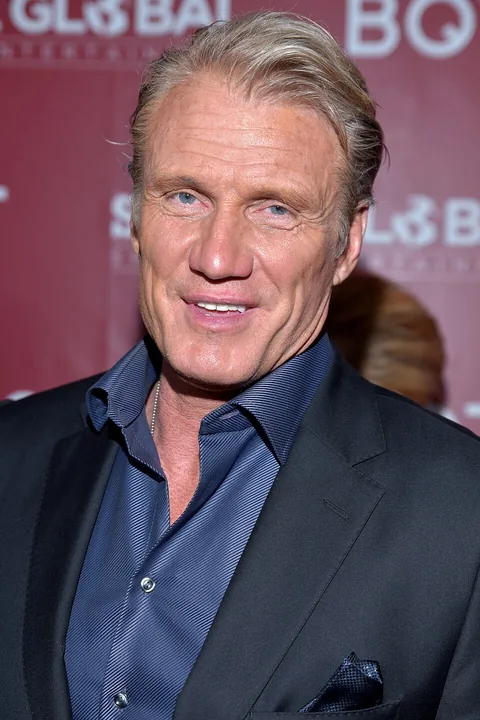

actor, film director, martial artist, film producer
Dolph Lundgren
Also known as Hans Lundgren
Born in Spånga, Stockholm, Sweden
Swedish-born actor, director, and karate competitor, best known as Ivan Drago in Rocky IV and Creed II and as Gunner Jensen in The Expendables. He trained as a chemical engineer before turning to acting.
Official and reference links
- Official websiteOfficial
- WikipediaReference
- WikiquoteReference
- Wikimedia Commons categoryArchive
- TEDxFulbrightSantaMonica event page (September 26, 2015)Video
- IMDbOther
Overview
Dolph Lundgren was born Hans Lundgren in 1957 in Spånga, in Stockholm County, Sweden, and is an actor, filmmaker, and martial artist.[1] He trained as a chemical engineer, studied in Sweden, the United States, and Australia, and won a Fulbright scholarship to MIT.[2][3] He was also a serious karate competitor, and he fought at the 1979 World Open Tournament in Tokyo.[4]
He left MIT after a few weeks and returned to New York, and in 1985 the role of the Soviet boxer Ivan Drago in Rocky IV made him famous.[5][3] His official biography counts more than fifty feature films, and he has directed several of them.[3][6]
His career was not a straight climb. After a He-Man film that failed with critics and at the box office, and long years of lower-budget action work, he returned in The Expendables (2010) and Creed II (2018).[7][8][9][10] He has spoken openly about therapy and daily meditation.[8] In 2023 he disclosed that he had been fighting cancer since 2015, and in November 2024 he said he was "finally cancer free."[11][12] He became a U.S. citizen in February 2024 and published a memoir in 2026.[13][14]
Life
1957–1976
Childhood in Stockholm
Hans Lundgren was born on November 3, 1957, in Spånga, in Stockholm County. His mother taught languages, and his father was an engineer and economist who worked for the Swedish government.[1][2] His official biography describes an "academic middle-class family" and says he chose to follow his father's and older brother's "cerebral footsteps" into engineering.[3]
Home was not easy. In a 2015 talk he said he remembered the first time his father hit him, when he was about three or four, and in an interview that same year he said his father's violence was "why I became a fighter."[15][8] He told the audience at the talk that things began to change once he was living with his grandparents in northern Sweden and found ice hockey, weight training, and karate.[15] He has also said that part of his reason for choosing engineering was to please his father.[8]
His official karate page says he started judo at sixteen and moved to karate about a year later, beginning in Goju-ryu before settling on Kyokushinkai. At nineteen he began to compete in non-contact point fighting, and he lost four of his first five fights, which he blamed on nerves and the pressure he put on himself.[4]
1976–1983
Engineer and karate fighter
Lundgren's academic record earned him scholarships to Washington State University and Clemson University, where he studied chemistry.[2][3] He also served in the Swedish Marine Corps, then studied chemical engineering at the Royal Institute of Technology (KTH) in Stockholm, with a focus on petroleum engineering. He completed a master's degree in chemical engineering through an exchange with the University of Sydney, which Nerdist dates to 1982.[2][3]
Karate ran alongside the degrees. In 1979 he fought at the Second World Open Karate Tournament in Tokyo as a green belt, borrowing a brown belt to be eligible. He knocked out his first two opponents with knee kicks to the face and then lost a disputed decision to Makoto Nakamura, the favorite, in what his site calls the eventual world champion's hardest fight.[4] The same page lists him as British Open knockdown heavyweight champion in 1980 and 1981 and as Australian Open champion, in both individual and team events, the following year. It also says that by age twenty-three he held a first-degree black belt.[4]
He has said his family could not afford to send him to the United States, so he got there on academic scholarships; in 1983 he won a Fulbright scholarship to MIT.[5][2]
1983–1985
Sydney, Grace Jones, and New York
Before he could settle in at MIT, his plans changed. In Australia he had worked as a concert bouncer, and he told NPR that the singer Grace Jones, whose dressing room he was assigned to guard, noticed him. "I was just a Swedish kid, I didn't know anything," he said.[5] He left MIT after a few weeks. "I just knew it wasn't right," he said, and he told NPR he was no longer sure he wanted to return to engineering. Their romance redirected him away from MIT; as he put it, "She changed it big time."[5]
He followed Jones to New York. His official biography says he modeled there for extra money, and The Irish Times reported that he also worked as a bouncer at Manhattan's Limelight club.[3][16] He took the name "Dolph" in this period.[6] His father called his choice to give up the scholarship and become an actor "a disastrous decision," Lundgren recalled in 2018, and he said it seemed "insane" when he thought back.[16]
He had little formal training. He has said he had studied acting for only a year before Rocky IV.[10] His film debut was a small part in the James Bond film A View to a Kill (1985); he later said he was in it "for about two seconds."[3][16]
1984–1986
Winning Ivan Drago
The Rocky IV casting did not start well. At an open call, a casting agent told him he was too tall. He then had photographs taken of himself in boxing gear and sent them toward Sylvester Stallone through his own connections, including his acting coach.[5][16] His official biography describes a nine-month audition process among 5,000 hopefuls, and it says Stallone cast him as Captain Ivan Drago.[3] "I knew I could fight," he told Grantland, "and I knew the guy was supposed to be Russian."[8]
Preparation took about a year. He has said that landing the part took about six months of meetings and a screen test, with a good deal of that time spent building muscle and working on his monologue, followed by another six months learning the fight choreography with Stallone and working on a Russian accent.[17] He recalled that the ring work was real enough that Stallone ended up in the hospital.[18]
The change in his life was abrupt. "It happened in like 90 minutes," he told NPR. "I went from a total nobody, basically, to Dolph Lundgren, movie star."[5]
1987–2009
He-Man, the Punisher, and the long middle
Lundgren followed Rocky IV by starring as He-Man in Masters of the Universe (1987), a $22 million film based on Mattel's toy franchise. It opened in third place and earned about $17.3 million in North America, and critics were unkind.[7] He later said it was "weird playing a toy."[18]The Punisher (1989) fared differently: it reached theaters in West Germany and France in 1989 but came out in the United States on home video in 1991.[19]
He has spoken frankly about the stretch that followed. "I was never 100 percent committed to my career," he told Grantland. He said the quality of the films he was in dropped, and that for some of those years he worked "with one hand tied behind my back" and "just went through the motions." Of the films from those years he said, "I remember them, but nothing stands out as remarkable."[8] His official biography counts more than fifty feature films, and he has said that after Rocky IV he was typecast as a tough, action-oriented actor.[3][17] Looking back in 2018, he said Rocky IV had helped his career but also hurt it a bit, because Drago was robotic, showed little emotion, and killed a beloved character.[10]
The turn began behind the camera. In 2002 or 2003, he said, the director Sidney Furie fell ill before a film Lundgren was to star in and suggested him as the replacement; Lundgren ended up directing it, which he called "a bit of a turning point," though he had to "relearn and reeducate" himself about everything.[8] His official biography lists five directed features, among them Command Performance, and in 2024 GQ counted Wanted Man as his eighth directing credit.[3][6] From about 1995 through the 2000s, he has said, what he remembers most is his family life and his children.[8]
2009–2018
The Expendables and Creed II
In 2009, his official biography says, Stallone called him about a script he had written with a character in it for Lundgren.[3][20] After reading a few pages, Lundgren said, "Immediately I thought I'd do it."[20]The Expendables, written and directed by Stallone, opened in August 2010, with Lundgren as Gunner Jensen, the mercenary team's sniper.[9][3] He returned for later films in the series.[3] Lundgren described the set as one led by Stallone from the front: in his words, Stallone "trains hard, he does his own stunts, he gets injured all the time."[20] Speaking to a Vancouver paper that summer, he kept his expectations modest, saying, "It's a job. If anything bigger happens, that is cool," and noting that "people still think I am Russian."[9]
In the early 2010s he also began the inner work that he says changed his life.[15] In a 2015 interview he said that within the previous two or three years he had begun therapy, "which I had never done," and that he meditated every day.[8] That September he gave a talk at TEDxFulbrightSantaMonica, whose theme was "fights worth fighting," about healing and forgiveness.[21][15] He also co-wrote, produced, and starred in the thriller Skin Trade, which opened in May 2015.[3]
For Creed II (2018), Stallone texted to ask whether he would like to play Drago again.[10] Lundgren said his honest reaction was "I'm not so sure," but he agreed once he saw that the character was more complex than in Rocky IV; one of the first scenes in the script, he said, was "a really deep scene, a lot of emotion."[10]
2015–present
Illness, citizenship, and a memoir
Doctors found a cancerous tumor in his kidney in 2015, and it was removed.[11][22] He was monitored with scans for five years before more tumors appeared in 2020.[11] He kept the diagnosis private until May 2023, when he described it on the podcast In Depth with Graham Bensinger.[11] In that interview he said surgeons removed six tumors in 2020, but that a surgeon then told him a larger one had grown too big to take out: "It's like the size of a small lemon."[11] In 2023 he was being treated to remove the remaining scar tissue.[11]
He kept working: he was in London in the fall of 2021 to begin production on Aquaman and the Lost Kingdom and The Expendables 4 when the cancer spread.[22] In February 2024 he and his wife, Emma Krokdal, were naturalized as U.S. citizens in Los Angeles.[13] In November 2024 he posted a video from his hospital bed at UCLA before a procedure to remove his last tumor, and in 2025 he described his status as "no evidence of disease."[12][23]
His memoir, Fights Worth Fighting: Finding Strength in Struggle, which recounts his nearly ten-year fight with cancer, had just been released when WJLA reported on it on September 22, 2026.[14] In an interview with Entertainment Weekly about the book, he said he hoped to "inspire people who have their own problems."[14]
Habits and rituals
Training early and often
1970s–present
Lundgren's discipline started with the body. Training in New York for the 3rd World Tournament in Tokyo, he recalled on his official karate page, "Every morning at 5 am, I ran 5 miles and trained karate for 2 hours."[4] He told Grantland that in his early New York years he was usually up training at five or six in the morning.[8] After his cancer treatment he has kept the gym in his week but turned the intensity down: in 2025 he said he goes four or five times a week, though not as hard as before.[23]
Seeking out teachers and hard tests
1970s–1998
He trained under named teachers and tested himself against rising standards. His site names Brian Fitkin as his teacher and says he trained in New York with Tadashi Nakamura and Shigeru Oyama, both seventh-degree black belts.[4] In 1998 he was promoted to third dan in Stockholm after a twenty-man kumite and three hours of technical examination.[4]
Preparing long before the part exists
1984–present
For Rocky IV he did not wait to be cast. He had photographs taken of himself in boxing gear, trained to get more muscular, and worked on a monologue, treating the effort like "a full time job" for a year.[17][16] In a 2025 interview he said that something iconic cannot be thrown together in four weeks.[17]
Learning the next craft
2002–present
Lundgren has moved from one field to the next; he once summed up his path as engineering, then fighting, then movie stardom.[8] When he began directing in 2002 or 2003, he said he had to "relearn and reeducate" himself about everything.[8] His official biography names his production companies, Thor Pictures and Red Orm Productions, and says they were developing projects for him to produce, star in, and direct.[3]
Daily meditation
c. 2012–present
He told Grantland, "I meditate every day. Vipassana meditation," and said that meditation and therapy had both been "very cleansing," freeing him from negative energy.[8] He said he had started both within the two or three years before that 2015 interview.[8]
Therapy and talking openly
c. 2012–present
In his 2015 talk he said therapy and meditation "totally changed my life," and that a fog he had been living in lifted.[15] In 2026 he told Entertainment Weekly that he was doing "what they call survivorship therapy" after cancer, and that he hoped to inspire others "to be positive and keep fighting."[14] He has also chosen to talk publicly about his illness, saying that if doing so could save one person's life it was worth it.[11]
Setbacks and comebacks
From He-Man to the straight-to-video years 1987–2010
What happened
After the success of Rocky IV, Lundgren's first leading roles struggled. Masters of the Universe opened third and took in about $17.3 million in North America, and The Punisher did not get a wide U.S. theatrical release.[7][19] Over the years that followed he made many lower-budget action films; one interviewer wrote that in the late 1990s he slipped into "straight-to-video purgatory."[8]
The cause
Several things overlapped. Wikipedia attributes the lack of a wide U.S. release for The Punisher to financial trouble at its distributor and the lack of interest in theatrical release shown by that company's new owners, though the article gives no specific source for the claim.[19] Lundgren has pointed to himself and to typecasting. He said Rocky IV "helped my career a lot, but it also hurt me a bit," and that after only a year of studying acting he was suddenly famous, without a chance to work out what he wanted to do.[10] He has said he was never fully committed to his career, that the quality of his movies dropped, and that the people he worked with were perhaps less talented.[8]
The comeback
The comeback had three parts. First, he learned to direct, starting around 2002 or 2003, and kept making films of his own.[8][3] Second, he began therapy and daily meditation around 2012.[8][15] Third, Stallone called with an offer: Lundgren joined The Expendables, released in 2010, and Stallone later asked him to play Drago again in Creed II (2018), a part more complex than the original.[20][10] Looking back, he said, "I'm not a guy who runs on regret."[10]
Cancer 2015–2024
What happened
Doctors found a cancerous kidney tumor in 2015. After about five years of scans, more tumors appeared in 2020. Doctors removed six, but one larger tumor remained.[11] He was later told he might have two to three years to live.[22] He told the public in May 2023.[11]
The cause
He has said that nearly a decade of steroid use could have contributed.[11] The 2020 recurrence came after about five years of scans that showed no new growth, and it was found when he had symptoms during a stay in Sweden.[22]
The comeback
He sought a second opinion from the oncologist Alexandra Drakaki, who found a mutation common in lung cancer. He was then treated off label with a lung cancer drug, and his tumors shrank.[11] IndieWire reported that the treatment shrank his tumors by about 30 percent within three months.[22] He continued to work despite the diagnosis, filming The Expendables 4 and other films in 2021.[11] In November 2024 he announced from UCLA that he was about to have his last known tumor removed, and in September 2025 he described his status as "no evidence of disease."[12][23]
In their own words
It happened in like 90 minutes. I went from a total nobody, basically, to Dolph Lundgren, movie star.[5]
NPR, All Things Considered (2014) · Source I just knew it wasn't right.[5]
NPR, All Things Considered (2014) · Source I knew I could fight, and I knew the guy was supposed to be Russian.[8]
Interview with Alex Pappademas, Grantland (2015) · Source I was usually up training in the morning at five or six.[8]
Interview with Alex Pappademas, Grantland (2015) · Source Every morning at 5 am, I ran 5 miles and trained karate for 2 hours.[4]
dolphlundgren.com, Karate page (c. 2011) · Source I meditate every day. Vipassana meditation.[8]
Interview with Alex Pappademas, Grantland (2015) · Source I was never 100 percent committed to my career.[8]
Interview with Alex Pappademas, Grantland (2015) · Source I started therapy, which I had never done.[8]
Interview with Alex Pappademas, Grantland (2015) · Source My dad was kind of violent, and that's why I became a fighter.[8]
Interview with Alex Pappademas, Grantland (2015) · Source If you heal yourself, you can heal others.[15]
TEDxFulbrightSantaMonica talk, On healing and forgiveness (2015) · Source Suddenly, this fog that I was living in lifted.[15]
TEDxFulbrightSantaMonica talk, On healing and forgiveness (2015) · Source I discovered ice hockey, and then weight training, and karate, and I started to heal.[15]
TEDxFulbrightSantaMonica talk, On healing and forgiveness (2015) · Source I was a movie star, but I was miserable most of the time.[15]
TEDxFulbrightSantaMonica talk, On healing and forgiveness (2015) · Source I had this feeling that I didn't want to be a chemical engineer.[16]
Interview with Tara Brady, The Irish Times (2018) · Source Rocky IV helped my career a lot, but it also hurt me a bit.[10]
Interview with Gary Thompson, The Philadelphia Inquirer (2018) · Source I'm not a guy who runs on regret.[10]
Interview with Gary Thompson, The Philadelphia Inquirer (2018) · Source It was weird playing a toy.[18]
Interview with Kevin Polowy, Yahoo Movies (2014) · Source If you can save one person's life who was in my situation, then it's worth it, for sure.[11]
In Depth with Graham Bensinger (2023), as reported by CBS News · Source You just appreciate being lucky enough to be alive.[24]
In Depth with Graham Bensinger (2023), as reported by The Daily Beast · Source I'm proud to finally become a U.S. citizen and officially make this my home.[13]
Statement to People (2024), as reported by The Daily Beast · Source I don't work out as hard, but I do hit the gym four, five times a week.[23]
Interview with People (2025), via AOL · Source I was attracted to acting because it gave me a chance to be emotional, and cry on stage and be a fool.[17]
Interview on the misSpelling podcast (2025), as reported by Parade via AOL · Source
Pictures
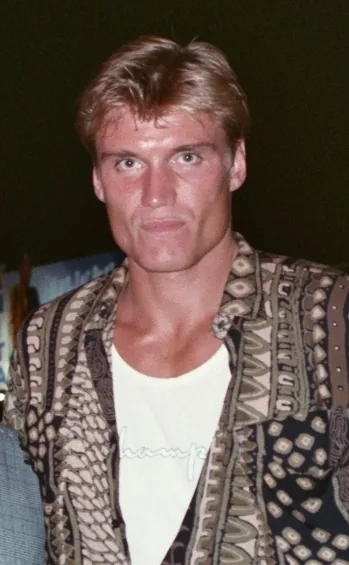
Lundgren at the premiere of Air America in 1990.1990Photo: · CC BY 2.0 · Wikimedia Commons 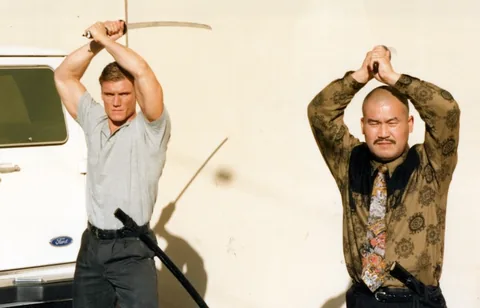
Lundgren and martial artist Toshishiro Obata holding swords on the set of Showdown in Little Tokyo.1991-12-12Photo: · CC0 1.0 Universal · Wikimedia Commons 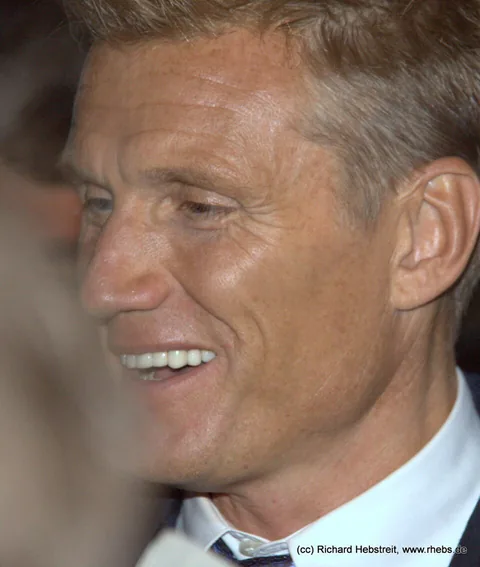
Lundgren at a Berlin screening event for The Expendables, August 2010.2010-08-06Photo: · CC BY 2.0 · Wikimedia Commons 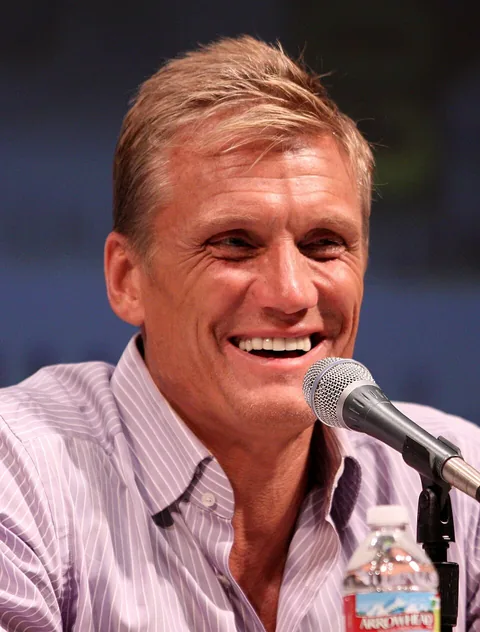
Lundgren at the 2010 San Diego Comic-Con.2010-07-22Photo: · CC BY-SA 3.0 · Wikimedia Commons 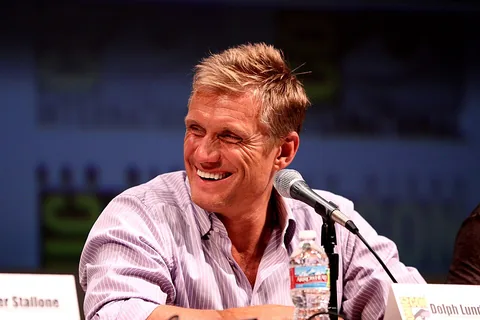
Lundgren on the Expendables panel at Comic-Con, July 2010.2010-07-22Photo: · CC BY-SA 2.0 · Wikimedia Commons 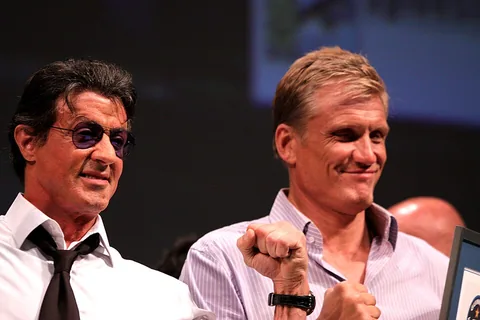
Sylvester Stallone and Lundgren, who first worked together on Rocky IV, at the 2010 Comic-Con.2010-07-22Photo: · CC BY-SA 2.0 · Wikimedia Commons 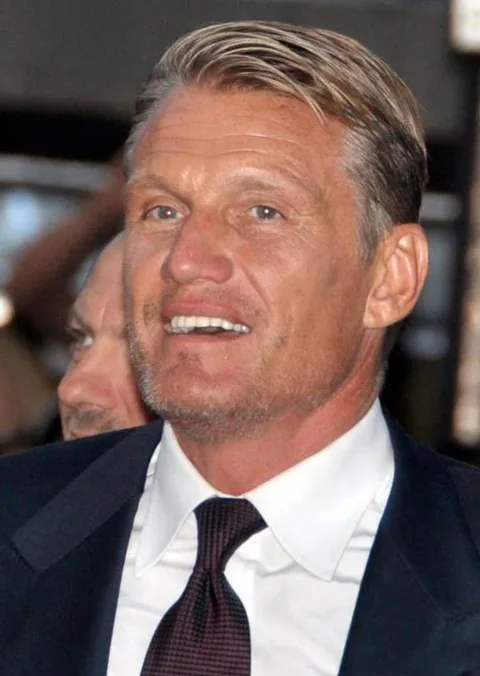
Lundgren at the French premiere of The Expendables 2 in Paris.2012-08-13Photo: · CC BY-SA 3.0 · Wikimedia Commons 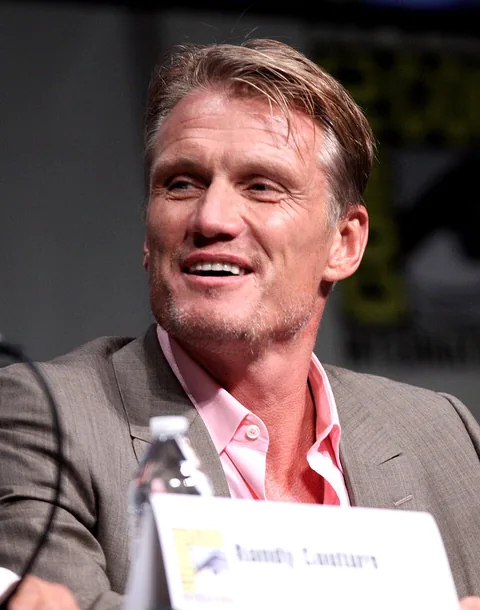
Lundgren at the 2012 San Diego Comic-Con.2012-07-12Photo: · CC BY-SA 3.0 · Wikimedia Commons 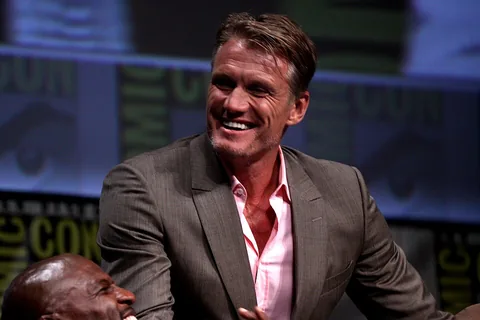
Lundgren speaking on a panel at Comic-Con International, July 2012.2012-07-12Photo: · CC BY-SA 2.0 · Wikimedia Commons 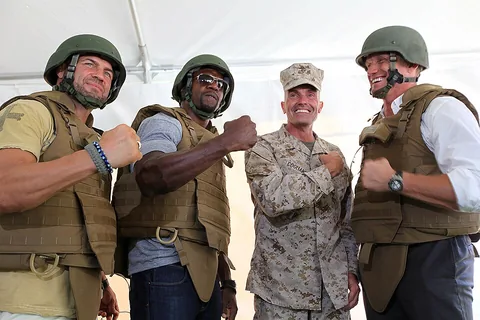
Randy Couture, Terry Crews, Brig. Gen. Vincent Coglianese, and Lundgren at Marine Corps Base Camp Pendleton for the premiere of The Expendables 2.2012-07-13Photo: · Public domain · Wikimedia Commons 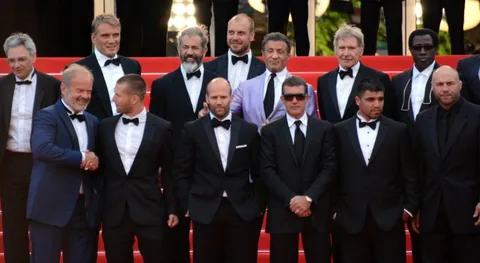
The cast of The Expendables 3, including Lundgren, at the Cannes Film Festival.2014-05Photo: · CC BY-SA 3.0 · Wikimedia Commons 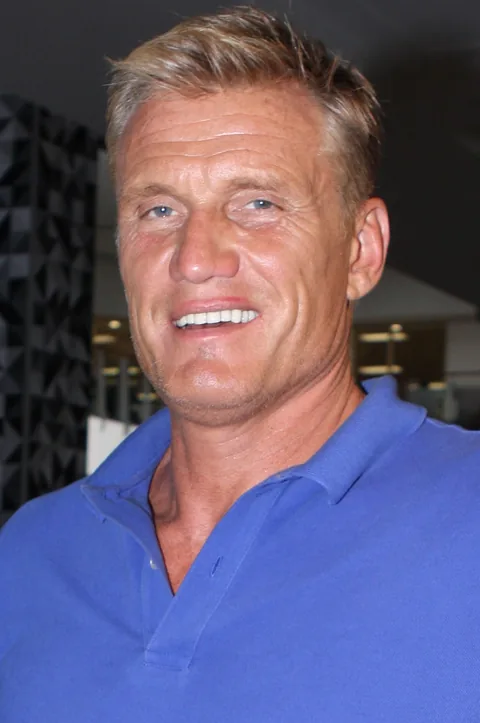
Lundgren in Sydney, the city where he earned his master's degree, in September 2014.2014-09-09Photo: · CC BY-SA 2.0 · Wikimedia Commons 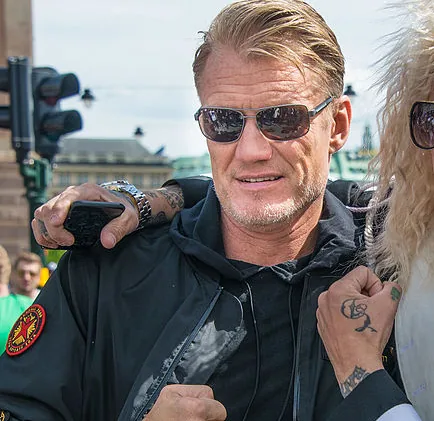
Lundgren in Stockholm, his home city, in May 2015.2015-05-24Photo: · CC BY-SA 4.0 · Wikimedia Commons Lundgren in Hollywood, California, in December 2018, the month after Creed II opened.2018-12-12Photo: · CC BY-SA 4.0 · Wikimedia Commons 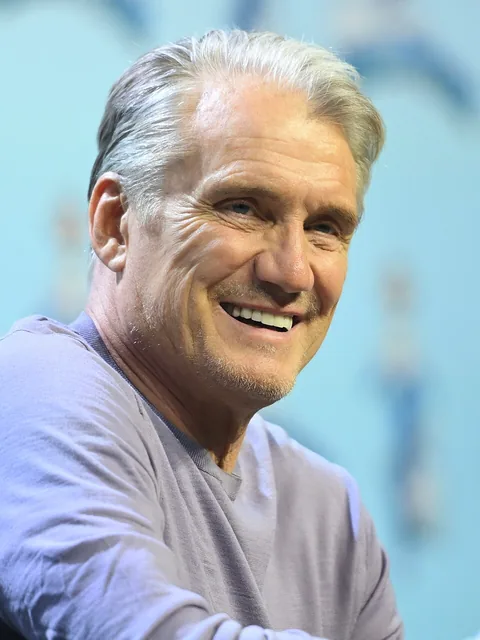
Lundgren at GalaxyCon Richmond, March 2024.2024-03-16Photo: · CC BY 2.0 · Wikimedia Commons 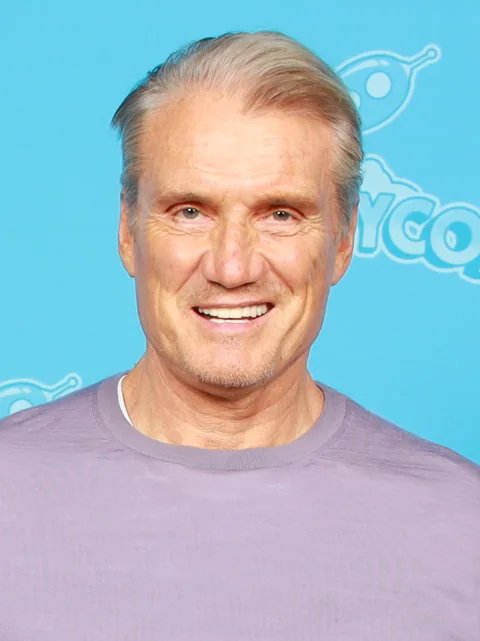
Lundgren at a fan photo session at GalaxyCon Richmond, March 2024.2024-03-16Photo: · CC BY 2.0 · Wikimedia Commons 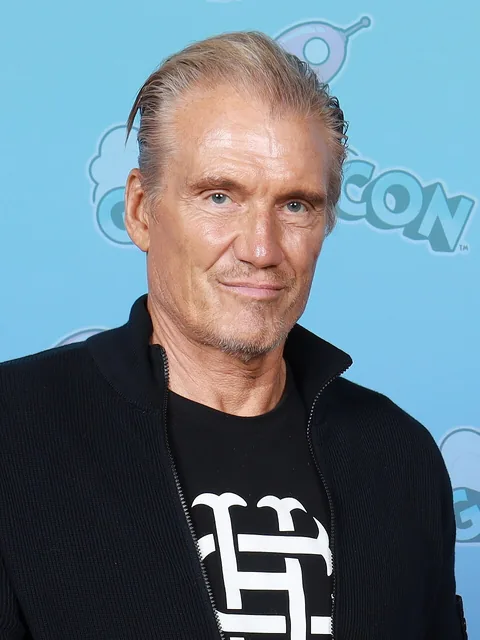
Lundgren at GalaxyCon San Jose, August 2025.2025-08-16Photo: · CC BY 4.0 · Wikimedia Commons


Watch and listen
Read
Notes
- "Dolph Lundgren," Wikipedia, accessed November 26, 2026 (cited only for his birth date and place, his parents' occupations, and a one-line description of his work; the article marks his father's occupations "citation needed"). https://en.wikipedia.org/wiki/Dolph_Lundgren↩1↩2
- Dave Trumbore, "Secret Science Nerds: Dolph Lundgren Will Break Your Chemical Bonds," Nerdist, August 9, 2016. https://archive.nerdist.com/secret-science-nerd-dolph-lundgren-will-break-your-chemical-bonds↩1↩2↩3↩4↩5
- "Biography," official website of Dolph Lundgren (dolphlundgren.com), accessed November 26, 2026. https://dolphlundgren.com/about/biography.html↩1↩2↩3↩4↩5↩6↩7↩8↩9↩10↩11↩12↩13↩14↩15↩16↩17
- "Karate," official website of Dolph Lundgren (dolphlundgren.com), accessed November 26, 2026. https://dolphlundgren.com/about/karate.html↩1↩2↩3↩4↩5↩6↩7↩8
- "How Dolph Lundgren Went from Chemical Engineer to Action Star," All Things Considered, NPR ("My Big Break" series), September 7, 2014, interview by Arun Rath, as posted by Michigan Public. https://www.michiganpublic.org/2014-09-07/how-dolph-lundgren-went-from-chemical-engineer-to-action-star↩1↩2↩3↩4↩5↩6↩7↩8
- Vince Mancini, "Dolph Lundgren, Action Auteur, on Fake Guns, Real Cocaine, and Kelsey Grammer," GQ, February 2, 2024, syndicated by Yahoo. https://www.yahoo.com/lifestyle/dolph-lundgren-action-auteur-fake-125000509.html↩1↩2↩3
- "Masters of the Universe (1987 film)," Wikipedia, accessed November 26, 2026 (cited for opening weekend and North American gross, which the article sources to the Los Angeles Times and Box Office Mojo, and for critical reception). https://en.wikipedia.org/wiki/Masters_of_the_Universe_(1987_film)↩1↩2↩3
- Alex Pappademas, "Drago Bleeds: An Emotional, Career-Spanning Conversation with Dolph Lundgren," Grantland, May 13, 2015. https://grantland.com/hollywood-prospectus/dolph-lundgren-skin-trade-q-and-a/↩1↩2↩3↩4↩5↩6↩7↩8↩9↩10↩11↩12↩13↩14↩15↩16↩17↩18↩19↩20↩21↩22↩23↩24
- Ron Yamauchi, "The Expendables Gave Dolph Lundgren a Workout," Georgia Straight, August 11, 2010. https://www.straight.com/article-338002/vancouver/expendables-gave-lundgren-workout↩1↩2↩3
- Gary Thompson, "Why Dolph Lundgren Didn't Want to Play 'Rocky IV' Villain Ivan Drago Ever Again," The Philadelphia Inquirer, November 20, 2018. https://inquirer.com/entertainment/dolph-lundgren-creed-ii-sylvester-stallone-20181120.html↩1↩2↩3↩4↩5↩6↩7↩8↩9↩10
- Caitlin O'Kane, "Actor Dolph Lundgren Reveals 8-Year Cancer Battle," CBS News, May 11, 2023. https://www.cbsnews.com/amp/news/dolph-lundgren-cancer-battle-2015-diagnosis-kidney-tumors-in-depth-with-graham-bensinger/↩1↩2↩3↩4↩5↩6↩7↩8↩9↩10↩11↩12↩13
- Elizabeth Stanton, "'Rocky' Star Dolph Lundgren Is 'Finally Cancer Free' after 9-Year Journey," Fox News, November 28, 2024. https://foxnews.com/entertainment/rocky-star-dolph-lundgren-finally-cancer-free-9-year-journey.amp↩1↩2↩3
- AJ McDougall, "Dolph Lundgren and Wife Emma Krokdal Finally Become U.S. Citizens," The Daily Beast, February 12, 2024 (citing People). https://www.thedailybeast.com/dolph-lundgren-and-wife-emma-krokdal-finally-become-us-citizens↩1↩2↩3
- Elizabeth Stanton, "Dolph Lundgren Considered 'Legal Suicide' during Cancer Struggle," WJLA, September 22, 2026 (citing Entertainment Weekly). https://wjla.com/news/entertainment/dolph-lundgren-considered-legal-suicide-during-cancer-struggle↩1↩2↩3↩4
- "Dolph Lundgren: On Healing and Forgiveness at TEDxFulbrightSantaMonica (Full Transcript)," The Singju Post, posted March 13, 2018, transcript of the talk given at TEDxFulbrightSantaMonica, Santa Monica, 2015. https://singjupost.com/dolph-lundgren-on-healing-and-forgiveness-at-tedxfulbrightsantamonica-full-transcript/↩1↩2↩3↩4↩5↩6↩7↩8↩9↩10
- Tara Brady, "Dolph Lundgren: Grace Jones Would Bring as Many as Five Girls Back... 'Exhausting,'" The Irish Times, November 23, 2018. https://www.irishtimes.com/culture/film/dolph-lundgren-grace-jones-would-bring-as-many-as-five-girls-back-exhausting-1.3704513↩1↩2↩3↩4↩5↩6
- Christine Burroni, "'Rocky' Icon, 67, Says He 'Never Really Wanted to Be an Action Star,'" Parade, July 11, 2025, republished by AOL. https://www.aol.com/rocky-icon-67-says-never-181200157.html↩1↩2↩3↩4↩5
- Kevin Polowy, "Role Recall: Dolph Lundgren on Rocky, He-Man, and More," Yahoo Movies, updated August 13, 2014. https://www.yahoo.com/movies/dolph-lundgren-best-movie-roles-interview-dolph-94581800507.html↩1↩2↩3
- "The Punisher (1989 film)," Wikipedia, accessed November 26, 2026 (release history; the article sources the U.S. home video date to Turner Classic Movies and gives no source for its explanation of the missing U.S. theatrical release). https://en.wikipedia.org/wiki/The_Punisher_(1989_film)↩1↩2↩3
- Simon Brew, "Dolph Lundgren Interview: The Expendables, Ivan Drago, Stallone and Jason Bourne," Den of Geek, August 10, 2010. https://www.denofgeek.com/movies/dolph-lundgren-interview-the-expendables-ivan-drago-stallone-and-jason-bourne/↩1↩2↩3↩4
- "TEDxFulbrightSantaMonica," TEDx event page, September 26, 2015, Santa Monica, theme "fights worth fighting." https://www.ted.com/tedx/events/15775↩
- Samantha Bergeson, "Dolph Lundgren Was Told He Had 'Two or Three Years' Left to Live Before Filming 'Aquaman 2' Amid Cancer Battle," IndieWire, May 10, 2023, republished by Yahoo News UK. https://uk.news.yahoo.com/dolph-lundgren-told-had-two-204541502.html↩1↩2↩3↩4↩5
- Charlotte Phillipp and Abby Stern, "Dolph Lundgren Shares Health Update after Cancer, Says He's Now 'a Little Kinder' to His Body (Exclusive)," People, September 15, 2025, republished by AOL. https://www.aol.com/articles/dolph-lundgren-shares-health-cancer-020332986.html↩1↩2↩3↩4
- AJ McDougall, "Rocky IV, Creed II Star Dolph Lundgren Reveals Cancer Battle," The Daily Beast, May 10, 2023. https://www.thedailybeast.com/rocky-iv-creed-ii-star-dolph-lundgren-reveals-cancer-battle↩