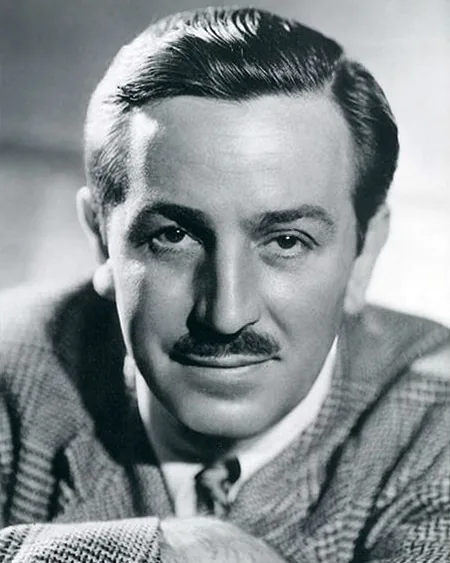

animator, film producer, voice actor, entrepreneur
Walt Disney
Also known as Walter Elias Disney
Born in Chicago, Illinois, United StatesDied in Burbank, California, United States
American animator, film producer, and entrepreneur who, with his brother Roy, founded the studio that became The Walt Disney Company. He co-created Mickey Mouse, made the first full-length animated musical feature, and opened Disneyland.
Official and reference links
- The Walt Disney Company (the company he founded)Official
- WikipediaReference
- WikiquoteReference
- BritannicaReference
- WikidataReference
- About Walt Disney (Walt Disney Archives, D23)Archive
- The Walt Disney Family MuseumMuseum
- Wikimedia Commons categoryArchive
- CBC Archives: Why the story of Walt Disney sort of begins in Canada (1963 interview)Video
Overview
Walter Elias Disney was born in Chicago on December 5, 1901, and died in Burbank, California, on December 15, 1966.[1] He was an American animator, film producer, and entrepreneur who, with his brother Roy, set up the studio that became The Walt Disney Company.[2]
With Ub Iwerks he developed Mickey Mouse in 1928, and Mickey reached the screen in Steamboat Willie, which the Walt Disney Archives calls the first fully synchronized sound cartoon.[2][3] In December 1937 his studio released Snow White and the Seven Dwarfs, the first full-length animated musical feature, after industry insiders nicknamed it "Disney's Folly."[3][4] In 1955 he opened Disneyland, and by 1965 he was planning a Florida resort and a community of the future called EPCOT.[5][3]
His road was rough. His first studio went bankrupt in 1923, he lost his first animated star in 1928, and in 1940 and 1941 he faced debt, falling revenue from Europe, and a bitter animators' strike.[6][2][7] He kept moving. Looking back at the first of those failures, he said, "I think it's important to have a good hard failure when you're young."[8]
Life
1901–1917
Chicago, Marceline, and Kansas City
Walt Disney was born on December 5, 1901, in the Hermosa neighborhood of Chicago, the fourth son of Elias and Flora Disney.[2] In 1906 the family moved to a farm near Marceline, Missouri. The Walt Disney Archives says he became interested in drawing early and was selling his first sketches to neighbors when he was only seven.[2][3] Britannica notes that Marceline is said to have furnished the inspiration and model for Main Street, U.S.A., at Disneyland.[1]
In 1911 the family moved to Kansas City, Missouri. Walt and his brother Roy woke at 4:30 each morning to deliver the Kansas City Times before school, and again after school with the Star, a route Walt kept for more than six years. He also attended Saturday classes at the Kansas City Art Institute and took a correspondence course in cartooning.[2]
The Walt Disney Family Museum describes a home where his mother, Flora, took great delight in her children's youthful innocence, while his father, Elias, demanded much more of them. Elias could not understand his son's ambition to become a cartoonist, but he agreed to pay for Walt's extra art classes at the Chicago Academy of Fine Arts.[4] The family had moved back to Chicago in 1917, and Walt enrolled at McKinley High School, where he drew cartoons for the school paper and took photographs.[2][1]
1918–1923
Ambulance driver, Laugh-O-gram, and a train west
In the fall of 1918, Walt tried to enlist and was turned down as too young.[3] The museum says the Navy turned him down for his age, and he and a friend then tried the Canadian armed forces before the two settled on the Red Cross Ambulance Corps.[9] The armistice came while he was still in training. He then shipped out in November and reached France on December 4, the day before his 17th birthday.[9] The Archives says he spent a year there driving an ambulance and chauffeuring Red Cross officials, and that his ambulance was covered with drawings and cartoons.[3] He later said that the months overseas helped make him more self-reliant.[9]
After the war he returned to Kansas City.[3] He found a job as an artist, was laid off a month later, and started a small business with Ub Iwerks that brought in little work. He took a job at the Kansas City Film Ad Company, where he learned about animation.[4] He then formed his own animation company, Laugh-O-gram Films, which made short fairy tales updated with jazz-age gags for a Kansas City theater owner named Frank Newman.[6]
By late July 1923 the company was headed for bankruptcy. Walt raised money for his fare by shooting home movies door to door, sold the camera, and bought a first-class ticket west.[8] The Archives says he arrived in Hollywood with $40 in his pocket and a finished film that mixed live action and animation.[3]
1923–1927
The Disney Brothers Studio and the Alice Comedies
In California, Walt visited his brother Roy, who was recovering from tuberculosis at a veterans' hospital, and persuaded him to check himself out, setting the stage for the two to co-found the Disney Brothers Cartoon Studio.[8] The Archives records that Roy had $250, that the brothers borrowed $500 more and built a camera stand in their uncle's garage, and soon received an order from New York for the first Alice Comedy.[3]
The distributor Margaret Winkler agreed to take an Alice series if the girl who played Alice, Virginia Davis, stayed in it. Walt wrote her mother a three-page letter and persuaded the family to move to California.[6] The museum says that success gave him confidence that if he truly believed in an idea he could sell it.[6]
On July 13, 1925, Walt married Lillian Bounds, one of his studio's inkers, in Lewiston, Idaho.[4][3] By 1927 Disney's studio had moved to a fully animated series, Oswald the Lucky Rabbit, distributed by Universal through Winkler Pictures. Universal's larger theaters brought attention and also a tougher eye from the distributors.[6]
1928–1936
Mickey, sound, and color
Mickey Mouse was created in 1928. The Archives says he was first used in a silent short, Plane Crazy, but sound arrived before it could be released, so Mickey made his screen debut in Steamboat Willie, which premiered in New York on November 18, 1928.[3] The Library of Congress calls Steamboat Willie the first film with sound to feature Mickey and Minnie Mouse. The film was registered for copyright in 1928 and inducted into the National Film Registry in 1998.[10] In the studio, Disney had a bouncing ball printed on the film so the orchestra could stay in sync.[4] Britannica says Disney himself supplied Mickey's voice until 1947.[1]
With Mickey established, Disney, by his own account an experimenter by nature, set out to diversify. His Silly Symphonies, one-reel shorts set to music, became a testing ground through the 1930s.[4] In 1932 he signed a two-year exclusive with Technicolor for its new three-strip process, and Flowers and Trees, remade in color, became the first cartoon to win an Academy Award.[4] The Archives counts it as the first of his 32 personal Academy Awards.[3] In 1933 The Three Little Pigs arrived in the middle of the Depression, and Britannica says its story of a pig who builds a house of brick suited the need for fortitude in the face of economic disaster.[1] He took a new focus on what the museum calls personality animation, so that each new character would have its own traits.[4]
1937–1945
Snow White, debt, and a world at war
By 1934 Disney believed a feature-length cartoon would be more profitable than shorts.[2] On June 3, 1934, The New York Times announced that Walt was making one, and industry insiders sneered, calling it "Disney's Folly."[4] The budget kept climbing as production fell behind, and still there was no compromise.[4] Snow White and the Seven Dwarfs opened on December 21, 1937, and the Archives says it was made at a cost of $1,499,000 during the Depression.[4][3] As Walt recalled, the studio had been heavily in debt, and within six months it had millions in the bank.[4] In 1937 the studio also debuted its multiplane camera on The Old Mill, which gave a convincing illusion of depth.[4]
More features followed, including Pinocchio, Fantasia, Dumbo, and Bambi, and in 1940 the Burbank studio was finished, with a staff of more than 1,000.[3] When Disney received the Irving G. Thalberg Memorial Award, the trade paper Daily Variety reported in February 1942 that he wept and called it "a vote of confidence from the whole industry."[11]
World War II reshaped the studio. The Archives says 94 percent of its facilities were doing government work, including training and propaganda films for the armed forces.[3] Pinocchio and Fantasia did not perform well at the box office, partly because revenue from Europe had dropped after the war began in 1939. The studio was deeply in debt by the end of February 1941, and after an animators' strike that year Disney's relationship with some of his staff stayed permanently strained.[2] The setbacks section tells that story.
1946–1954
Nature films, Cinderella, and the idea of Disneyland
In 1948 Disney began the True-Life Adventures, a series of live-action nature films that started with Seal Island.[2] The Archives says his inquisitive mind and his sense for education through entertainment produced it.[3] Cinderella (1950) was his first animated feature in eight years. It cost $2.2 million and earned nearly $8 million in its first year.[2] In 1950 he also made his first entirely live-action feature, Treasure Island.[2] At the March 25, 1954, ceremony he won four Academy Awards, which the museum says made him the first individual with four Oscar wins in a single year.[11]
Walt wanted something that would not be finished. In 1952 he formed a private company, WED Enterprises, now Walt Disney Imagineering, and used his own money to start designing a park.[4][2] By the museum's account he could not get anyone to back the idea, and he hocked his own life insurance. To pitch it to investors he had studio artist Herb Ryman draw a rendering over a 48-hour weekend while Walt described every detail.[4] Wikipedia notes that he visited Tivoli Gardens in Copenhagen and was heavily influenced by its cleanliness and layout, and that in mid-1954 he sent his Imagineers to every amusement park in the United States.[2] The money from the ABC television network was tied to Disney television programs, and Walt Disney's Disneyland began in 1954.[2]
1955–1966
Disneyland, Mary Poppins, and Florida
Disneyland opened on July 17, 1955, with a live ABC broadcast. The Walt Disney Archives says it was launched as a $17 million park.[4][5][3] The Mickey Mouse Club and the Davy Crockett miniseries followed on television, and Disney was a consultant to the 1959 American National Exhibition in Moscow and designed ceremonies for the 1960 Winter Olympics.[2] In 1962 he began Mary Poppins, using nearly every trick the studio had learned. It premiered in 1964, earned 12 Academy Award nominations, and won five.[4] The museum quotes him recalling, in amusement, that he never saw a sad face around the entire studio, and that the "horrible thought" struck him that the staff had finally conceded he knew what he was doing.[4] The 1964 New York World's Fair carried four Disney exhibits, among them "it's a small world."[2]
His personal honors included the Presidential Medal of Freedom, and he took a deep interest in founding the California Institute of the Arts.[3] On November 15, 1965, he and Roy joined Florida's governor in announcing Disney World.[2] At its heart would be EPCOT, which the museum describes as an urban experiment to enrich the quality of everyday life.[4] Disney filmed his EPCOT presentation on October 27, 1966, on a studio soundstage, one of his final on-screen appearances.[12]
In early November 1966 he was diagnosed with lung cancer. He died at St. Joseph Hospital on December 15, 1966, in Burbank, and his ashes were interred at Forest Lawn Memorial Park in Glendale.[2][1] Roy Disney put off his retirement to take full control of the Disney companies and changed the focus of the EPCOT project from a town to an attraction. Walt Disney World opened on October 1, 1971.[2][3]
Habits and rituals
Story first, on a storyboard
1930s–1966
Disney believed story development was one of the most important parts of making an animated film. In the 1930s his studio developed storyboards, series of sketches that map out a story in order so that filmmakers could judge whether it was clear and whether it had plot holes.[13] Around the time of The Three Little Pigs (1933), he invested in a story department separate from the animators, with storyboard artists who detailed the plots.[2] In March 1938 The New York Times quoted him saying that the studio's most important aim was to develop definite personalities in its cartoon characters, because characters who are merely shadows provoke no emotional response.[14]
Plussing: keep making it better
1950s–1966
Disney talked about "plussing" Disneyland: adding to it after it opened. In a roughly 1956 interview with journalist Pete Martin, he said a film was finished once handed to Technicolor, and he could not touch it again, whereas Disneyland was something he could keep developing and adding to.[15] He also treated audiences as a source of lessons. When a picture was out, he said, he found out what the public liked or didn't like and had to apply that to some other thing.[15]
Experiment, diversify, move on
1928–1966
Disney described himself as an experimenter by nature. According to the Walt Disney Archives' collection of his quotations, he did not believe in sequels, could not follow popular cycles, and had to move on to new things, so after Mickey's success he set out to diversify.[16] The museum says the Silly Symphonies were his creative testing ground for the advancement of animation through the 1930s, and that his successful experiments with them gave him the courage to tackle Snow White.[4] A 1958 Wall Street Journal piece, as Wikiquote reports it, carried his formula as "dream, diversify and never miss an angle."[14]
Studying the real thing
1937–1965
For Snow White, Wikipedia says he sent animators to classes at the Chouinard Art Institute, brought animals into the studio, and hired actors so the animators could study realistic movement.[2] On the 1941 goodwill tour of South America, he later recalled, "I set up a shop," and he skipped the embassy circuit to start gathering material. His artists studied the Brazilian parrot in local zoos and museums, which led to the character José Carioca.[7] Before Disneyland opened, Wikipedia says he sent his Imagineers to study every amusement park in the United States for what worked and what went wrong.[2]
Betting his own money
1934–1955
Disney tended to put his own resources behind an idea before others would. For the feature that became Snow White he said "go for broke—shoot the works."[4] When he could not get backers for Disneyland, the museum says he worked on it with his own money, and used his initials to name WED Enterprises, which he funded himself.[4] A 1996 book quotes him saying he could never convince financiers that Disneyland was feasible, "because dreams offer too little collateral."[14]
Coordinating the talent
1920s–1966
By his own description, he no longer drew Mickey Mouse; his part was coordinating the talents around him. The Archives' collection has him saying that the most vital thing he did was coordinating those who worked with him and aiming their efforts at a goal, and that he was no longer the perfectionist because his staff insisted on doing it better and better.[17] The museum describes the Disney partnership as Walt spearheading the creative side while Roy handled the business side.[4]
Family time and a backyard railroad
1925–1966
The museum says Disney held that a man should never neglect his family for business. He rarely brought work home, looked forward to "Daddy's Day" on weekends, and drove his daughters to school each day until they could drive themselves.[4] After the family moved to Holmby Hills in 1949, he built a miniature live-steam railroad in the backyard, the Carolwood Pacific, with a locomotive named Lilly Belle after his wife.[2] The museum, which now displays the train, calls it Walt's pride and joy.[18]
Setbacks and comebacks
Laugh-O-gram goes bankrupt 1922–1923
What happened
Laugh-O-gram Films, Walt's first animation studio, went bankrupt in 1923, and Walt left Kansas City for California.[6][8] He later called it a failure and added that he thought it was important to have a good hard failure when you are young.[8]
The cause
The studio's first and only big contract came from a company called Pictorial Clubs, which offered $11,000 for six shorts with a $100 payment up front. Pictorial Clubs went bankrupt after paying only the $100, and the projects Walt tried to save the company did not do it.[6] The museum says he was young and inexperienced and entered a bad business deal that cost him his company.[4]
The comeback
With the Alice's Wonderland reel in his suitcase, Walt headed west and, with Roy, founded the Disney Brothers Cartoon Studio, which sold the Alice Comedies to Margaret Winkler.[8][6] The museum calls Laugh-O-gram his first poor experience with an outside distributor and says it encouraged him to take a more discerning look at future contracts.[6]
Losing Oswald the Lucky Rabbit 1927–1928
What happened
In February 1928 Walt traveled to New York hoping to negotiate a larger budget for the Oswald series, and he was refused. He learned that Universal owned the rabbit, and he lost most of his animation staff.[2]
The cause
Charles Mintz, who headed Winkler Pictures, rejected Walt's request for a raise and demanded he take a pay cut or lose his staff, many of whom had made back-room deals with Mintz. Oswald was Universal's property, so Mintz held the leverage.[6] Only Ub Iwerks stayed with Disney.[2]
The comeback
Disney and Iwerks developed Mickey Mouse to replace Oswald.[2] The museum says the loss taught Walt a hard lesson about owning the characters he created.[6] Plane Crazy, the first Mickey short produced, did not attract new distributors, and the arrival of talking pictures led Disney to synchronized sound for the third Mickey short, Steamboat Willie.[6][4] Later he called Mickey "a symbol of independence."[14] The distribution deal he signed for sound taught another lesson. The museum says he did not read his contract with Pat Powers closely, and when Roy suspected they were being cheated, the brothers hired an attorney, Gunther Lessing, and began meeting their remaining legal obligations to Powers while they looked for a better distributor.[6]
Debt, lost markets, and the 1941 strike 1940–1945
What happened
Pinocchio and Fantasia, both released in 1940, did not do well at the box office, and by the end of February 1941 the studio was deeply in debt.[2] In response Disney and Roy offered stock to the public for the first time, in 1940, and cut salaries. A five-week strike by animators began in 1941.[2] The museum says the painfully bitter strike cast a shadow over everything he had built.[7]
The cause
Wikipedia attributes the financial trouble partly to the loss of European revenue after World War II began in 1939, and says the salary cuts and what it calls Disney's sometimes high-handed and insensitive manner with staff led to the strike. The strike and the debt led several animators to leave, and relations with others stayed strained.[2] The museum adds that war all but cut off profits from Europe.[7]
The comeback
Disney made Dumbo simply and inexpensively, and audiences and critics liked it.[2] He accepted a goodwill trip to South America once it was suggested he focus on research for films, and the government promised to underwrite it. The tour yielded Saludos Amigos (1942) and The Three Caballeros (1944), which were well received, and Walt later said the government did not have to put up one nickel.[7] During the war the studio did government work, and it kept making comedy shorts.[3] In 1944, as Wikipedia tells it, Bank of America's founder told his executives to give the Disneys time to market their product.[2] The True-Life Adventures followed in 1948 and Cinderella in 1950.[2]
Financing Disneyland and a rough opening day 1952–1955
What happened
Disneyland was hard to fund and rocky to open, and Smithsonian magazine says Disney bet everything on it.[4][5] When it opened on July 17, 1955, park employees called the day "Black Sunday."[5]
The cause
Backers were skeptical. The museum records him saying he could not get anybody to go along, and that almost everyone warned it would be a spectacular failure.[4] On opening day, workers were still hammering and painting as the broadcast began. Counterfeit tickets left the park over capacity by almost 15,000 people, the asphalt on Main Street was melting, a seven-mile freeway backup built up, and the refreshment stands and three restaurants ran out of food.[5]
The comeback
Disney had told reporters on opening day that it might take a month for things to go smoothly.[5] Smithsonian magazine reports that more than 100,000 people had visited by the end of the first week.[5] According to Wikipedia the park drew 3.6 million guests in its first year.[2] Disney described the park as "alive," something he could keep changing.[15]
In their own words
I think it's important to have a good hard failure when you're young.[8]
Recalling his 1923 move to Hollywood, quoted by The Walt Disney Family Museum (2023) · Source You may not realize it when it happens, but a kick in the teeth may be the best thing in the world for you.[19]
The Story of Walt Disney (1957), via Quote Investigator · Source The park means a lot to me in that it's something that will never be finished. Something that I can keep developing, keep plussing and adding to—it's alive.[15]
Interview with Pete Martin (c. 1956), quoted by The Walt Disney Family Museum · Source I wanted something live, something that could grow, something I could keep plussing with ideas, you see?[15]
Interview with Pete Martin (c. 1956), quoted by The Walt Disney Family Museum · Source By nature I'm an experimenter. To this day, I don't believe in sequels. I can't follow popular cycles. I have to move on to new things. So with the success of Mickey, I was determined to diversify.[16]
Walt Disney Archives quotation collection (D23) · Source I suppose my formula might be: dream, diversify and never miss an angle.[14]
Wall Street Journal (February 4, 1958), via Wikiquote · Source You should have heard the howls of warning![4]
Walt Disney: Famous Quotes, quoted by The Walt Disney Family Museum · Source Almost everyone warned us that Disneyland would be a Hollywood spectacular—a spectacular failure. But they were thinking about an amusement park, and we believed in our idea: a family park where parents and children could have fun—together.[4]
Walt Disney Famous Quotes, quoted by The Walt Disney Family Museum · Source I could never convince the financiers that Disneyland was feasible, because dreams offer too little collateral.[14]
As quoted in The Stuff Americans Are Made Of (1996), via Wikiquote · Source Disneyland is your land. Here age relives fond memories of the past, and here youth may savor the challenge and promise of the future.[14]
Disneyland dedication speech (July 17, 1955), via Wikiquote · Source Our most important aim is to develop definite personalities in our cartoon characters. We don't want them to be just shadows, for merely as moving figures they provoke no emotional response from the public.[14]
The New York Times (March 1938), via Wikiquote · Source Of all the things I've done, the most vital is coordinating those who work with me and aiming their efforts at a certain goal.[17]
Walt Disney Archives quotation collection (D23) · Source I'm not the perfectionist any more. It's my staff. They're the ones always insisting on doing something better and better.[17]
Walt Disney Archives quotation collection (D23) · Source Courage is the main quality of leadership, in my opinion, no matter where it is exercised. Usually it implies some risk — especially in new undertakings.[14]
As quoted in The Magic of Teamwork (1997), via Wikiquote · Source Mickey Mouse is, to me, a symbol of independence. He was a means to an end.[14]
Quoted in a 2004 book on organizational complexity, via Wikiquote · Source EPCOT will be an experimental prototype community of tomorrow that will take its cue from the new ideas and new technologies that are now emerging from the creative centers of American industry. It will be a community of tomorrow that will never be completed, but will always be introducing and testing and demonstrating new materials and systems.[14]
EPCOT promotional film (1966), via Wikiquote · Source I want to thank everybody here. This is a vote of confidence from the whole industry.[11]
Thalberg Award acceptance (1942), reported in Daily Variety and quoted by The Walt Disney Family Museum · Source
Pictures
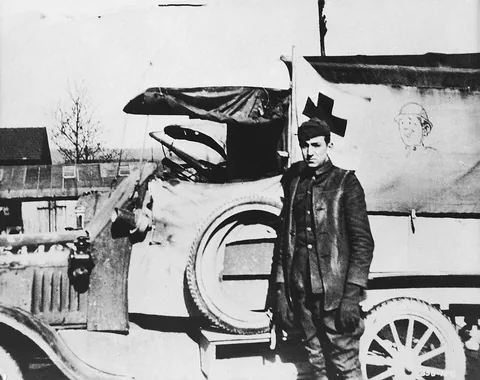
Walt Disney at 17, a Red Cross Ambulance Corps volunteer in France, where he arrived just after the World War I armistice.1919Photo: · Public domain · Wikimedia Commons 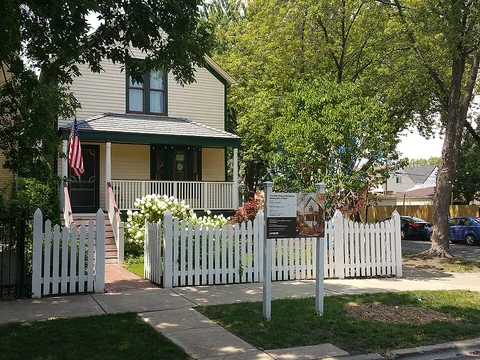
The Hermosa, Chicago, house that Elias and Flora Disney built, where Walt was born.2017-08-02Photo: · CC BY-SA 4.0 · Wikimedia Commons 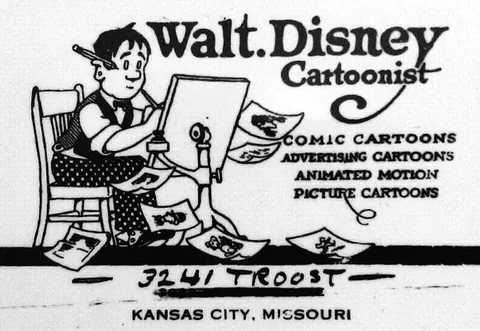
The return address on a business envelope Disney used around 1921, with a self-portrait, on display at The Walt Disney Family Museum.1921Photo: · Public domain · Wikimedia Commons 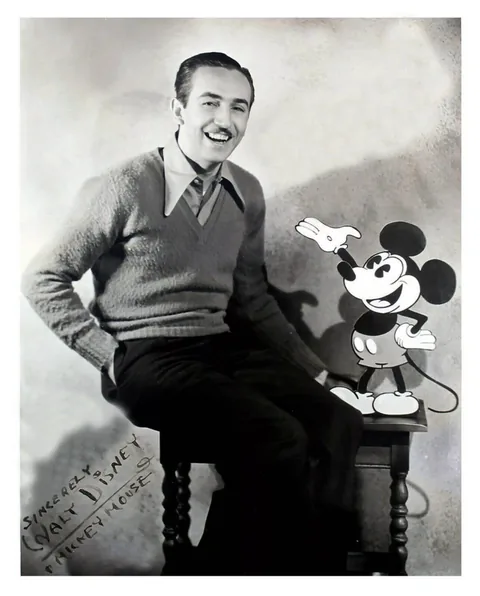
Walt Disney with Mickey Mouse in 1929, the year after Mickey's debut.1929-01-01Photo: · Public domain · Wikimedia Commons 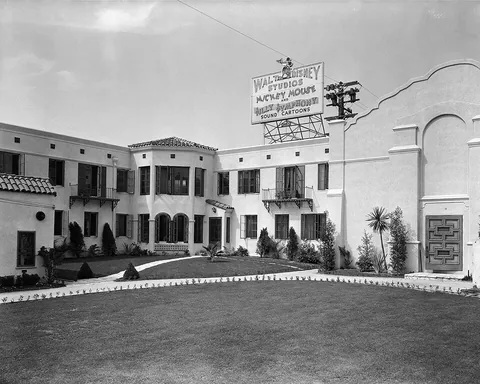
The Walt Disney Studios on Hyperion in 1929; the studio stayed there from 1926 to 1940.1929-01-01Photo: · Public domain · Wikimedia Commons 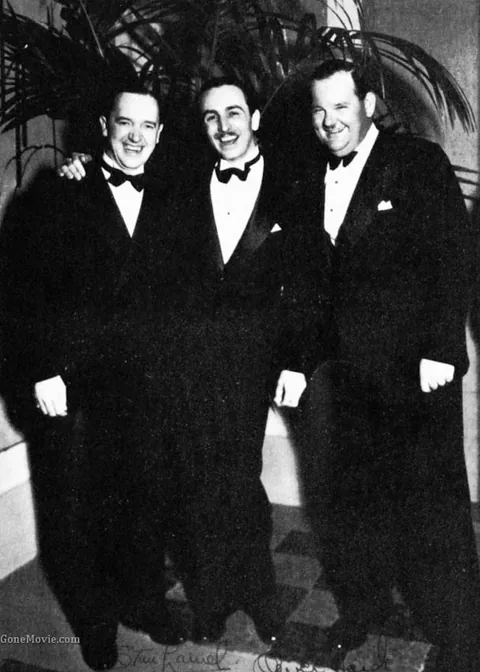
Stan Laurel, Walt Disney, and Oliver Hardy.circa 1930Photo: · Public domain · Wikimedia Commons 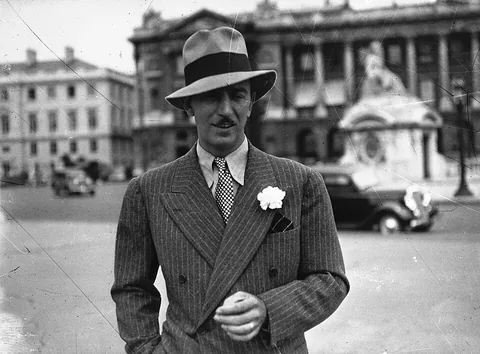
Disney in Paris in 1935 on the Place de la Concorde, in front of the Hotel de Crillon.about 1935-06-25Photo: · Public domain · Wikimedia Commons 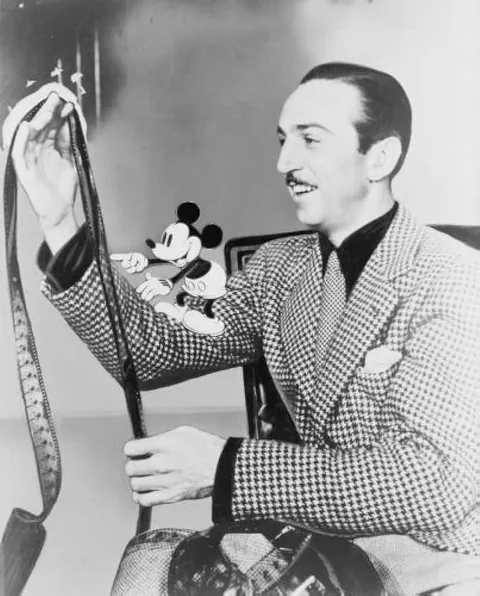
Disney, seated, examines film with Mickey Mouse perched on his right arm (Library of Congress).1935Photo: · CC0 1.0 Universal · Wikimedia Commons 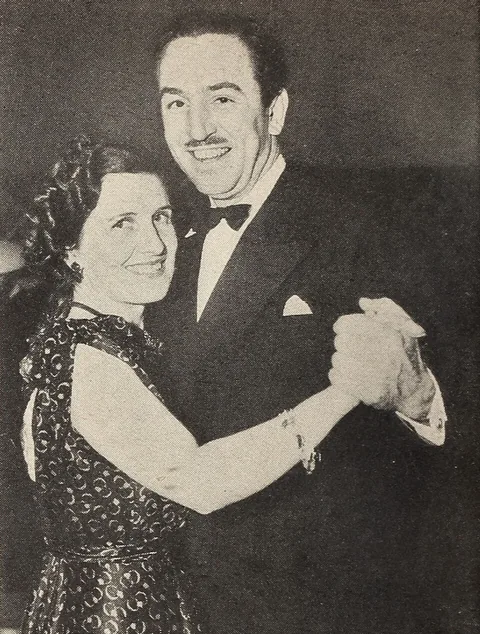
Walt and Lillian Disney dancing, in a photograph published in Screenland in May 1939.1939-05Photo: · Public domain · Wikimedia Commons A 1946 Boy Scouts of America publicity photograph of Disney, who was given an award by the group that year.1946-05-17Photo: · Public domain · Wikimedia Commons 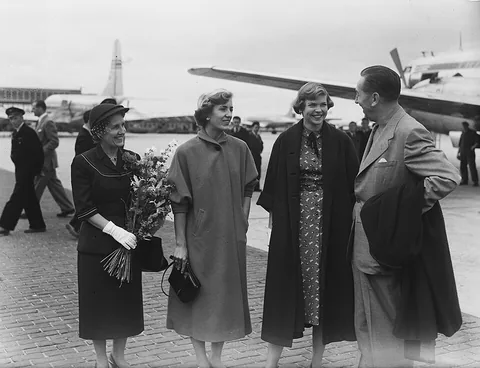
Disney and his family arriving at Schiphol Airport near Amsterdam in 1951.1951-06-29Photo: · CC0 1.0 Universal · Wikimedia Commons 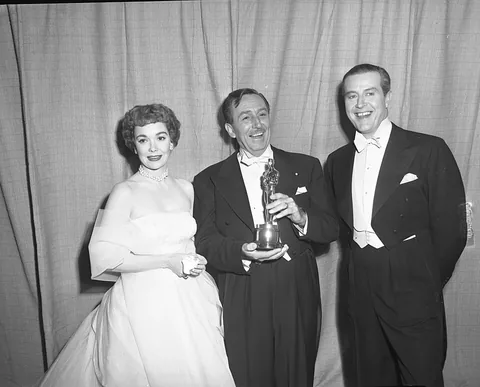
Ray Milland, Walt Disney, and Jane Wyman at the 1953 Academy Awards, where Disney won for the short Water Birds.1953-03-19Photo: · CC BY 2.0 · Wikimedia Commons 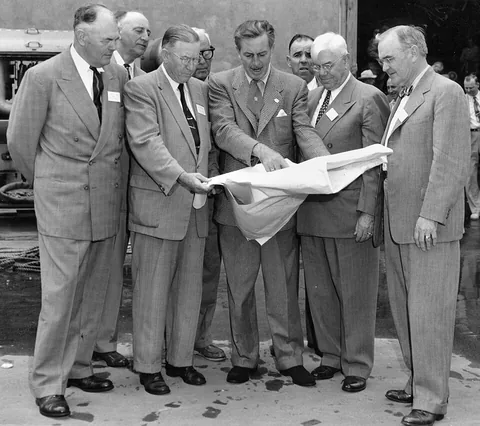
Disney showing Disneyland plans to Orange County officials in December 1954.1954-12Photo: · CC BY 2.0 · Wikimedia Commons 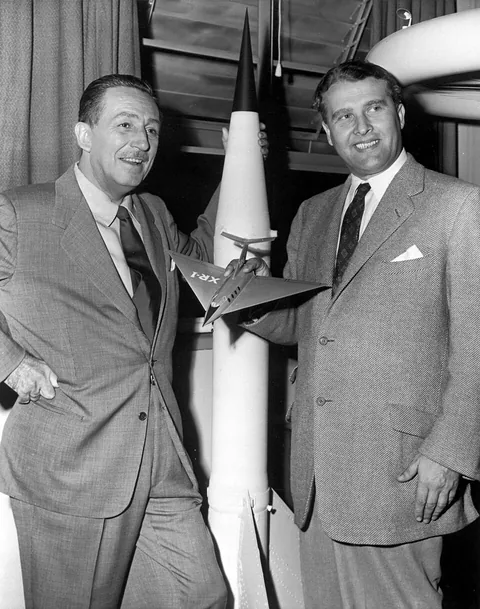
Disney with rocket scientist Wernher von Braun, who worked with him on the Man in Space television episode.1954Photo: · Public domain · Wikimedia Commons 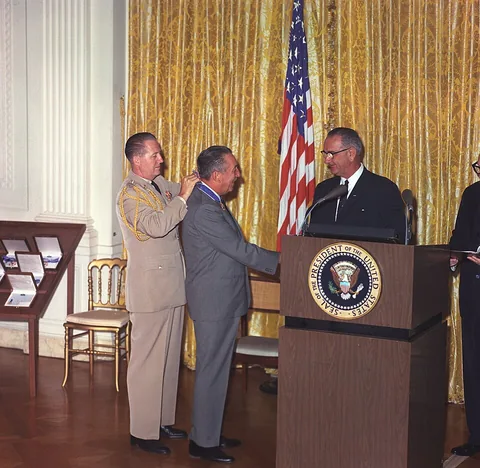
President Lyndon B. Johnson presents Disney with the Presidential Medal of Freedom in 1964.1964-09-14Photo: · Public domain · Wikimedia Commons 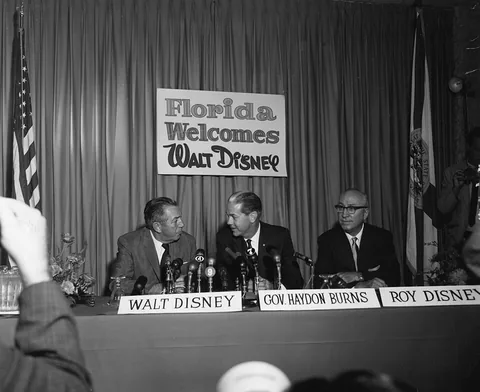
Disney at the November 15, 1965, press conference announcing Disney World in Florida.1965-11-15Photo: · Public domain · Wikimedia Commons 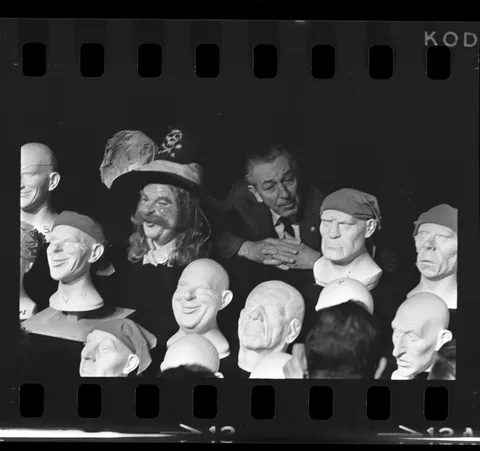
Disney inspecting plastic heads for the Pirates of the Caribbean attraction, one of four additions then set for Disneyland.1966-02-03Photo: · CC BY 4.0 · Wikimedia Commons 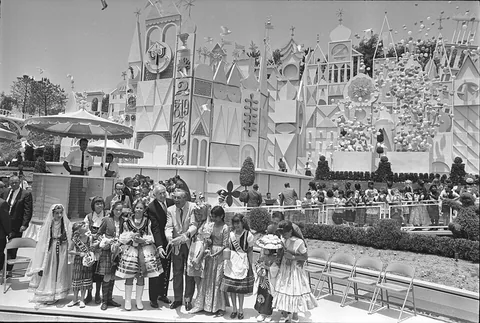
Disney and Louis B. Lundborg at the opening of it's a small world at Disneyland in 1966.1966-05-31Photo: · CC BY 4.0 · Wikimedia Commons 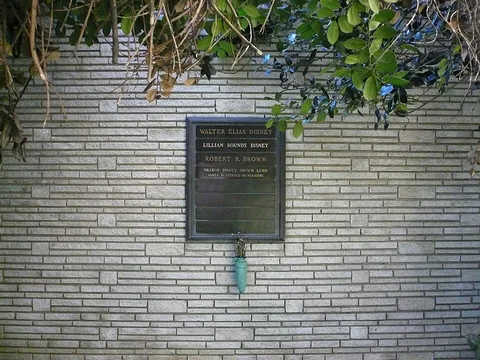
Disney's grave at Forest Lawn Memorial Park in Glendale, California.2007-08-16Photo: · CC BY-SA 2.0 · Wikimedia Commons


Watch and listen
Read
Notes
- "Walt Disney," Encyclopaedia Britannica, accessed November 27, 2026. https://www.britannica.com/biography/Walt-Disney↩1↩2↩3↩4↩5↩6
- "Walt Disney," Wikipedia, accessed November 27, 2026. https://en.wikipedia.org/wiki/Walt_Disney↩1↩2↩3↩4↩5↩6↩7↩8↩9↩10↩11↩12↩13↩14↩15↩16↩17↩18↩19↩20↩21↩22↩23↩24↩25↩26↩27↩28↩29↩30↩31↩32↩33↩34
- "About Walt Disney," Walt Disney Archives, D23, accessed November 27, 2026. https://d23.com/about-walt-disney/↩1↩2↩3↩4↩5↩6↩7↩8↩9↩10↩11↩12↩13↩14↩15↩16↩17↩18↩19↩20
- "Walt Disney: The man, his story, his work, his innovations," The Walt Disney Family Museum, accessed November 27, 2026. https://www.waltdisney.org/sites/default/files/walt-disney/walt-disney.html↩1↩2↩3↩4↩5↩6↩7↩8↩9↩10↩11↩12↩13↩14↩15↩16↩17↩18↩19↩20↩21↩22↩23↩24↩25↩26↩27↩28↩29↩30
- Kat Eschner, "Disneyland's Terrible First Day Didn't Stop the Crowds From Coming," Smithsonian magazine, July 17, 2017. https://www.smithsonianmag.com/smart-news/disneylands-terrible-first-day-didnt-stop-crowds-coming-180964013/↩1↩2↩3↩4↩5↩6↩7
- "Mickey's Follies: Walt's Distribution Deals, Defeats, and Decisions," The Walt Disney Family Museum blog, February 19, 2017. https://www.waltdisney.org/blog/mickeys-follies-walts-distribution-deals-defeats-and-decisions↩1↩2↩3↩4↩5↩6↩7↩8↩9↩10↩11↩12↩13
- "Walt and the Goodwill Tour," The Walt Disney Family Museum blog, September 8, 2016. https://www.waltdisney.org/blog/walt-and-goodwill-tour↩1↩2↩3↩4↩5
- "100 Years Ago: Walt Goes West," The Walt Disney Family Museum blog, August 15, 2023. https://www.waltdisney.org/blog/100-years-ago-walt-goes-west↩1↩2↩3↩4↩5↩6↩7
- Thomas Price, "'Over There': Walt Disney's World War I Adventure," The Walt Disney Family Museum blog, May 21, 2012. https://www.waltdisney.org/blog/over-there-walt-disneys-world-war-i-adventure↩1↩2↩3
- "Lifecycle of Copyright: 1928 Works in the Public Domain," U.S. Copyright Office blog, Library of Congress, January 2024. https://blogs.loc.gov/copyright/2024/01/lifecycle-of-copyright-1928-works-in-the-public-domain/↩
- Jim Korkis, "Award-Winning Walt," The Walt Disney Family Museum blog, February 15, 2012. https://www.waltdisney.org/blog/award-winning-walt↩1↩2↩3
- "Behind the Scenes of Walt's Last Dream," Walt Disney Archives, D23, accessed November 27, 2026. https://d23.com/walt-epcot-film/↩
- "Open Studio: Storyboards," The Walt Disney Family Museum blog, January 11, 2013. https://www.waltdisney.org/blog/open-studio-storyboards↩
- "Walt Disney," Wikiquote, accessed November 27, 2026. https://en.wikiquote.org/wiki/Walt_Disney↩1↩2↩3↩4↩5↩6↩7↩8↩9↩10↩11
- "In Walt's Own Words: Plussing Disneyland," The Walt Disney Family Museum blog, July 17, 2014. https://www.waltdisney.org/blog/walts-own-words-plussing-disneyland↩1↩2↩3↩4↩5
- "Walt Disney Quotes Archive," Walt Disney Archives, D23, accessed November 27, 2026. https://d23.com/walt-disney-quote/↩1↩2
- "Walt Disney Quotes Archive," page 2, Walt Disney Archives, D23, accessed November 27, 2026. https://d23.com/walt-disney-quote/page/2/↩1↩2↩3
- "Look Closer: Walt's Carolwood-Pacific Railroad with the Lilly Belle," The Walt Disney Family Museum blog, October 24, 2011. https://www.waltdisney.org/blog/look-closer-walts-carolwood-pacific-railroad-lilly-belle↩
- "A Kick in the Teeth May Be the Best Thing in the World for You," Quote Investigator, May 21, 2013. https://quoteinvestigator.com/2013/05/21/disney-kick/↩