
U.S. Army officer, author, philanthropist
H. Norman Schwarzkopf Jr.
Also known as Stormin' Norman, The Bear
Born in Trenton, New Jersey, United StatesDied in Tampa, Florida, United States
A West Point graduate and Vietnam veteran, he rose to four-star general, led U.S. Central Command from 1988 to 1991, and commanded the coalition that liberated Kuwait in Operation Desert Storm. He retired in 1991 and published his memoir in 1992.
Official and reference links
- WikipediaReference
- WikiquoteReference
- WikidataReference
- Camp Boggy Creek (Schwarzkopf was a co-founder)Foundation
- Wikimedia Commons categoryArchive
- Academy of Achievement: biography and 1992 interviewArchive
- FRONTLINE (PBS): Schwarzkopf oral history, The Gulf WarArchive
- Hall of Valor: Schwarzkopf awards and citationsArchive
- C-SPAN Booknotes: It Doesn't Take a Hero (1992)Video
- Encyclopedia.com biographyOther
Overview
H. Norman Schwarzkopf Jr. (1934 to 2012) was the U.S. Army general who commanded the coalition that drove Iraq's army out of Kuwait in 1991.[1] He was born in Trenton, New Jersey, the son of the founding superintendent of the New Jersey State Police.[2][3] He graduated from West Point in 1956 and served two tours in Vietnam, first as an adviser and then as a battalion commander, and came home highly decorated.[4][5]
After brigade, division, and corps commands, he was named commander of U.S. Central Command in November 1988.[6] When Iraq invaded Kuwait on August 2, 1990, he led the buildup and then Operation Desert Storm: an extended air campaign followed by a ground offensive of about 100 hours.[7][8]
He was nicknamed "Stormin' Norman," had a well-known short temper with subordinates, and became familiar to the public through televised briefings.[9][10] He retired in August 1991, published the memoir It Doesn't Take a Hero in 1992, supported children's charities and prostate cancer awareness, and died in Tampa, Florida, on December 27, 2012.[11][12][13][14]
His record includes hard passages: friendly-fire and minefield deaths in his Vietnam battalion, the criticized joint operation in Grenada, and the debate over how the Gulf War ended. This profile tells each of them along with what he did next.[15][16][17]
Life
1934–1952
A soldier's son abroad
Herbert Norman Schwarzkopf Jr. was born in Trenton, New Jersey, on August 22, 1934.[2] In January 1952 his birth certificate was amended to read "H. Norman Schwarzkopf," reportedly because his father disliked the name Herbert.[18] His father was a West Point graduate and World War I veteran who founded the New Jersey State Police and served as its first superintendent.[3] Looking back in a 1992 interview, the son said of him, "My dad was a man of great honor."[19]
After World War II the elder Schwarzkopf served at posts across the Middle East and Europe, and his son went with him on many of them.[20] In 1946, when Norman was twelve, he went with his father to Tehran, and in 1947 the family moved to Geneva.[21] He remembered the school system in Iran as terrible.[22]
He went to schools in Tehran, Geneva, Frankfurt, and Heidelberg and graduated from Valley Forge Military Academy in 1952.[23] He played football, ran track, wrestled, and played soccer, and he later judged himself a very good high school athlete but not a very good college athlete.[24]
1952–1964
West Point and the early Army
Schwarzkopf entered the U.S. Military Academy at West Point, as his father had, and graduated 43rd of 480 in the Class of 1956 with a Bachelor of Science degree.[4] He later said he finished in the top 10 percent of his class "without very much work."[25] At his memorial service in 2013, his daughter Cynthia said, "Duty, honor, country was his creed. Doing what was right was his guide."[26]
He started in the airborne infantry, as a platoon leader and later executive officer of E Company, 2nd Airborne Battle Group, 187th Airborne Infantry Regiment, 101st Airborne Division, at Fort Campbell, Kentucky.[27] In July 1960 he became aide-de-camp to Brig. Gen. Charles Johnson, commander of the Berlin Brigade.[28] He earned a master's degree in mechanical and aerospace engineering at the University of Southern California in 1964, then returned to West Point for an obligatory tour as an instructor in the Department of Mechanics.[29]
After a year of teaching he volunteered for service in South Vietnam, seeking faster career advancement through a combat tour, and West Point approved the request in early 1965.[30]
1965–1970
Vietnam: adviser and battalion commander
On his first tour, beginning in 1965, Schwarzkopf served as a task force adviser to the South Vietnamese Army's airborne division. For his leadership in the battle at Duc Co he was awarded the Silver Star, and on February 14, 1966, he was wounded four times by small-arms fire while leading a South Vietnamese paratrooper assault.[31] The Hall of Valor lists Silver Star citations for him as a major serving as an adviser with Military Assistance Command, Vietnam, in 1965 and 1966.[32] He remembered his first homecoming as confusing, because he had been so intensely involved in the war while few at home seemed to notice it.[33]
After finishing his teaching tour at West Point and attending the Army's Command and General Staff College, he went back to Vietnam in 1969, and in December he took his first field command, the 1st Battalion, 6th Infantry, 198th Infantry Brigade, at Chu Lai.[34] His time in command was costly. In one incident, American artillery fell short and killed soldiers in his unit, and the parents of one of them later blamed him.[35][36] In another, troops of B Company stumbled into a minefield; Schwarzkopf landed his helicopter and went to help the wounded.[37] He later said of walking into the minefield, "it was something that somebody had to do, and I was the man in charge."[38]
On his return to the United States in 1970 he was awarded a third Silver Star and a second Purple Heart for the risks he took to protect his men, as well as three Bronze Star Medals and the Legion of Merit for his command.[39] Looking back, he faulted the piecemeal way the war was fought and the failure to use full military power: "We were fighting with one hand tied behind our back."[40] The setbacks section below tells how he weighed leaving the Army.[41]
1970–1986
Rebuilding a career and rising to general
After Vietnam, Schwarzkopf considered leaving the military, and then decided to stay in the hope of fixing some of the problems the war had exposed.[41] In October 1974 he became deputy commander of the 172nd Infantry Brigade at Fort Richardson, Alaska, and he later commanded the 1st Brigade of the 9th Infantry Division at Fort Lewis, Washington.[42] After he raised that brigade's combat readiness, he was nominated for his first star as a brigadier general.[43]
In June 1983 he became commanding general of the 24th Infantry Division (Mechanized) at Fort Stewart, Georgia.[44] That October he was appointed to the command group for the invasion of Grenada, as chief Army adviser to the operation's commander, Vice Adm. Joseph Metcalf III, and he was named deputy commander of the invasion at the last minute.[45][46] The operation drew criticism for poor cooperation among the services, and the setbacks section returns to it.[16]
At a Pentagon ceremony on May 30, 1986, he received the three stars of a lieutenant general, and he went on to command I Corps at Fort Lewis; Wikipedia dates the promotion itself to July 1, 1986.[47][48] The National Archives photograph of the ceremony shows his wife, Brenda, picking up the three-star insignia from a case as she and Gen. Maxwell R. Thurman, the Army's vice chief of staff, prepare to pin the stars on his shoulders.[47]
1986–1990
Commander of U.S. Central Command
In August 1987 he returned to the Pentagon as the Army's deputy chief of staff for operations and plans, and in a second role he was the Army's senior member on the Military Staff Committee at the United Nations Security Council.[49] In November 1988 he was named commander of U.S. Central Command (CENTCOM), headquartered at MacDill Air Force Base in Florida; he held the post until August 1991.[6][1]
He and his staff used the post to prepare for a regional crisis. He later said his team studied the area and concluded that the worst-case scenario was Iraq, and then planned against it.[50] In July 1990 CENTCOM held an exercise, Internal Look '90, for which Schwarzkopf wrote a scenario of a regional dictator invading a neighbor and threatening its oilfields, and the scenario closely matched the rising tension between Iraq and Kuwait.[51] One week after the exercises ended, on August 2, 1990, Iraq invaded Kuwait.[7]
1990–1991
Desert Shield and Desert Storm
Saudi Arabia was the base for the response. Schwarzkopf said the buildup depended on Saudi airfields and ports, so it was "absolutely necessary to have their approval because we very, very much needed to use their equipment."[52] He said Washington never gave him a formal strategic directive, only a series of phone calls, so he had to set his own objectives.[53][54] More and more, he and Colin Powell focused on what the end game would be.[55]
His planning produced an air campaign followed by a ground attack. Working with the air staff, he arrived at a four-phase campaign that began with a strategic air campaign and ended with an offensive ground campaign.[56] He said Washington's approach to Iraq's Scud missiles was political while his was military, and that chasing the mobile launchers diverted huge amounts of aircraft from the overall campaign plan.[57] At first, he said, the only viable offensive plan his staff could produce was a penetration into Kuwait, which he judged a very high-risk operation.[58] The plan he finally briefed to his commanders was a very wide, deep move across unknown terrain, almost a "turning movement in the military definition," and he called it "a bold plan" that "required bold planning and it required bold execution."[59]
The air campaign began on January 17, 1991, and he began the ground campaign in earnest at 4:00 a.m. on February 24.[60][61] The ground war lasted 100 hours, and his "left hook," a flanking move that sent coalition forces into Iraq first and then into Kuwait, was key to its success.[62] During the war he gave regular briefings to journalists, and his February 27, 1991, briefing became widely known as the "Mother of All Briefings."[63][64] On March 3, Schwarzkopf and other coalition commanders met Iraqi officers at Safwan, Iraq, where the Iraqis agreed to all coalition terms for a permanent cease-fire.[65]
The welcome home was large. He received a standing ovation during a joint session of Congress in May 1991, led the Desert Storm homecoming parade in Washington on June 8, 1991, and two days later, during New York's Welcome Home parade, displayed his key to the city.[66][67][68]
1991–2012
Retirement, advocacy, and the last years
Schwarzkopf retired from the military in August 1991 and moved to Tampa, Florida.[11] In 1992 he published a memoir, It Doesn't Take a Hero, written with Peter Petre, an editor at Fortune magazine; it became a bestseller.[12][69] He discussed the book with Brian Lamb on C-SPAN's Booknotes on November 22, 1992, talking about his two Vietnam tours, the press in Vietnam and Grenada, and the Gulf War.[70]
In 1993 he was found to have prostate cancer and was successfully treated.[71] In 1996 he became one of the public faces of the disease: he appeared on the cover of Time as a prostate cancer patient, joined a Larry King Show broadcast about it, and agreed to co-chair a proposed march on Washington.[72] That year he and actor Paul Newman led the effort to build Camp Boggy Creek, a camp for children with serious illnesses, of which he was a co-founder.[73]
Honors followed, among them the Congressional Gold Medal (1991), the Presidential Medal of Freedom in 2002, and an honorary knighthood from Queen Elizabeth II.[74][75] He initially endorsed the 2003 invasion of Iraq, and in 2004 he criticized Donald Rumsfeld's handling of the war.[76][77]
He died of complications of pneumonia on December 27, 2012, at age 78.[78][79] President George H. W. Bush called him "a true American patriot and one of the great military leaders of his generation."[80] A memorial service was held at the Cadet Chapel at West Point on February 28, 2013, and he was buried near his father in the West Point Cemetery.[81][82] There, retired Maj. Gen. Leroy Suddath called him "one of the brightest lights in the Long Gray Line," and Colin Powell said he "gained the full confidence of the American people."[83][84]
Habits and rituals
Planning for the worst case
1988–1991
Asked whether he had doubts about his strategy, Schwarzkopf said doubt was part of the job: "My job is to have doubts. My job is to think of everything that could possibly go wrong, and then try and fix it."[85] At CENTCOM that meant naming the most dangerous threat in the region, which his team judged to be Iraq, and building a plan for it before a crisis arrived.[50] In the Internal Look exercise of July 1990 he tested his command against a scenario he had written: a regional dictator invading a neighbor and threatening its oilfields.[51]
Take charge and do what is right
1956–1991
He told his interviewer that "the secret to modern leadership is two rules": "Rule 13: When placed in command, take charge," and "Rule 14: Do what's right."[86] He defined leadership as a matter of people rather than organizations: "Leadership is not managing an organization. Organizations are made up of people. Leadership is motivating people."[87]
Leading from the front
1965–1991
Wikipedia reports that during his Vietnam service Schwarzkopf developed a reputation as a commander who preferred to lead from the front.[88] The minefield episode in 1970 shows what that meant in practice: he landed his helicopter and went to the wounded himself, and he explained it simply, as "something that somebody had to do, and I was the man in charge."[37][38]
Asking what the end looks like
1990–1991
With no written strategic directive from Washington, Schwarzkopf and Powell kept returning to the question of what the end game would be and when American forces could come home.[53][55] He set his own objectives: first, Iraqi forces out of Kuwait; second, as much damage as he could inflict on Iraq's armed forces so they could not come back another day.[54] When the war ended, he said, it was because he had accomplished all of his military objectives.[89] His 1992 summary of the approach was to use full strength and finish quickly: "I was bound and determined that if we were going to war, we were going to get it over with."[90]
Daily contact with Powell
1990–1991
He kept a daily line open to Gen. Colin Powell. Of that relationship he said, "We talked to each other on the phone every single day," and he described the two of them as good friends.[91] Their talks kept returning to the end game and to when American forces could come home.[55]
Explaining the plan and briefing the press
1990–1991
Schwarzkopf described the Army's practice of presenting the commander's concept so that subordinates understand it and can use their own initiative, and he briefed his principal commanders on the whole strategic and operational concept for that reason.[92] With the press he held regular briefings.[63] When an interviewer spoke of "tremendous control of the press," he answered, "That's a word I violently disagree with. Nobody controlled the press over there at all," though he said guidelines on what not to report were needed because instant satellite reports could reach the enemy's headquarters.[93]
Naming fear and holding himself to account
1965–1992
He spoke plainly about fear: "True courage is being afraid, and going ahead and doing your job anyhow, that's what courage is," and "Nothing wrong with being afraid at all, and everybody should understand that."[94] He also described himself as his own harshest judge: "I'm my own strongest critic."[95]
Setbacks and comebacks
Friendly fire, blame, and a doubt about staying 1970–1978
What happened
In 1970, while Schwarzkopf commanded a battalion in Vietnam, men under his command died in two separate incidents. On February 17, an American artillery shell that he had called in struck a tree near two of his men and killed them; the parents of one soldier blamed him for their son's death, a claim he denied, calling it an accident of war.[15][36] In the second incident, a mine went off during a rescue in a minefield and killed three soldiers, and his Silver Star citation says he was injured as well.[96][97]
The cause
The deaths came from an artillery round that fell short and from mines in ground his troops had stumbled into.[35][37] The aftermath was harder to bear because of the climate at home. As he recalled, "When I came back in 1970 it was different because now we were being blamed for the war," and he called the blame that drafted soldiers met at home "intolerable."[98][99] He was also deeply unsettled by an Army War College report, the Study on Military Professionalism, which found that adherence to the officer code of "Duty, Honor, Country" had badly eroded.[100]
The comeback
Schwarzkopf considered leaving the military but in the end stayed, hoping to fix some of the problems the war had exposed.[41] He went on to command a brigade at Fort Lewis, was nominated for his first star, and was promoted to brigadier general at a ceremony at Fort Lewis shortly after he gave up the brigade.[43] In his 1992 interview he contrasted the blame returning troops met in 1970 with the more mature public attitude toward the troops of the Gulf War.[99]
Grenada and the cost of poor joint coordination 1983–1986
What happened
In 1983 Schwarzkopf, then commander of the 24th Infantry Division, was drawn into the invasion of Grenada. A Military Times history says he was pulled from command of the division and made the senior Army adviser to Vice Adm. Joseph Metcalf III, the task force commander.[101] Wikipedia reports that afterward he was among the leaders criticized for poor interservice cooperation in the operation, especially poor communication between the branches in combat.[16]
The cause
The joint task force had less than four days to finish its plan, with no military maps or on-site intelligence.[102] Schwarzkopf was named deputy commander only at the last minute, which left him little say in the planning.[46] During the fighting, Rangers and Marine aviators worked on different radio frequencies and different maps.[103]
The comeback
Within three years he was a lieutenant general commanding I Corps, and in 1988 he took command of U.S. Central Command.[48][6] A Military Times account says congressional hearings on the interoperability and joint-training problems the operation exposed led to the 1986 Goldwater-Nichols Department of Defense Reorganization Act.[104] Wikipedia calls Grenada a learning experience for Schwarzkopf, who saw the need for greater cooperation between the services and later pushed to make joint warfare standard practice.[105]
The debate over how the Gulf War ended 1991
What happened
When the war stopped after 100 hours, critics argued that too much had been left undone. Several historians, including Spencer C. Tucker, argued that his cease-fire agreement let Iraq keep flying armed helicopters, which it later used against its Shia Arab and Kurdish populations.[17] Thomas E. Ricks argued that Schwarzkopf was overly cautious for fear of repeating the mistakes of Vietnam, so that his troops failed to destroy the Iraqi Republican Guard.[106] Ricks concluded that the war was a "tactical triumph but a strategic draw at best."[107]
The cause
Critics point to the Republican Guard units that got away. In the PBS NewsHour report on his death, New York Times reporter Michael Gordon said that "a significant number of the Republican Guard forces managed to escape," and he called the decision to stop at 100 hours "a decision made in Washington that he acquiesced in."[108][109] Schwarzkopf said in his FRONTLINE interview that the decision was made in Washington, that he concurred in it, and that he had accomplished all of his military objectives.[110][89]
The comeback
There was no comeback in the usual sense, because he stood by the decision. He defended it in his FRONTLINE interview, saying it "had to be made at some point and that was as good a point as any," and Wikipedia reports that he later wrote that it would have been a mistake to continue the offensive and capture all of Iraq.[111][112] His standing with the public stayed high: he led the Washington victory parade in June 1991 and retired two months later.[67][11]
In their own words
True courage is being afraid, and going ahead and doing your job anyhow, that's what courage is.[94]
Interview, Academy of Achievement (June 26, 1992) · Source My job is to have doubts. My job is to think of everything that could possibly go wrong, and then try and fix it.[85]
Interview, Academy of Achievement (June 26, 1992) · Source Leadership is not managing an organization. Organizations are made up of people. Leadership is motivating people.[87]
Interview, Academy of Achievement (June 26, 1992) · Source Rule 13: When placed in command, take charge.[86]
Interview, Academy of Achievement (June 26, 1992) · Source The answer is Rule 14: Do what's right.[86]
Interview, Academy of Achievement (June 26, 1992) · Source Nothing wrong with being afraid at all, and everybody should understand that.[94]
Interview, Academy of Achievement (June 26, 1992) · Source We were fighting with one hand tied behind our back.[40]
Interview, Academy of Achievement (June 26, 1992) · Source My dad was a man of great honor.[19]
Interview, Academy of Achievement (June 26, 1992) · Source One of the things I say to young people is, dare to be yourself.[113]
Interview, Academy of Achievement (June 26, 1992) · Source Take your God-given talent and use it the way you feel you should use it.[113]
Interview, Academy of Achievement (June 26, 1992) · Source Nobody controlled the press over there at all.[93]
Interview, Academy of Achievement (June 26, 1992) · Source It was a bold plan. And therefore it required bold planning and it required bold execution.[59]
FRONTLINE oral history interview, The Gulf War (PBS) · Source More and more Colin and I started focusing on, what is the end game?[55]
FRONTLINE oral history interview, The Gulf War (PBS) · Source We never had such a strategic directive.[53]
FRONTLINE oral history interview, The Gulf War (PBS) · Source When the decision was made to end the war, the decision was made, it's because I had accomplished all of my military objectives.[89]
FRONTLINE oral history interview, The Gulf War (PBS) · Source He is neither a strategist, nor is he schooled in the operational arts, nor is he a tactician, nor is he a general, nor is he a soldier.[114]
CENTCOM press briefing, Riyadh (February 27, 1991) · Source It doesn't take a hero to order men into battle. It takes a hero to be one of those men who goes into battle.[115][116]
Interview with Barbara Walters (March 15, 1991), repeated in It Doesn't Take a Hero (1992) · Source
Pictures
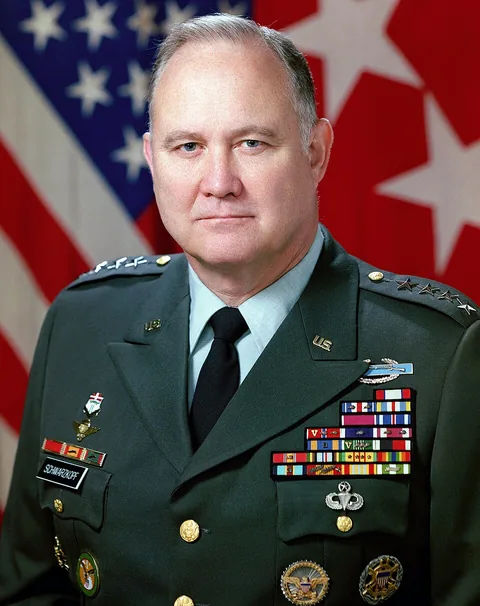
Official Army portrait of General H. Norman Schwarzkopf Jr., 1988.1988-11-09Photo: · Public domain (Work of a U.S. Army soldier or employee, taken or made as part of official duties (Commons template PD-USGov-Military-Army).) · Wikimedia Commons 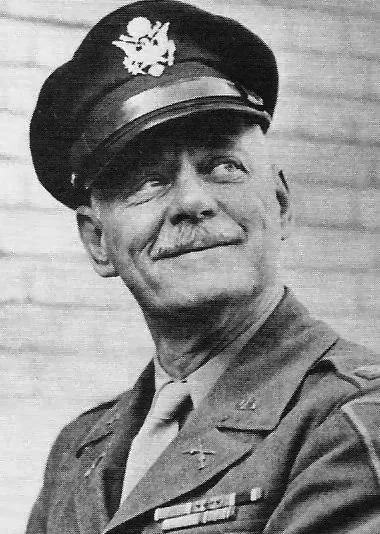
Major General Herbert Norman Schwarzkopf Sr., the general's father and the first superintendent of the New Jersey State Police.undatedPhoto: · Public domain · Wikimedia Commons 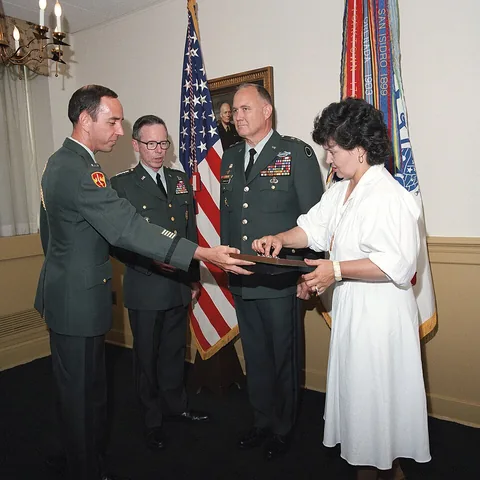
Brenda Schwarzkopf picks up the three-star insignia from its case as she and Gen. Maxwell R. Thurman prepare to pin the stars on her husband at the Pentagon.1986-05-30Photo: · Public domain (Work of a U.S. Army soldier or employee (National Archives record NAID 6458665); Commons states it is public domain in the United States.) · Wikimedia Commons 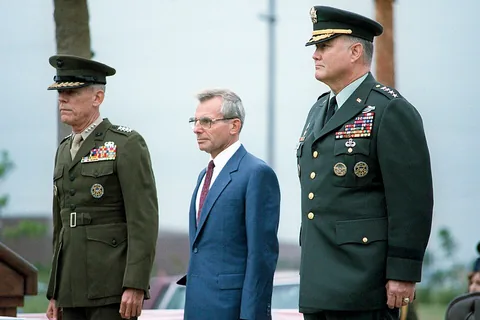
Defense Secretary Frank Carlucci presides as Marine Gen. George Crist hands U.S. Central Command to Schwarzkopf.1988-11-01Photo: · Public domain (Commons states it is a work of a U.S. Army soldier or employee made as part of official duties.) · Wikimedia Commons 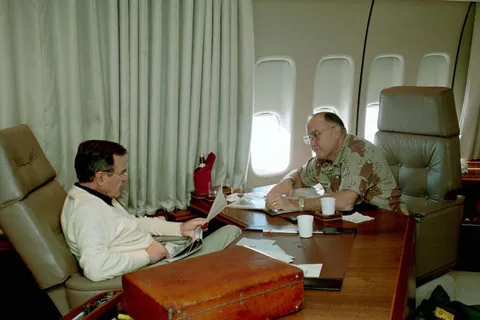
President George H. W. Bush meets with Schwarzkopf aboard Air Force One.1990-11-22Photo: · Public domain · Wikimedia Commons 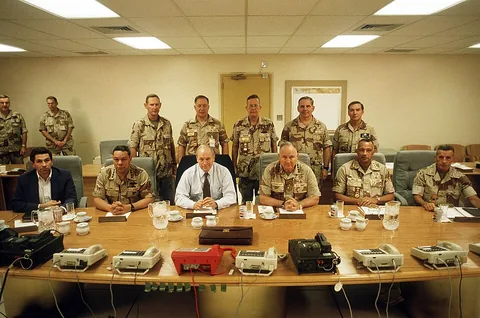
Civilian and military leaders, including Dick Cheney, Colin Powell, Paul Wolfowitz, and Schwarzkopf, pose before a Persian Gulf strategy discussion during Operation Desert Shield.1990-12-01Photo: · Public domain (Commons states it is a work of a U.S. military or Department of Defense employee made as part of official duties.) · Wikimedia Commons 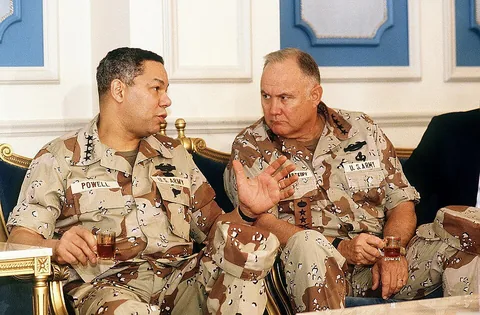
Gen. Colin Powell and Gen. Schwarzkopf in conversation during the Gulf crisis.1990-1991Photo: · Public domain (Commons states it is a work of a U.S. Army soldier or employee made as part of official duties.) · Wikimedia Commons 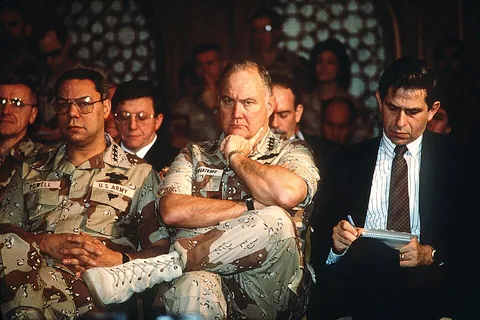
Paul Wolfowitz takes notes while Gen. Colin Powell and Gen. Schwarzkopf listen to Defense Secretary Dick Cheney answer questions during Operation Desert Storm.circa 1991-02Photo: · Public domain (Commons states it is a work of a U.S. military or Department of Defense employee made as part of official duties.) · Wikimedia Commons 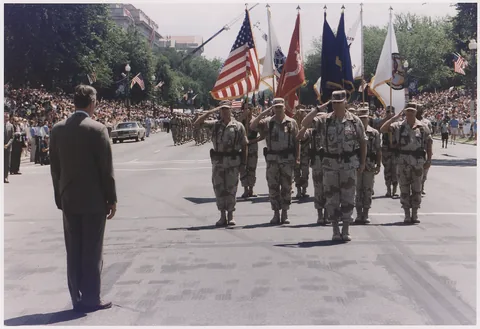
President Bush greets Schwarzkopf, who led the National Victory Celebration parade in Washington, D.C.1991-06-08Photo: · Public domain · Wikimedia Commons 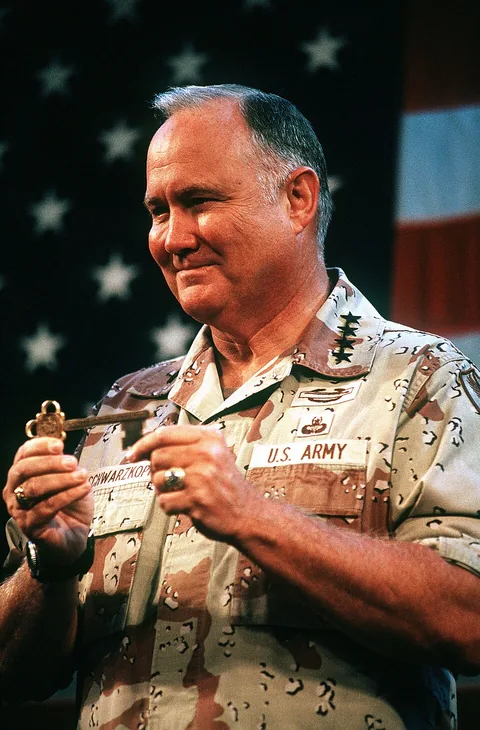
Schwarzkopf displays his key to New York City during the Desert Storm Welcome Home parade.1991-06-10Photo: · Public domain (Commons states it is a work prepared by a U.S. federal government employee as part of official duties (National Archives NAID 6481475).) · Wikimedia Commons 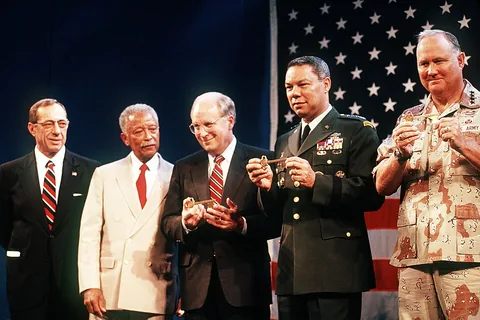
Governor Mario Cuomo presents keys to New York City to Defense Secretary Dick Cheney, Gen. Colin Powell, and Schwarzkopf before the Desert Storm Welcome Home celebration.1991-06-10Photo: · Public domain · Wikimedia Commons 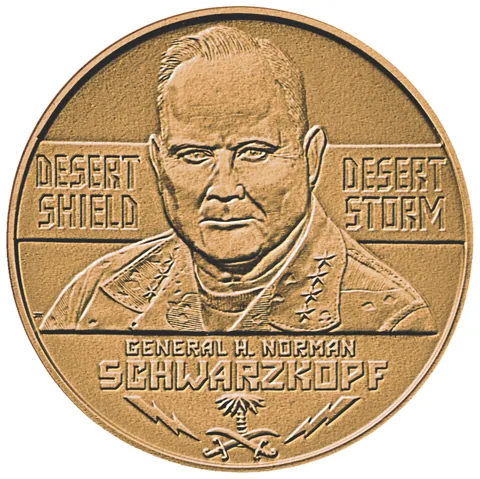
The front of the medal struck in Schwarzkopf's honor, as shown on the file page by the U.S. Mint.1991Photo: · Public domain · Wikimedia Commons 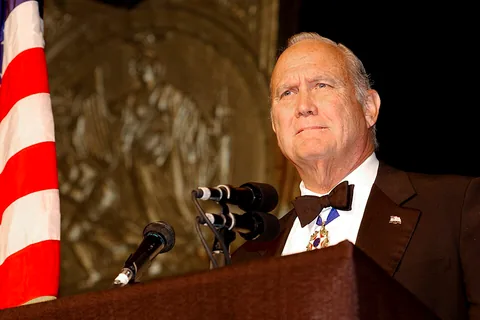
Retired Gen. Schwarzkopf gives an acceptance speech at a Congressional Medal of Honor Society ceremony in Shreveport, Louisiana.2002-09-12Photo: · Public domain (Commons states it is a work of a U.S. military employee made as part of official duties; the file page lists both Army and Air Force attributions.) · Wikimedia Commons 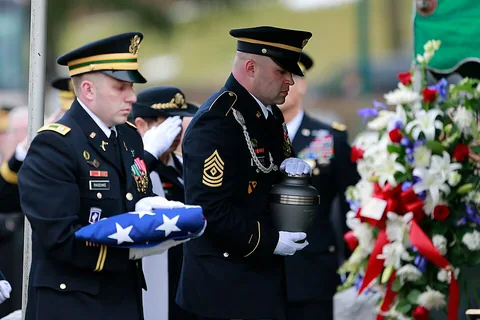
Memorial service for Schwarzkopf in the Cadet Chapel at West Point, 22 years to the day after Operation Desert Storm ended.2013-02-28Photo: · Public domain (Work of a U.S. Army soldier or employee made as part of official duties (Commons template PD-USGov-Military-Army).) · Wikimedia Commons 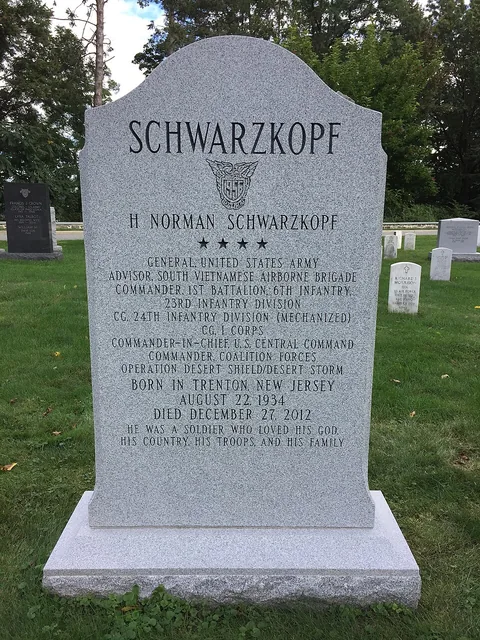
Schwarzkopf's grave in Section X of the West Point Cemetery.2013-02-28Photo: · Public domain (Commons states it is a work of a U.S. Army soldier or employee made as part of official duties.) · Wikimedia Commons


Watch and listen
- Booknotes: It Doesn't Take a Hero, with Brian Lamb
- Gen. Norman Schwarzkopf, Academy Class of 1991, Part 16
- Gen. Norman Schwarzkopf, Academy Class of 1991, Part 15
- Revisiting Interview with Gen. Norman Schwarzkopf (NewsHour interview recorded September 1990)
- Gen. Norman Schwarzkopf, 78, 'Stormin' Commander in Persian Gulf War
- The Gulf War (two-part documentary)
- From the Archives: General Schwarzkopf Desert Storm briefing
- General Schwarzkopf (funeral at West Point)
Read
About them
- In the Eye of the Storm: The Life of General H. Norman Schwarzkopf
- Schwarzkopf: In His Own Words
- Crusade: The Untold Story of the Gulf War
- The Generals
Notes
- C. Todd Lopez, "Schwarzkopf, Architect of Operation Desert Storm, Dies at 78," U.S. Army, December 28, 2012, https://www.army.mil/article/93595/schwarzkopf_architect_of_operation_desert_storm_dies_at_78. Command of CENTCOM and the coalition.↩1↩2
- "Norman Schwarzkopf Jr.," Wikipedia, accessed November 26, 2026, https://en.wikipedia.org/wiki/Norman_Schwarzkopf_Jr.. Early life.↩1↩2
- Mike Strasser, "Gen. Schwarzkopf Laid to Rest at West Point with Honor, Fond Memories," U.S. Army, March 4, 2013, https://www.army.mil/article/97469/. His father.↩1↩2
- "Norman Schwarzkopf Jr.," Wikipedia, accessed November 26, 2026, https://en.wikipedia.org/wiki/Norman_Schwarzkopf_Jr.. West Point class standing.↩1↩2
- "Norman Schwarzkopf Jr.," Wikipedia, accessed November 26, 2026, https://en.wikipedia.org/wiki/Norman_Schwarzkopf_Jr.. Summary of his Vietnam service.↩
- "Norman Schwarzkopf Jr.," Wikipedia, accessed November 26, 2026, https://en.wikipedia.org/wiki/Norman_Schwarzkopf_Jr.. Appointment to U.S. Central Command.↩1↩2↩3
- "Norman Schwarzkopf Jr.," Wikipedia, accessed November 26, 2026, https://en.wikipedia.org/wiki/Norman_Schwarzkopf_Jr.. The invasion of Kuwait.↩1↩2
- "Norman Schwarzkopf Jr.," Wikipedia, accessed November 26, 2026, https://en.wikipedia.org/wiki/Norman_Schwarzkopf_Jr.. Summary of Operation Desert Storm.↩
- "Gen. Norman Schwarzkopf, 78, 'Stormin' Commander in Persian Gulf War," PBS NewsHour, December 28, 2012, https://www.pbs.org/newshour/show/remembering-general-norman-schwarzkopf. His nickname.↩
- "Norman Schwarzkopf Jr.," Wikipedia, accessed November 26, 2026, https://en.wikipedia.org/wiki/Norman_Schwarzkopf_Jr.. His temper.↩
- "Norman Schwarzkopf Jr.," Wikipedia, accessed November 26, 2026, https://en.wikipedia.org/wiki/Norman_Schwarzkopf_Jr.. Retirement.↩1↩2↩3
- "Norman Schwarzkopf Jr.," Wikipedia, accessed November 26, 2026, https://en.wikipedia.org/wiki/Norman_Schwarzkopf_Jr.. The memoir.↩1↩2
- "Norman Schwarzkopf Jr.," Wikipedia, accessed November 26, 2026, https://en.wikipedia.org/wiki/Norman_Schwarzkopf_Jr.. Charitable causes.↩
- C. Todd Lopez, "Schwarzkopf, Architect of Operation Desert Storm, Dies at 78," U.S. Army, December 28, 2012, https://www.army.mil/article/93595/schwarzkopf_architect_of_operation_desert_storm_dies_at_78. Nickname and death.↩
- "Norman Schwarzkopf Jr.," Wikipedia, accessed November 26, 2026, https://en.wikipedia.org/wiki/Norman_Schwarzkopf_Jr.. The February 1970 friendly-fire incident.↩1↩2
- "Norman Schwarzkopf Jr.," Wikipedia, accessed November 26, 2026, https://en.wikipedia.org/wiki/Norman_Schwarzkopf_Jr.. Criticism after Grenada.↩1↩2↩3
- "Norman Schwarzkopf Jr.," Wikipedia, accessed November 26, 2026, https://en.wikipedia.org/wiki/Norman_Schwarzkopf_Jr.. Criticism of the cease-fire agreement.↩1↩2
- "Norman Schwarzkopf Jr.," Wikipedia, accessed November 26, 2026, https://en.wikipedia.org/wiki/Norman_Schwarzkopf_Jr.. The 1952 change to his birth certificate.↩
- H. Norman Schwarzkopf, interview, Academy of Achievement, Las Vegas, NV, June 26, 1992, https://achievement.org/achiever/general-h-norman-schwarzkopf/. On his father.↩1↩2
- "H. Norman Schwarzkopf," Encyclopedia.com, accessed November 26, 2026, https://www.encyclopedia.com/people/history/us-history-biographies/h-norman-schwarzkopf. His father's postwar assignments.↩
- "Norman Schwarzkopf Jr.," Wikipedia, accessed November 26, 2026, https://en.wikipedia.org/wiki/Norman_Schwarzkopf_Jr.. Childhood in Iran and Switzerland.↩
- H. Norman Schwarzkopf, interview, Academy of Achievement, Las Vegas, NV, June 26, 1992, https://achievement.org/achiever/general-h-norman-schwarzkopf/. On schooling in Iran.↩
- "Norman Schwarzkopf Jr.," Wikipedia, accessed November 26, 2026, https://en.wikipedia.org/wiki/Norman_Schwarzkopf_Jr.. Schools abroad and Valley Forge Military Academy.↩
- H. Norman Schwarzkopf, interview, Academy of Achievement, Las Vegas, NV, June 26, 1992, https://achievement.org/achiever/general-h-norman-schwarzkopf/. On sports.↩
- H. Norman Schwarzkopf, interview, Academy of Achievement, Las Vegas, NV, June 26, 1992, https://achievement.org/achiever/general-h-norman-schwarzkopf/. On his West Point class standing.↩
- Mike Strasser, "Gen. Schwarzkopf Laid to Rest at West Point with Honor, Fond Memories," U.S. Army, March 4, 2013, https://www.army.mil/article/97469/. Cynthia Schwarzkopf's tribute.↩
- "Norman Schwarzkopf Jr.," Wikipedia, accessed November 26, 2026, https://en.wikipedia.org/wiki/Norman_Schwarzkopf_Jr.. First assignment.↩
- "Norman Schwarzkopf Jr.," Wikipedia, accessed November 26, 2026, https://en.wikipedia.org/wiki/Norman_Schwarzkopf_Jr.. Aide-de-camp in Berlin.↩
- "Norman Schwarzkopf Jr.," Wikipedia, accessed November 26, 2026, https://en.wikipedia.org/wiki/Norman_Schwarzkopf_Jr.. Graduate study and West Point instructor tour.↩
- "Norman Schwarzkopf Jr.," Wikipedia, accessed November 26, 2026, https://en.wikipedia.org/wiki/Norman_Schwarzkopf_Jr.. Volunteering for Vietnam.↩
- "Norman Schwarzkopf Jr.," Wikipedia, accessed November 26, 2026, https://en.wikipedia.org/wiki/Norman_Schwarzkopf_Jr.. First Vietnam tour.↩
- "H. Norman Schwarzkopf, Awards and Citations," Hall of Valor, Military Times, accessed November 26, 2026, https://valor.militarytimes.com/?p=282420. Silver Star citations for 1965 and 1966.↩
- H. Norman Schwarzkopf, interview, Academy of Achievement, Las Vegas, NV, June 26, 1992, https://achievement.org/achiever/general-h-norman-schwarzkopf/. On returning from Vietnam in 1966.↩
- "Norman Schwarzkopf Jr.," Wikipedia, accessed November 26, 2026, https://en.wikipedia.org/wiki/Norman_Schwarzkopf_Jr.. Second Vietnam tour.↩
- H. Norman Schwarzkopf, interview, Academy of Achievement, Las Vegas, NV, June 26, 1992, https://achievement.org/achiever/general-h-norman-schwarzkopf/. On the artillery incident.↩1↩2
- "Norman Schwarzkopf Jr.," Wikipedia, accessed November 26, 2026, https://en.wikipedia.org/wiki/Norman_Schwarzkopf_Jr.. The soldier's parents and Schwarzkopf's answer.↩1↩2
- "Norman Schwarzkopf Jr.," Wikipedia, accessed November 26, 2026, https://en.wikipedia.org/wiki/Norman_Schwarzkopf_Jr.. The minefield incident.↩1↩2↩3
- H. Norman Schwarzkopf, interview, Academy of Achievement, Las Vegas, NV, June 26, 1992, https://achievement.org/achiever/general-h-norman-schwarzkopf/. On the minefield.↩1↩2
- "Norman Schwarzkopf Jr.," Wikipedia, accessed November 26, 2026, https://en.wikipedia.org/wiki/Norman_Schwarzkopf_Jr.. Awards for the second tour.↩
- H. Norman Schwarzkopf, interview, Academy of Achievement, Las Vegas, NV, June 26, 1992, https://achievement.org/achiever/general-h-norman-schwarzkopf/. On Vietnam.↩1↩2
- "Norman Schwarzkopf Jr.," Wikipedia, accessed November 26, 2026, https://en.wikipedia.org/wiki/Norman_Schwarzkopf_Jr.. Deciding to stay in the Army.↩1↩2↩3
- "H. Norman Schwarzkopf," Encyclopedia.com, accessed November 26, 2026, https://www.encyclopedia.com/people/history/us-history-biographies/h-norman-schwarzkopf. Alaska and Fort Lewis.↩
- "Norman Schwarzkopf Jr.," Wikipedia, accessed November 26, 2026, https://en.wikipedia.org/wiki/Norman_Schwarzkopf_Jr.. Promotion to brigadier general.↩1↩2
- "Norman Schwarzkopf Jr.," Wikipedia, accessed November 26, 2026, https://en.wikipedia.org/wiki/Norman_Schwarzkopf_Jr.. Command of the 24th Infantry Division.↩
- "Norman Schwarzkopf Jr.," Wikipedia, accessed November 26, 2026, https://en.wikipedia.org/wiki/Norman_Schwarzkopf_Jr.. His role in the invasion of Grenada.↩
- "Norman Schwarzkopf Jr.," Wikipedia, accessed November 26, 2026, https://en.wikipedia.org/wiki/Norman_Schwarzkopf_Jr.. Named deputy commander in Grenada.↩1↩2
- National Archives and Records Administration, photograph DA-SC-91-09549 (NAID 6458665), by Helene C. Stikkel, May 30, 1986, as described on Wikimedia Commons, https://commons.wikimedia.org/wiki/File:Major_General_H._Norman_Schwarzkopf_Jr._is_promoted_to_Lieutenant_General_DA-SC-91-09549_(6458665).jpg.↩1↩2
- "Norman Schwarzkopf Jr.," Wikipedia, accessed November 26, 2026, https://en.wikipedia.org/wiki/Norman_Schwarzkopf_Jr.. Promotion to lieutenant general and I Corps.↩1↩2
- "Norman Schwarzkopf Jr.," Wikipedia, accessed November 26, 2026, https://en.wikipedia.org/wiki/Norman_Schwarzkopf_Jr.. Pentagon post and the United Nations Military Staff Committee.↩
- H. Norman Schwarzkopf, interview, Academy of Achievement, Las Vegas, NV, June 26, 1992, https://achievement.org/achiever/general-h-norman-schwarzkopf/. On planning for the worst-case scenario.↩1↩2
- "Norman Schwarzkopf Jr.," Wikipedia, accessed November 26, 2026, https://en.wikipedia.org/wiki/Norman_Schwarzkopf_Jr.. The Internal Look '90 exercise.↩1↩2
- H. Norman Schwarzkopf, oral history interview, The Gulf War, FRONTLINE, PBS, accessed November 26, 2026, https://www.pbs.org/wgbh/pages/frontline/gulf/oral/schwarzkopf/1.html. On Saudi approval.↩
- H. Norman Schwarzkopf, oral history interview, The Gulf War, FRONTLINE, PBS, accessed November 26, 2026, https://www.pbs.org/wgbh/pages/frontline/gulf/oral/schwarzkopf/1.html. On the absence of a strategic directive.↩1↩2↩3
- H. Norman Schwarzkopf, oral history interview, The Gulf War, FRONTLINE, PBS, accessed November 26, 2026, https://www.pbs.org/wgbh/pages/frontline/gulf/oral/schwarzkopf/1.html. On setting his own objectives.↩1↩2
- H. Norman Schwarzkopf, oral history interview, The Gulf War, FRONTLINE, PBS, accessed November 26, 2026, https://www.pbs.org/wgbh/pages/frontline/gulf/oral/schwarzkopf/1.html. On the end game.↩1↩2↩3↩4
- H. Norman Schwarzkopf, oral history interview, The Gulf War, FRONTLINE, PBS, accessed November 26, 2026, https://www.pbs.org/wgbh/pages/frontline/gulf/oral/schwarzkopf/1.html. On the four-phase campaign.↩
- H. Norman Schwarzkopf, oral history interview, The Gulf War, FRONTLINE, PBS, accessed November 26, 2026, https://www.pbs.org/wgbh/pages/frontline/gulf/oral/schwarzkopf/1.html. On Scud policy.↩
- H. Norman Schwarzkopf, oral history interview, The Gulf War, FRONTLINE, PBS, accessed November 26, 2026, https://www.pbs.org/wgbh/pages/frontline/gulf/oral/schwarzkopf/1.html. On early offensive options.↩
- H. Norman Schwarzkopf, oral history interview, The Gulf War, FRONTLINE, PBS, accessed November 26, 2026, https://www.pbs.org/wgbh/pages/frontline/gulf/oral/schwarzkopf/1.html. On the ground plan.↩1↩2
- "Norman Schwarzkopf Jr.," Wikipedia, accessed November 26, 2026, https://en.wikipedia.org/wiki/Norman_Schwarzkopf_Jr.. Start of the air campaign.↩
- "Norman Schwarzkopf Jr.," Wikipedia, accessed November 26, 2026, https://en.wikipedia.org/wiki/Norman_Schwarzkopf_Jr.. Start of the ground campaign.↩
- C. Todd Lopez, "Schwarzkopf, Architect of Operation Desert Storm, Dies at 78," U.S. Army, December 28, 2012, https://www.army.mil/article/93595/schwarzkopf_architect_of_operation_desert_storm_dies_at_78. The 100-hour ground war and the "left hook."↩
- "Norman Schwarzkopf Jr.," Wikipedia, accessed November 26, 2026, https://en.wikipedia.org/wiki/Norman_Schwarzkopf_Jr.. Briefings for journalists.↩1↩2
- National Geospatial-Intelligence Agency, "Operation Desert Storm and Lessons from the Mother of All Briefings," DVIDS, February 27, 2026, https://www.dvidshub.net/news/559063/operation-desert-storm-and-lessons-mother-all-briefings.↩
- "H. Norman Schwarzkopf," Encyclopedia.com, accessed November 26, 2026, https://www.encyclopedia.com/people/history/us-history-biographies/h-norman-schwarzkopf. The cease-fire meeting at Safwan.↩
- "Gen. Norman Schwarzkopf, 78, 'Stormin' Commander in Persian Gulf War," PBS NewsHour, December 28, 2012, https://www.pbs.org/newshour/show/remembering-general-norman-schwarzkopf. The joint session of Congress.↩
- David Valdez, White House Photograph Office, photograph of the Desert Storm Homecoming Parade, Washington, D.C., June 8, 1991 (National Archives, NAID 186434), as described on Wikimedia Commons, https://commons.wikimedia.org/wiki/File:President_Bush_greets_General_H._Norman_Schwarzkopf_who_leads_the_Desert_Storm_Homecoming_Parade_in_Washington,_D.C_-_NARA_-_186434.tif.↩1↩2
- SSGT. Charles Regner, photograph of Schwarzkopf with his key to New York City, June 10, 1991 (NAID 6481475), as described on Wikimedia Commons, https://commons.wikimedia.org/wiki/File:Schwarzkopf_showing_his_key_to_New_York_City.jpg.↩
- Booknotes, interview with Gen. Norman Schwarzkopf by Brian Lamb about It Doesn't Take a Hero (New York: Bantam Books, 1992), C-SPAN, November 22, 1992, https://booknotes.c-span.org/Watch/35014-1. On Peter Petre.↩
- Booknotes, interview with Gen. Norman Schwarzkopf by Brian Lamb about It Doesn't Take a Hero (New York: Bantam Books, 1992), C-SPAN, November 22, 1992, https://booknotes.c-span.org/Watch/35014-1.↩
- "Norman Schwarzkopf Jr.," Wikipedia, accessed November 26, 2026, https://en.wikipedia.org/wiki/Norman_Schwarzkopf_Jr.. Prostate cancer.↩
- "1996: A Bigger Megaphone," Prostate Cancer Foundation, accessed November 26, 2026, https://www.pcf.org/?p=4635.↩
- Noelle Malfa, "Camp Boggy Creek Celebrates Co-Founder's Birthday and Lasting Legacy," Camp Boggy Creek, August 22, 2024, https://www.boggycreek.org/news/happy-birthday-general-norman-schwarzkopf-1.↩
- United States Mint, "General H. Norman Schwarzkopf Congressional Gold Medal" (front), 1991, as described on Wikimedia Commons, https://commons.wikimedia.org/wiki/File:General_H._Norman_Schwarzkopf_Congressional_Gold_Medal.jpg.↩
- "Norman Schwarzkopf Jr.," Wikipedia, accessed November 26, 2026, https://en.wikipedia.org/wiki/Norman_Schwarzkopf_Jr.. Honors.↩
- "Norman Schwarzkopf Jr.," Wikipedia, accessed November 26, 2026, https://en.wikipedia.org/wiki/Norman_Schwarzkopf_Jr.. The 2003 invasion of Iraq.↩
- "Norman Schwarzkopf Jr.," Wikipedia, accessed November 26, 2026, https://en.wikipedia.org/wiki/Norman_Schwarzkopf_Jr.. Criticism of Donald Rumsfeld.↩
- "Remembering Gulf War Commander Norman Schwarzkopf," PBS NewsHour, December 28, 2012, https://www.pbs.org/newshour/nation/general-stormin-norman-schwarzkopf-dies-at-78.↩
- "Norman Schwarzkopf Jr.," Wikipedia, accessed November 26, 2026, https://en.wikipedia.org/wiki/Norman_Schwarzkopf_Jr.. Death.↩
- "Gen. Norman Schwarzkopf, 78, 'Stormin' Commander in Persian Gulf War," PBS NewsHour, December 28, 2012, https://www.pbs.org/newshour/show/remembering-general-norman-schwarzkopf. President George H. W. Bush's statement.↩
- "Norman Schwarzkopf Jr.," Wikipedia, accessed November 26, 2026, https://en.wikipedia.org/wiki/Norman_Schwarzkopf_Jr.. Memorial service.↩
- Mike Strasser, "Gen. Schwarzkopf Laid to Rest at West Point with Honor, Fond Memories," U.S. Army, March 4, 2013, https://www.army.mil/article/97469/. Burial at the West Point Cemetery.↩
- Mike Strasser, "Gen. Schwarzkopf Laid to Rest at West Point with Honor, Fond Memories," U.S. Army, March 4, 2013, https://www.army.mil/article/97469/. Leroy Suddath's tribute.↩
- Mike Strasser, "Gen. Schwarzkopf Laid to Rest at West Point with Honor, Fond Memories," U.S. Army, March 4, 2013, https://www.army.mil/article/97469/. Colin Powell's tribute.↩
- H. Norman Schwarzkopf, interview, Academy of Achievement, Las Vegas, NV, June 26, 1992, https://achievement.org/achiever/general-h-norman-schwarzkopf/. On doubt and preparation.↩1↩2
- H. Norman Schwarzkopf, interview, Academy of Achievement, Las Vegas, NV, June 26, 1992, https://achievement.org/achiever/general-h-norman-schwarzkopf/. On Rules 13 and 14.↩1↩2↩3
- H. Norman Schwarzkopf, interview, Academy of Achievement, Las Vegas, NV, June 26, 1992, https://achievement.org/achiever/general-h-norman-schwarzkopf/. On leadership.↩1↩2
- "Norman Schwarzkopf Jr.," Wikipedia, accessed November 26, 2026, https://en.wikipedia.org/wiki/Norman_Schwarzkopf_Jr.. Leading from the front.↩
- H. Norman Schwarzkopf, oral history interview, The Gulf War, FRONTLINE, PBS, accessed November 26, 2026, https://www.pbs.org/wgbh/pages/frontline/gulf/oral/schwarzkopf/1.html. On ending the war.↩1↩2↩3
- H. Norman Schwarzkopf, interview, Academy of Achievement, Las Vegas, NV, June 26, 1992, https://achievement.org/achiever/general-h-norman-schwarzkopf/. On fighting the Gulf War.↩
- H. Norman Schwarzkopf, interview, Academy of Achievement, Las Vegas, NV, June 26, 1992, https://achievement.org/achiever/general-h-norman-schwarzkopf/. On Colin Powell.↩
- H. Norman Schwarzkopf, oral history interview, The Gulf War, FRONTLINE, PBS, accessed November 26, 2026, https://www.pbs.org/wgbh/pages/frontline/gulf/oral/schwarzkopf/1.html. On briefing his commanders.↩
- H. Norman Schwarzkopf, interview, Academy of Achievement, Las Vegas, NV, June 26, 1992, https://achievement.org/achiever/general-h-norman-schwarzkopf/. On the press.↩1↩2
- H. Norman Schwarzkopf, interview, Academy of Achievement, Las Vegas, NV, June 26, 1992, https://achievement.org/achiever/general-h-norman-schwarzkopf/. On courage and fear.↩1↩2↩3
- H. Norman Schwarzkopf, interview, Academy of Achievement, Las Vegas, NV, June 26, 1992, https://achievement.org/achiever/general-h-norman-schwarzkopf/. On self-criticism.↩
- "Norman Schwarzkopf Jr.," Wikipedia, accessed November 26, 2026, https://en.wikipedia.org/wiki/Norman_Schwarzkopf_Jr.. Deaths in the minefield.↩
- "H. Norman Schwarzkopf, Awards and Citations," Hall of Valor, Military Times, accessed November 26, 2026, https://valor.militarytimes.com/?p=282420. Silver Star citation for the minefield rescue.↩
- H. Norman Schwarzkopf, interview, Academy of Achievement, Las Vegas, NV, June 26, 1992, https://achievement.org/achiever/general-h-norman-schwarzkopf/. On returning from Vietnam in 1970.↩
- "Gen. Norman Schwarzkopf, Academy Class of 1991, Part 15," Academy of Achievement, accessed November 26, 2026, https://achievement.org/video/norman-schwarzkopf-15/.↩1↩2
- "Norman Schwarzkopf Jr.," Wikipedia, accessed November 26, 2026, https://en.wikipedia.org/wiki/Norman_Schwarzkopf_Jr.. The Army War College Study on Military Professionalism.↩
- Sharon Tosi Lacey, "How the Invasion of Grenada Was Planned with a Tourist Map and a Copy of 'The Economist,'" Military Times, October 25, 2018, https://www.militarytimes.com/veterans/military-history/2018/10/25/how-the-invasion-of-grenada-was-planned-with-a-tourist-map-and-a-copy-of-the-economist/. His assignment as Metcalf's adviser.↩
- Sharon Tosi Lacey, "How the Invasion of Grenada Was Planned with a Tourist Map and a Copy of 'The Economist,'" Military Times, October 25, 2018, https://www.militarytimes.com/veterans/military-history/2018/10/25/how-the-invasion-of-grenada-was-planned-with-a-tourist-map-and-a-copy-of-the-economist/. Planning time and intelligence.↩
- Sharon Tosi Lacey, "How the Invasion of Grenada Was Planned with a Tourist Map and a Copy of 'The Economist,'" Military Times, October 25, 2018, https://www.militarytimes.com/veterans/military-history/2018/10/25/how-the-invasion-of-grenada-was-planned-with-a-tourist-map-and-a-copy-of-the-economist/. Radio frequencies and maps.↩
- Sharon Tosi Lacey, "How the Invasion of Grenada Was Planned with a Tourist Map and a Copy of 'The Economist,'" Military Times, October 25, 2018, https://www.militarytimes.com/veterans/military-history/2018/10/25/how-the-invasion-of-grenada-was-planned-with-a-tourist-map-and-a-copy-of-the-economist/. On the Goldwater-Nichols Act.↩
- "Norman Schwarzkopf Jr.," Wikipedia, accessed November 26, 2026, https://en.wikipedia.org/wiki/Norman_Schwarzkopf_Jr.. Lessons of Grenada.↩
- "Norman Schwarzkopf Jr.," Wikipedia, accessed November 26, 2026, https://en.wikipedia.org/wiki/Norman_Schwarzkopf_Jr.. Thomas E. Ricks's criticism.↩
- "Norman Schwarzkopf Jr.," Wikipedia, accessed November 26, 2026, https://en.wikipedia.org/wiki/Norman_Schwarzkopf_Jr.. Ricks's conclusion.↩
- "Gen. Norman Schwarzkopf, 78, 'Stormin' Commander in Persian Gulf War," PBS NewsHour, December 28, 2012, https://www.pbs.org/newshour/show/remembering-general-norman-schwarzkopf. Michael Gordon on the Republican Guard.↩
- "Gen. Norman Schwarzkopf, 78, 'Stormin' Commander in Persian Gulf War," PBS NewsHour, December 28, 2012, https://www.pbs.org/newshour/show/remembering-general-norman-schwarzkopf. Michael Gordon on the decision to stop the war.↩
- H. Norman Schwarzkopf, oral history interview, The Gulf War, FRONTLINE, PBS, accessed November 26, 2026, https://www.pbs.org/wgbh/pages/frontline/gulf/oral/schwarzkopf/1.html. On the decision in Washington to stop the war.↩
- H. Norman Schwarzkopf, oral history interview, The Gulf War, FRONTLINE, PBS, accessed November 26, 2026, https://www.pbs.org/wgbh/pages/frontline/gulf/oral/schwarzkopf/1.html. On the decision to stop the war.↩
- "Norman Schwarzkopf Jr.," Wikipedia, accessed November 26, 2026, https://en.wikipedia.org/wiki/Norman_Schwarzkopf_Jr.. Schwarzkopf's later statement on continuing the offensive.↩
- H. Norman Schwarzkopf, interview, Academy of Achievement, Las Vegas, NV, June 26, 1992, https://achievement.org/achiever/general-h-norman-schwarzkopf/. Advice to young people.↩1↩2
- U.S. Central Command, "Press Briefing 27 FEB 91," transcript of briefing by Gen. H. Norman Schwarzkopf, Riyadh, February 27, 1991, page 10 of 17, GulfLink, https://gulflink.health.mil/declassdocs/centcom/19960318/doc53_10.html. The scanned text is partly garbled.↩
- Sarah Sicard, "4 Badass Schwarzkopf Quotes in Honor of the 25th Gulf War Anniversary," Task & Purpose, January 18, 2016, https://taskandpurpose.com/news/5-badass-schwarzkopf-quotes-in-honor-of-the-25th-gulf-war-anniversary/.↩
- "Norman Schwarzkopf Jr.," Wikiquote, accessed November 26, 2026, https://en.wikiquote.org/wiki/Norman_Schwarzkopf. Lists the quote from the Barbara Walters interview (March 15, 1991) and from H. Norman Schwarzkopf, It Doesn't Take a Hero (1992), xiii.↩