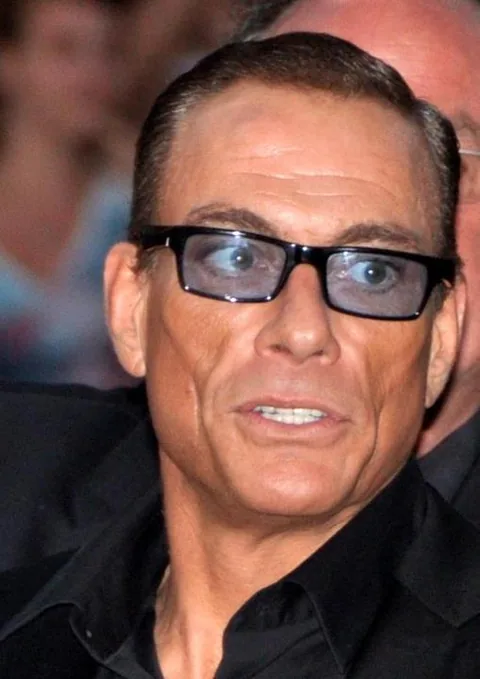

actor, martial artist, film director, film producer
Jean-Claude Van Damme
Also known as Jean-Claude Camille François Van Varenberg, JCVD, The Muscles from Brussels
Born in Berchem-Sainte-Agathe, Brussels, Belgium
Belgian actor and martial artist, best known for Bloodsport, Kickboxer, Universal Soldier, and Timecop. He has spoken publicly about cocaine addiction and bipolar disorder, and his career recovered after he played himself in JCVD (2008).
Official and reference links
- Official website (JCVD World)Official
- Official biography pageOfficial
- WikipediaReference
- WikiquoteReference
- Official YouTube channelVideo
- Wikimedia Commons categoryArchive
- IMDbOther
Overview
Jean-Claude Van Damme was born Jean-Claude Camille François Van Varenberg on October 18, 1960, in Berchem-Sainte-Agathe, Brussels, and is a Belgian martial artist and actor.[1][2] His father enrolled him in a martial arts school as a boy, and he later added weight training and five years of ballet.[1] In 1982 he and his friend Michel Qissi moved to the United States hoping to become stars.[1]
His breakthrough was Bloodsport, a $1.5 million film that became a box-office hit in 1988.[1][2]Kickboxer, Universal Soldier, Hard Target, and Timecop followed, and at the height of his career he was one of the biggest action stars in the world.[2][3] The fall was fast. The Guardian wrote that after Timecop he demanded $20 million a film when Universal offered $12 million, and he said, "I was on the blacklist."[4] In 1998 he confessed to a cocaine addiction, and Rolling Stone reports he was diagnosed with bipolar disorder in the late 1990s.[5][6] By 2008, Time wrote, his films had been going direct to video for a decade.[7]
The comeback began when he played a worn-down version of himself in JCVD (2008), and it continued with The Expendables 2 (2012), a viral Volvo Trucks ad in 2013, and the Amazon series Jean-Claude Van Johnson (2017).[7][2][6] This profile is dated November 27, 2026. Wikipedia, read that day, lists credits as recent as 2024, and the more recent facts here rest on it.[2]
Life
1960–1975
A shy kid in Brussels
Jean-Claude Van Varenberg was born on October 18, 1960, in Berchem-Sainte-Agathe, Brussels, the son of Eliana and Eugène Van Varenberg, who worked as an accountant and a florist.[1][2] The journalist Jeremy Duns, who interviewed him in 2003, wrote that by all accounts he was a shy and sensitive boy who liked comic books and admired the physiques of superheroes such as the Silver Surfer.[8]
His father enrolled him in karate. The official site and Wikipedia say he began martial arts at ten, Duns says twelve, and Van Damme told The A.V. Club eleven, so the starting age is reported three ways.[1][2][8][9] The official site says that at ten or eleven he joined Belgium's National Center of Karate under Claude Goetz. Goetz, who still ran his school when Duns visited, told Duns the boy was "weak, short and wore glasses" but keen to learn.[1][8] According to the official site, he trained there for four years, earned a spot on the Belgian team, and later trained in full contact with Dominique Valera; Wikipedia says that training covered full-contact karate and kickboxing.[1][2]
He has said that at thirteen or fourteen he played make-believe games with friends, staging a deal gone wrong and a shootout in a living room, and that it was "kind of like rehearsing without knowing."[9] He later counted karate as his acting school: by the time of Bloodsport, he said, he had in effect rehearsed the part for more than twenty years.[9]
1975–1982
Karate, ballet, and a gym of his own
He began competing at fifteen. His official biography says that from 1976 to 1980 he compiled 44 wins and four defeats in tournament and non-tournament semi-contact matches, and that he was on the Belgian team that won the European championship on December 26, 1979, at the La Coupe Francois Persoons tournament in Brussels.[1] Those are the figures at the center of the record dispute covered in the setbacks section, and none of the pages read for this profile cites a federation record behind them.[1][10]
At sixteen he took up ballet and kept it for five years, and he began lifting weights, which his biography links to a Mr. Belgium bodybuilding title.[1] Wikipedia dates that title to 1978.[2] His ballet teacher, Monette Loza, told Duns he was extraordinarily flexible and that she thought she had finally found someone she could make into a dancer, but he told her, "I want to make lots of money."[8]
Duns reports that after a karate contest in Florida and a visit to Gold's Gym in California, he left school and, with his father's help, opened a gym in Brussels called the California at eighteen, telling visitors he would one day be a movie star.[8]The Hollywood Reporter says he saved money as a youth selling flowers before opening the gym, and Wikipedia adds that he took a loan for it, that it opened in 1979, and that at its peak it made $15,000 a month, until he sold it to move to the United States.[11][2] Duns says he also went to Hong Kong in 1979 to try to break into martial arts films, and nothing came of it.[8]
1982–1987
Broke in Los Angeles
The official site says that in 1982 he and his friend Michel Qissi moved to the United States hoping to become stars, and that both were cast as extras in Breakin'; Wikipedia calls Qissi a childhood friend.[1][2] Duns dates the move to 1981 and says he arrived with $2,000 in cash, worked as a chauffeur, carpet layer, bouncer, and pizza delivery boy, slept in a rented car, and showered at the gym.[8] Van Damme told The A.V. Club that for years he had no money and was "staying in a car, moving from place to place."[9]
He became friendly with Chuck Norris, and in 2019 he confirmed to The Hollywood Reporter that he had worked as a bouncer at Norris's bar in Long Beach and trained with Norris three days a week.[11] He kept a routine. Wikipedia says he ran every night in Santa Monica, trained at Gold's Gym afterward, and sent out his picture and résumé each week in answer to casting listings.[2]
His first sizable part was the Russian villain in No Retreat, No Surrender (1986).[1][2] He told The A.V. Club that he got the part at a casting session in a karate school, where a loud-mouthed fighter was showing off; he was asked to spar with him and knocked him out in front of everybody.[9] In 1987 he was cast as the creature in Predator, then replaced; accounts of why differ, and the setbacks section covers them.[2][11]
1988–1991
Bloodsport and the Cannon years
Bloodsport opened on February 26, 1988, from Cannon Films, on a $1.5 million budget, and became a hit in the United States that spring.[2] He has said that it "put me on the top."[9] In 2019 The Hollywood Reporter told a story he confirmed: the first cut was so bad that the screenwriter Sheldon Lettich called him in Thailand, where he was shooting Kickboxer, and begged him to come back. "I came back from Thailand, and we saw the cut and I wept," Van Damme recalled. By the magazine's account, he then begged producer Menahem Golan to let him re-cut the film and, with Lettich and the editor Carl Kress, delivered a much-improved version. Golan, who had planned to send the film to VHS, put it on one screen in New York, and the reaction convinced him to give it a proper release.[11]
How he got the part is told more than one way. Duns retells the story, which E! called Hollywood folklore, that in 1986 Van Damme aimed a 360-degree kick that stopped just short of Golan's face outside a Beverly Hills restaurant, and that Golan gave him his card.[8][10] Van Damme told The A.V. Club that Golan was excited to sign him after hearing he had played the Predator.[9] The film's earnings are reported differently too: Duns says $35 million, and E! said over $11 million.[8][10]
Cannon used him again. Kickboxer (1989) returned more than $50 million on a $3 million budget, and Cyborg, Death Warrant, Lionheart, and Double Impact followed through 1991.[2]
1992–1995
At the top of the box office
Universal Soldier (1992), directed by Roland Emmerich and co-starring Dolph Lundgren, grossed about $102 million worldwide on a $23 million budget, according to Wikipedia.[2] Van Damme told The A.V. Club that a good script, director, and cast, plus a studio release and good distribution, made the difference, and that he learned the importance of fighting for distribution very late in his career.[9]
He also pushed for Hard Target (1993). In his telling he told the Universal Pictures chairman, Tom Pollock, that he wanted to fly to Hong Kong to get the director John Woo; Pollock gave him a release date, and he chased Woo in Hong Kong and convinced him to make a film in the United States.[9]The A.V. Club notes that he went on to star in the first American films of Ringo Lam (Maximum Risk, 1996) and Tsui Hark (Double Team, 1997), and Wikipedia counts Woo, Tsui, and Lam as three Hong Kong filmmakers who made their Western debuts with him between 1993 and 1998.[9][2] Duns reports his pay climbing from a million dollars for Universal Soldier to $3 million for Hard Target and over $6 million for Street Fighter.[8]
Timecop (1994) grossed over $100 million worldwide and, per Wikipedia, remains his highest-grossing film in a lead role; Street Fighter was poorly reviewed but made about three times its production cost.[2] Looper puts Timecop's domestic take at $44 million, the most of any live-action film he has headlined.[3]
1996–2007
The slide and the direct-to-video years
He directed and starred in The Quest (1996), which Wikipedia says under-performed in the United States but did better abroad.[2] Later films did worse: Knock Off (1998) flopped, Legionnaire (1998) got no U.S. theatrical release, and Universal Soldier: The Return (1999) opened at number four and was his last theatrical release until 2008.[2]The A.V. Club wrote in 2008 that by the late 1990s his films were going direct to DVD, and Rolling Stone wrote in 2017 that many of his films since 2001 had come out direct-to-video.[9][6]
In a 2008 interview he put the era's problems in his own words: he said that on Double Team (1997) he "wasn't really Jean-Claude Van Damme," that he was "less responsible," and that he was going through a divorce.[9] The setbacks section covers the addiction, the diagnosis, and the lost deal behind that stretch.[12][4]
2008–2017
JCVD and the return
JCVD (2008) cast him as himself, more or less, a has-been caught up in a bank robbery in Brussels. Time's Richard Corliss called it "the best movie Van Damme ever made," adding "(granted, not the highest encomium)," and singled out an unbroken six-and-a-half-minute close-up in which the star confesses his personal and career sins.[7] He then returned as Luc Deveraux alongside Lundgren in Universal Soldier: Regeneration (2009), which Wikipedia says went direct to video in the United States.[2]
In 2010 he turned down the part of Gunner Jensen in The Expendables.[2] Stallone has been reported as saying he balked at losing a fight to Jet Li's character. Van Damme told The Hollywood Reporter in 2019 that this was not true and that he was too busy with The Tower, a film he was directing, while Looper says he told the Guardian the conflict was his film The Eagle's Path.[11][3] In 2011 he voiced Master Croc in Kung Fu Panda 2.[2] In 2012 he played the villain in The Expendables 2, which grossed over $310 million worldwide.[2] On October 21, 2012, a statue of him was unveiled in Anderlecht, Brussels; he said it "represented the dream of a Brussels kid" and stood for "a guy from the street who believed in something."[2][3]
On November 13, 2013, Volvo Trucks released a 75-second ad in which he does the splits between two trucks driving backward.[13][2] Wikipedia says it drew more than 11 million views in its first three days.[2] In December 2017 Amazon released Jean-Claude Van Johnson, in which he plays a fictionalized, down-on-his-luck version of himself; Rolling Stone wrote that by his account it was his first production filmed in the United States in more than a decade.[6] Looper reports that Amazon canceled the series a few weeks later, in January 2018.[3]
2018–present
A long second act
The 2018 films Kickboxer: Retaliation, Black Water (with Lundgren), and The Bouncer were followed by We Die Young (2019).[2] Talking to The Hollywood Reporter that year, he said of his career, "I had my ups and downs," and the magazine wrote that he was no longer so focused on "the biceps and the ass muscles."[11] Wikipedia says he was inducted into the Martial Arts History Museum Hall of Fame in 2020, voiced Jean-Clawed in Minions: The Rise of Gru (2022), lent his likeness and voice to Johnny Cage in Mortal Kombat 1 (2023), and appeared in Darkness of Man (2024).[2] In 2022, the same article says, he was appointed the Democratic Republic of the Congo's ambassador on the environment.[2] Wikipedia also says his films have grossed over $3.3 billion worldwide.[2]
Habits and rituals
Stretching, but not too much
1970s–present
Rolling Stone called him "the kickboxing King of the Splits." At 57 he told the magazine that the secret is to keep stretching, but not too much: only three times a week, or you can inflame your tendons.[6] The magazine adds that his discipline comes from martial arts, which he called his real love and "the art of perfection."[6]
Ballet as cross-training
1976–1981
He studied ballet for five years from age sixteen and has said it is "an art, but it's also one of the most difficult sports."[1][2] His teacher Monette Loza told Duns that he would come to her class, do what he had to do, and then head off to the gym.[8] His official site describes ballet and bodybuilding as part of his own "scientific way of martial arts," meant to build balance, strength, and control.[1]
Running at night, training at Gold's
1982–1987
In his first lean years in Los Angeles, Wikipedia reports, he went for a run every night in Santa Monica and then trained at Gold's Gym, a routine that reportedly helped him get through those years.[2] Duns adds that while he was sleeping in a rented car, he showered at the gym.[8]
A weekly casting routine
1982–1987
Wikipedia describes a fixed weekly cycle: buy the casting magazine Drama-Logue on Wednesday, then mail his picture and résumé in answer to its listings on Thursday morning.[2] The article adds that he was willing to try anything to succeed, including calling studios with a made-up story about a Hong Kong investor so that producers would take his calls.[2]
Going after the people who could make it happen
1988–1993
When he saw how poor the first cut of Bloodsport was, he did not wait. By The Hollywood Reporter's account he came back from Thailand, begged Menahem Golan for a chance to re-cut the film, and worked on it with Lettich and an editor, after which Golan agreed to put the new version on one screen in New York.[11] With Hard Target, he says he asked Universal's chairman for a release date and then went to Hong Kong to bring John Woo to the United States.[9]
Soldier on set, student of the part
2000s–present
He told Rolling Stone that when he makes a movie, he is "completely focused," and that it is "like a different life. I'm like a soldier."[6] He told The A.V. Club that he learned from the director Ringo Lam, who told him "acting doesn't exist," that he had to go into a character and prepare: what family the man came from, how he behaved before the events of the film.[9] He said he understood this only in his last couple of films before 2008.[9]
Studying himself after the diagnosis
1998–present
Rolling Stone reports that after he was diagnosed with bipolar disorder in the late 1990s, he took the time to study himself, and that he credits training with helping him handle depression. He told the magazine he trains differently, eats differently, and tries to "talk less fast."[6] He described a simple routine off set: coffee at around ten in the morning, time with his dogs, the gym, and a slow ride home at night with his dog, and no trips to Las Vegas or Monaco.[6]
Setbacks and comebacks
Broke in Los Angeles, then replaced in Predator 1982–1988
What happened
His first years in the United States were thin. Duns reports he arrived with $2,000 and worked odd jobs, and he told The A.V. Club he was staying in a car.[8][9] In 1987 he was cast as the creature in Predator, then replaced. Wikipedia says he was replaced by Kevin Peter Hall and that he reportedly complained that the suit was too hot and made him pass out.[2]The Hollywood Reporter wrote that its 2017 oral history of the film held six differing accounts of his exit, from the studio deciding he was too short to a dust-up with producer Joel Silver.[11]
The cause
By his own account, the cause was the suit. The Hollywood Reporter, relaying his 2019 version, wrote that he started to panic in the cast, that the final costume put him on stilts and cut his mobility so much that he felt the stunts would be too dangerous, and that when Silver asked him to jump he said, "This is impossible, Joel," after which he was replaced.[11] He had earlier told The A.V. Club the outfit was "very unsecure, very dangerous."[9] Other accounts differ: Looper, for one, says he walked off after two days because the part left no room for his martial arts. This profile does not choose among them.[11][3]
The comeback
The comeback was Bloodsport. He told The A.V. Club that when Cannon's Menahem Golan heard he had played the Predator, Golan was excited to sign him, and that the Predator studio's money helped him stretch another year in Los Angeles.[9] After the film's first cut disappointed, he pushed to re-cut it with Lettich and an editor, which led to its proper release and to his run of Cannon films.[11][2]
The refused deal, cocaine, and the diagnosis 1993–2000
What happened
After Timecop, according to the Guardian's 2012 interview as reported by the NZ Herald, Universal offered him $12 million a film for a three-film deal and he demanded $20 million, "Like Jim Carrey." He said, "I was on the blacklist. That was it."[4] Looper says the offer was rescinded.[3] In 1998 Empire reported that he had confessed to a cocaine addiction and told Entertainment Weekly he had still been struggling a year earlier.[5] A Newhouse News Service story in The Seattle Times that September said that a year before, just after filming Knock Off, he had nearly overdosed on cocaine in a Hong Kong hotel room, and it described a six-day stint in rehabilitation and an acrimonious split from Darcy LaPier.[12] Duns writes that in 1996 he admitted the addiction and left a Los Angeles hospital after a week; the pages do not make clear whether that is the same stay.[8] Rolling Stone says he was diagnosed with bipolar disorder in the late 1990s, and Wikipedia dates the diagnosis to 1998.[6][2] On drunk driving, Wikipedia says he was arrested in 1999, Looper says he had a DUI charge by 1999, and Duns says he was fined in 2000.[2][3][8]
The cause
He gives several causes. Of the lost deal, he told the Guardian he was tired from making movie after movie with promotion in between, that "everything I was touching was making money," and that he wanted to "play with the system. Like an idiot."[4] Wikipedia says that, by his account, the stress of constant filming and promotion led to his cocaine habit between 1993 and 1996.[2] The Seattle Times story traced the start of a "tailspin" to 1993, when he divorced his third wife, Gladys Portugues, and courted Darcy LaPier.[12] On Double Team, he said he was "less responsible" and going through a divorce, adding, "I'm very sensitive, and sometimes when you have those obstacles in your life, it can derange the way we are normally."[9]
The comeback
The Seattle Times story described a "noticeably grayer and more subdued" Van Damme on David Letterman's show, saying he was taking care of his demons "day by day," and quoted him: "I lost some of my soul, but I came back."[12] Rolling Stone wrote that after the diagnosis he took the time to study himself; "I train differently, I eat differently, I'm trying to talk less fast," he said.[6] In JCVD (2008), Time's reviewer wrote, an unbroken close-up lets the star confess his personal and career sins, and Van Damme described the film to The A.V. Club as one in which "I almost do a therapy on the screen."[7][9] The career took about a decade longer to turn: JCVD, then The Expendables 2, then Jean-Claude Van Johnson.[2][6]
The Dux lawsuit and the fight-record dispute 1997–1998
What happened
In 1997 Frank Dux, the martial artist Van Damme played in Bloodsport, sued him in Los Angeles, saying he was owed $50,000 for co-writing and consulting on The Quest (1996).[14][3] The Las Vegas Sun reported, in September 1997, Dux's claim that "Van Damme had lied to the public that he was a martial arts champion," and his story that when he asked Van Damme to do a simple forward roll, "he landed on his head."[14] E! reported that Dux said he had been paid only $50,000 of the $100,000 due him, plus a percentage of the profits from The Quest, and that he wanted punitive damages because Van Damme had misrepresented himself as a world-class martial artist.[10] The same piece said that two years after Bloodsport opened, Howard Hanson, president of the World Karate Association, said he knew of only one amateur bout in Europe in which Van Damme had competed, and that Jim Baker, a writer for Black Belt magazine, called the actor "a complete fraud."[10] His lawyer, Martin Singer, said, "There are records to document his martial arts acclaim."[14][10] Accounts of what Dux sought differ: Empire put it at $900,000 in damages, and Looper says the claim was later raised to $1.5 million.[15][3] Empire reported on November 11, 1998, that a Los Angeles court had ruled for Van Damme in the breach-of-contract suit.[15]
The cause
The suit was a dispute over credit and money for The Quest: Empire says Dux claimed he co-wrote the film and was denied a screen credit and a share of the profits, and he used the case to attack the actor's claims about his martial arts past.[15][10] The record itself is hard to check. His official biography gives 44 wins and four defeats in semi-contact matches from 1976 to 1980. Wikipedia repeats that figure and adds 18 full-contact wins, all by knockout, and one loss from 1977 to 1982, a line it marks "citation needed."[1][2] Looper states both records as fact, and Time's 2008 review called him "the former European middleweight karate champ," but neither names a source.[3][7] None of the pages read for this profile cites a federation record behind either number.[1][2]
The comeback
He won the case: Empire said the jury found it extremely hard to believe Dux's claim that he had lost a tape of their oral agreement in an earthquake.[15] Looper says Dux talked of an appeal but that it does not seem he ever filed one.[3] The ruling concerned the contract claim. The pages read for this profile do not say it settled the question of his fight record, and they disagree on that record, so this profile gives both sides rather than a verdict.[15][10][1]
The direct-to-video years 1999–2008
What happened
After Universal Soldier: The Return (1999), Wikipedia says he had no theatrical release until JCVD in 2008.[2] Time wrote in 2008 that his films had been going direct to video for a decade.[7] He told Rolling Stone in 2017, "For a while, I was kind of forgotten there."[6] Duns's 2003 profile said that he, like Norris, Stallone, and Seagal, was discovering that his kind of testosterone-laden action film was no longer in fashion, and that his last three films had gone straight to video.[8]
The cause
Several causes overlapped. The lost studio deal and the turmoil of the late 1990s were part of it.[4][12] He also said that he missed out on experiences because he did not have an agent fighting for him the way he should have, adding, "I was really a loner without wanting to be."[9] Duns attributed the downturn partly to a change in fashion in action films.[8]
The comeback
In JCVD (2008) he played a worn-down version of himself, and Time called it his best film and "a cogent, probing, funny critique on celebrity."[7] He came back to blockbuster work in The Expendables 2 (2012), which grossed over $310 million, then to the Volvo ad (2013) and the Amazon series Jean-Claude Van Johnson (2017).[2][13][6] In 2017 he said, "I have been through so many situations in my life, where I say, 'OK, I am back up,'" and added, "There could be an earthquake tomorrow."[6]
In their own words
Bloodsport did well for me. It put me on the top. That movie was my trigger to success.[9]
Interview with Nathan Rabin, The A.V. Club (2008) · Source I rehearsed my part for more than 20 years, when you think about it, because I was training karate for 20 years, and that movie was full of karate that fit.[9]
Interview with Nathan Rabin, The A.V. Club (2008) · Source In this business, you need a good team of people protecting you, and I was really a loner without wanting to be.[9]
Interview with Nathan Rabin, The A.V. Club (2008) · Source I wasn't really Jean-Claude Van Damme. I was not me.[9]
Interview with Nathan Rabin, The A.V. Club (2008) · Source I'm very sensitive, and sometimes when you have those obstacles in your life, it can derange the way we are normally.[9]
Interview with Nathan Rabin, The A.V. Club (2008) · Source I'm not a movie star. I'm a brand name. Van Damme is like Levi's.[9]
Interview with Nathan Rabin, The A.V. Club (2008) · Source Everybody understands a slap in the face. In Japan, Belgium, or America, a punch is a punch.[9]
Interview with Nathan Rabin, The A.V. Club (2008) · Source I'm proud to say I started the Chinese flavor, when all these Chinese directors came to the States, because I really opened the gate for them.[9]
Interview with Nathan Rabin, The A.V. Club (2008) · Source When I make a movie, I'm completely focused. It's like a different life. I'm like a soldier.[6]
Interview with Kory Grow, Rolling Stone (2017) · Source You have to keep stretching. That's the secret.[6]
Interview with Kory Grow, Rolling Stone (2017) · Source I train differently, I eat differently, I'm trying to talk less fast because I have lots of passion for the project.[6]
Interview with Kory Grow, Rolling Stone (2017) · Source I'm better than yesterday.[6]
Interview with Kory Grow, Rolling Stone (2017) · Source For a while, I was kind of forgotten there.[6]
Interview with Kory Grow, Rolling Stone (2017) · Source I have been through so many situations in my life, where I say, 'OK, I am back up.'[6]
Interview with Kory Grow, Rolling Stone (2017) · Source Jim Carrey was being paid a fortune. And I wanted to play with the system. Like an idiot. Ridiculous.[4]
Interview with Alex Godfrey, The Guardian (2012), as reported by the NZ Herald · Source I was on the blacklist. That was it.[4]
Interview with Alex Godfrey, The Guardian (2012), as reported by the NZ Herald · Source I lost some of my soul, but I came back.[12]
Telephone interview with Joyce J. Persico, Newhouse News Service (September 1998) · Source Nobody can buy me. That's one thing that's beautiful about me in Hollywood. Nobody can put a leash around my neck. I say what I want.[11]
Interview with Aaron Couch and Patrick Shanley, The Hollywood Reporter (2019) · Source I came back from Thailand, and we saw the cut and I wept.[11]
Interview with Aaron Couch and Patrick Shanley, The Hollywood Reporter (2019) · Source I had my ups and downs.[11]
Interview with Aaron Couch and Patrick Shanley, The Hollywood Reporter (2019) · Source Belgium is paying me back something, but really it's to pay back to the dream. So when people come by here, it is not Jean-Claude van Damme but it's a guy from the street who believed in something. I want the statue to represent that.[2]
Remarks at the unveiling of his statue, Anderlecht, Brussels (October 2012), as quoted by Wikipedia · Source
Pictures
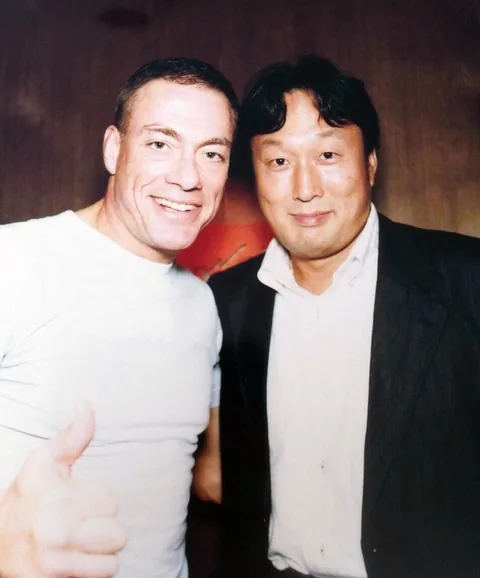
Van Damme with Junichi Matsushita at a film-production event in 2003.2003-01-30Photo: · CC BY-SA 4.0 · Wikimedia Commons 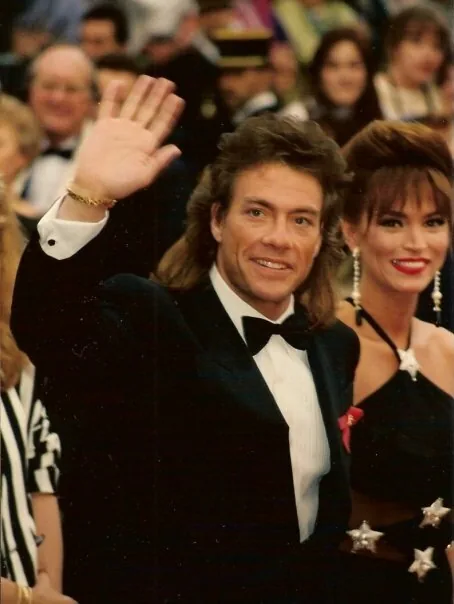
Van Damme at the Cannes Film Festival, with Darcy LaPier; Commons gives no date.undated on CommonsPhoto: · CC BY-SA 3.0 · Wikimedia Commons 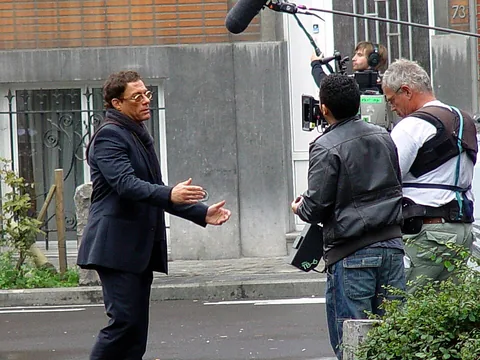
Van Damme on the set of JCVD in October 2007.2007-10-09Photo: · CC BY-SA 4.0 · Wikimedia Commons 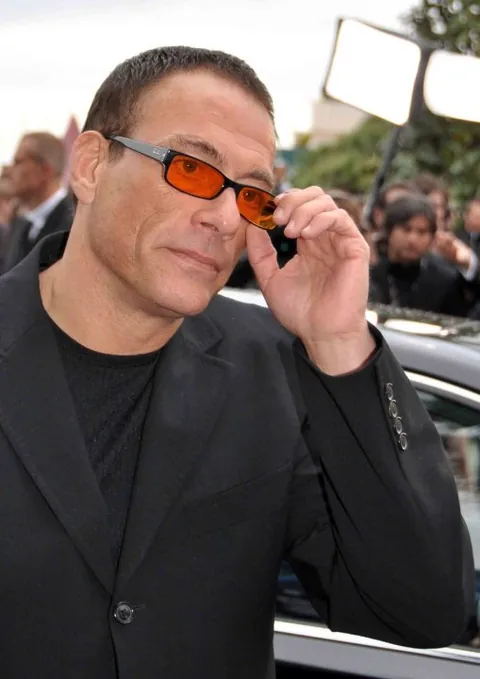
Van Damme at the Cannes Film Festival in 2010.2010Photo: · CC BY-SA 3.0 · Wikimedia Commons Van Damme in Paris at the French premiere of The Expendables 2, August 2012.2012-08-09Photo: · CC BY-SA 3.0 · Wikimedia Commons 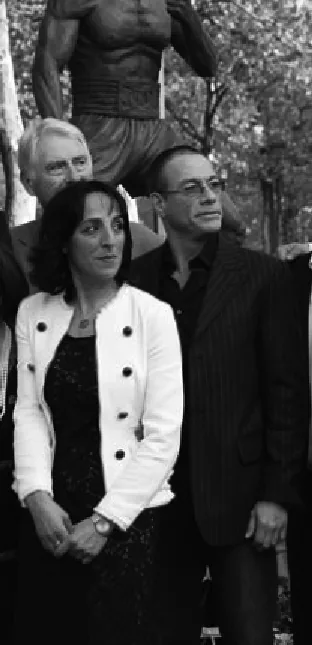
Van Damme with the Belgian culture minister Fadila Laanan in October 2012, the month a statue of him was unveiled in Anderlecht.2012-10-14Photo: · CC BY-SA 3.0 · Wikimedia Commons 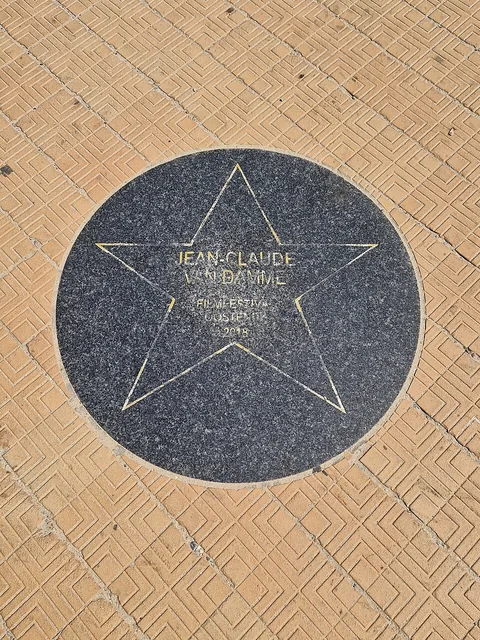
Van Damme at the Oostende Film Festival in 2018.2018Photo: · CC BY-SA 4.0 · Wikimedia Commons 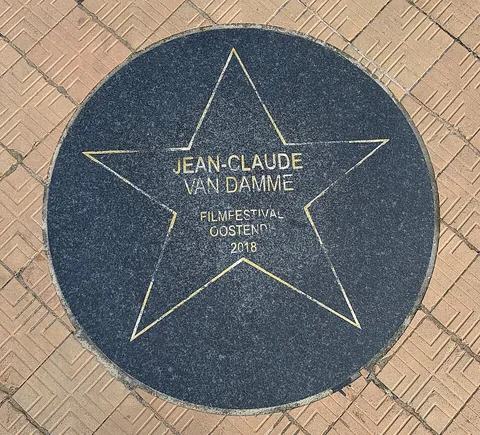
Van Damme's star on the Oostende Walk of Fame, laid for the 2018 film festival, photographed in October 2022.2022-10-27Photo: · CC BY-SA 4.0 · Wikimedia Commons 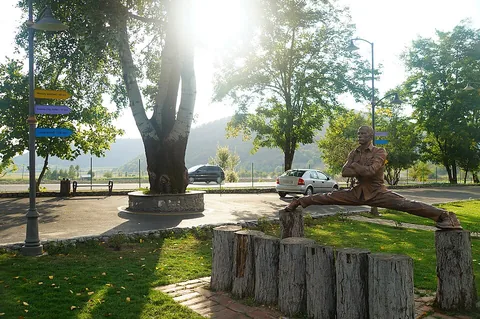
The Van Damme monument in the village of Vandam, Qabala, Azerbaijan, photographed in September 2022.2022-09-30Photo: · CC BY-SA 4.0 · Wikimedia Commons 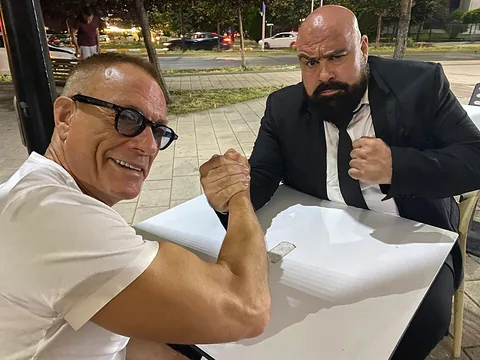
Van Damme with Afrim Ismaili, July 2023.2023-07-05Photo: · CC BY-SA 4.0 · Wikimedia Commons 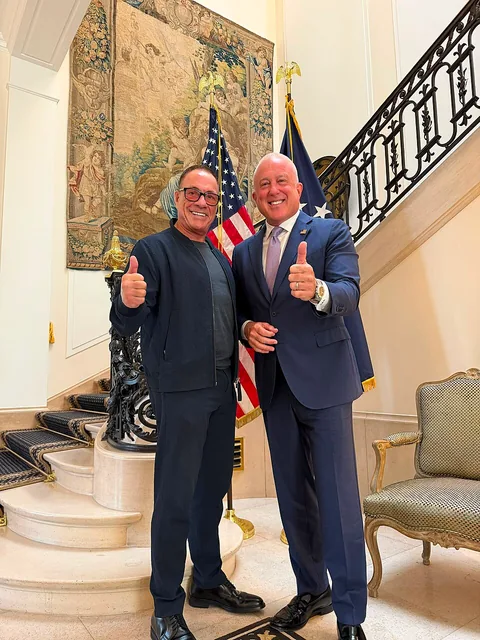
Van Damme (left) with U.S. Ambassador to Belgium Bill White, July 2026.2026-07-14Photo: · Public domain · Wikimedia Commons


Watch and listen
- Volvo Trucks - The Epic Split feat. Van Damme (Live Test)
- BLOODSPORT (1988) | Official Trailer | MGM
- The Expendables 2 (2012) - Official Trailer #1
- Jean-Claude Van Johnson - Official Trailer
- Jean-Claude Van Damme: Stunts, Statues & Ballet
- Jean-Claude Van Damme "Double Impact" 1991 - Bobbie Wygant Archive
- Jean-Claude Van Damme "Je suis arrivé illégalement aux USA" (archive interview, in French)
- Jean-Claude Van Damme interview about 'Bloodsport,' 'Kickboxer,' 'Double Impact' and more
- Van Damme | Comic Con Brussels [P2]
- Universal Soldiers Q&A with Jean-Claude Van Damme & Dolph Lundgren for the Love of Sci-Fi
Notes
- "Biography," JCVD World (official website of Jean-Claude Van Damme), accessed November 27, 2026. https://jcvdworld.com/biography.html↩1↩2↩3↩4↩5↩6↩7↩8↩9↩10↩11↩12↩13↩14↩15↩16↩17↩18
- "Jean-Claude Van Damme," Wikipedia, accessed November 27, 2026 (cited for film dates, box-office figures, credits, and awards, the Los Angeles routines, the 2012 statue remarks, and the 1998 diagnosis and 1999 arrest dates; where another cached page covers a claim, it is cited too). https://en.wikipedia.org/wiki/Jean-Claude_Van_Damme↩1↩2↩3↩4↩5↩6↩7↩8↩9↩10↩11↩12↩13↩14↩15↩16↩17↩18↩19↩20↩21↩22↩23↩24↩25↩26↩27↩28↩29↩30↩31↩32↩33↩34↩35↩36↩37↩38↩39↩40↩41↩42↩43↩44↩45↩46↩47
- Brian Boone, "Whatever Happened To Jean-Claude Van Damme?," Looper, updated March 27, 2023. https://www.looper.com/86843/whatever-happened-jean-claude-van-damme↩1↩2↩3↩4↩5↩6↩7↩8↩9↩10↩11↩12
- "Jean-Claude Van Damme admits Kylie Minogue fling," NZ Herald, August 13, 2012 (reporting a Guardian interview by Alex Godfrey; cited only for the passage on the three-film deal and the blacklist). https://nzherald.co.nz/entertainment/jean-claude-van-damme-admits-kylie-minogue-fling/CFGULWMJ5S4ZDTPPYJQ6WQYJZI↩1↩2↩3↩4↩5↩6↩7
- "Van Damme's drug struggle," Empire, August 28, 1998. https://empireonline.com/movies/news/van-damme-drug-struggle↩1↩2
- Kory Grow, "The Reinvention of Jean-Claude Van Damme," Rolling Stone, December 14, 2017. https://www.rollingstone.com/tv-movies/tv-movie-features/the-reinvention-of-jean-claude-van-damme-199531/↩1↩2↩3↩4↩5↩6↩7↩8↩9↩10↩11↩12↩13↩14↩15↩16↩17↩18↩19↩20↩21
- Richard Corliss, review of JCVD, Time, November 6, 2008 (the full review, on a page Time files under "Quotes of the Day"). https://content.time.com/time/quotes/0,26174,1857303,00.html↩1↩2↩3↩4↩5↩6↩7
- Jeremy Duns, "Being Jean-Claude," first published in The Bulletin, May 2003; republished at jeremy-duns.com, accessed November 27, 2026. https://www.jeremy-duns.com/belgian-angles/beingjeanclaude↩1↩2↩3↩4↩5↩6↩7↩8↩9↩10↩11↩12↩13↩14↩15↩16↩17
- Nathan Rabin, "Jean-Claude Van Damme," The A.V. Club, March 11, 2008. https://www.avclub.com/jean-claude-van-damme-1798213466↩1↩2↩3↩4↩5↩6↩7↩8↩9↩10↩11↩12↩13↩14↩15↩16↩17↩18↩19↩20↩21↩22↩23↩24↩25↩26↩27↩28↩29
- "Van Damme Karate Sham, Says Ex-Ninja," E! Online (the page shows no date; it reports a suit filed in Santa Monica Superior Court in March). https://www.eonline.com/news/35234/van-damme-karate-sham-says-ex-ninja↩1↩2↩3↩4↩5↩6↩7↩8
- Aaron Couch and Patrick Shanley, "Jean-Claude Van Damme Takes On His Biggest Myths," The Hollywood Reporter, March 1, 2019. https://www.hollywoodreporter.com/heat-vision/jean-claude-van-damme-street-fighter-rumors-putin-friendship-1191335↩1↩2↩3↩4↩5↩6↩7↩8↩9↩10↩11↩12↩13↩14
- Joyce J. Persico, "Van Damme Is Back On Track -- He's Dealt With Drug Addiction, Family Upheaval," The Seattle Times (Newhouse News Service), September 17, 1998. https://archive.seattletimes.com/archive/19980917/2772460/van-damme-is-back-on-track----hes-dealt-with-drug-addiction-family-upheaval↩1↩2↩3↩4↩5↩6
- "The Epic Split," Wikipedia, accessed November 27, 2026. https://en.wikipedia.org/wiki/Epic_Split↩1↩2
- "People in the News for September 25, 1997," compiled by Scott Dickensheets, Las Vegas Sun, September 25, 1997. https://lasvegassun.com/news/1997/sep/25/people-in-the-news-for-september-25-1997/↩1↩2↩3
- "Van Damme wins court battle fiasco," Empire, November 11, 1998. https://empireonline.com/movies/news/van-damme-wins-court-battle-fiasco↩1↩2↩3↩4↩5