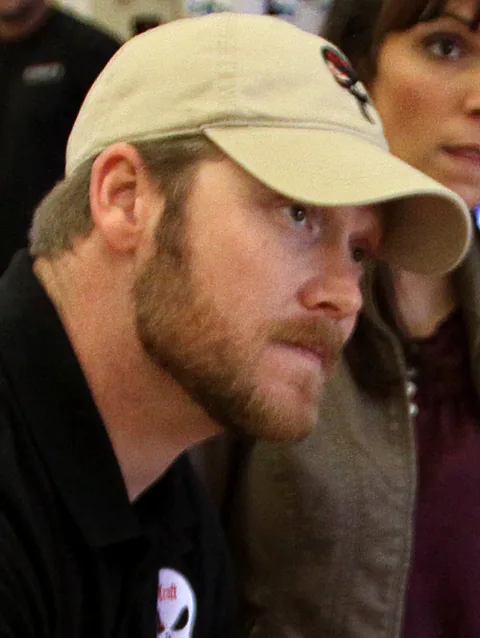

Navy SEAL, sniper, author, businessman
Chris Kyle
Also known as Christopher Scott Kyle, The Legend, The Devil of Ramadi
Born in Odessa, Texas, United StatesDied in Erath County, Texas, United States
American Navy SEAL sniper who served four tours in the Iraq War and wrote the memoir American Sniper. He was killed in 2013 at a Texas shooting range by a veteran he was trying to help.
Official and reference links
- WikipediaReference
- WikiquoteReference
- Taya and Chris Kyle FoundationFoundation
- Wikimedia Commons categoryArchive
- Texas State Cemetery recordArchive
Overview
Christopher Scott Kyle was born on April 8, 1974, in Odessa, Texas, and became a U.S. Navy SEAL sniper and an author.[1] He served four tours in the Iraq War, left the Navy in 2009, and published the memoir American Sniper in 2012, which spent 37 weeks on The New York Times bestseller list.[1]
After the Navy he was president of a tactical training company, helped create a foundation that provided exercise equipment and counseling to veterans, and often took troubled veterans shooting or hunting.[1][2][3] He told one interviewer that the book was meant to be about the sacrifices of service members' families and of the men who died, not about himself.[4]
His record is contested in places. A federal jury in Minnesota found in 2014 that a bar-fight story in his memoir had defamed the former governor Jesse Ventura; an appeals court threw out the award in 2016, and in 2017 the parties agreed to dismiss the case after a settlement whose amount was not made public.[5][6][7][8] In 2016 the Navy corrected the medal count on his discharge paperwork, and Wikipedia notes that several other incidents he claimed were unverifiable.[9][1]
On February 2, 2013, Kyle and his friend Chad Littlefield were shot and killed at a Texas shooting range by Eddie Ray Routh, a former Marine whose mother had asked Kyle for help. Routh was convicted in 2015 and sentenced to life in prison without parole.[3][10]
Life
1974–1992
Boyhood in Texas
Kyle was born in Odessa, Texas, the elder of two boys born to Deborah Lynn and Wayne Kenneth Kyle.[1] History.com calls him the son of a church deacon and a Sunday school teacher.[2] He and his brother Jeff grew up raising cattle, and he went to high school in Midlothian, graduating in 1992.[1]
In first-person remarks published by Texas Monthly in January 2012, he said his first gun was a Daisy BB rifle for shooting birds and squirrels, and that his father later bought him a shotgun for hunting dove and pheasant and a rifle for deer.[11] He added that he "honestly didn't know I was a decent shot until I joined the military."[11] A Dallas Morning News reporter told PBS that Kyle had said he dreamed of becoming a cowboy or joining the military.[12]
1992–1998
Rodeo, ranch work, and college
After high school Kyle became a professional bronco rider and ranch hand, but his rodeo career ended abruptly when he severely injured his arm.[1] Military.com reports that the injury came during a ride and that pins were set in the arm.[13] He also spent two years at Tarleton State University, from 1992 to 1994, studying ranch and range management.[1]
1998–2003
Becoming a SEAL
Kyle went to a recruiting office hoping to join Marine Corps special operations. A Navy recruiter talked him into trying for the SEALs instead, and he enlisted on August 5, 1998.[1] He began basic training in February 1999 and then trained as an intelligence specialist before he was invited to the 24-week SEAL course, Basic Underwater Demolition/SEAL training, in Coronado, California.[1] He graduated with Class 233 in March 2001, finished SEAL Qualification Training that August, and was assigned to SEAL Team 3, in the sniper element of Platoon Charlie.[1]
He later admitted he was no fan of the water: "If I see a puddle I will walk around it. I hate the water." He described the course as seven months of being cold and wet.[4] He married Taya Studebaker in 2002.[1]
2003–2008
Four tours in Iraq
Kyle deployed to Iraq four times: the 2003 invasion, Fallujah in 2004, Ramadi in 2006, and Baghdad in 2008.[2] In his words, "Fallujah was bad, Ramadi was worse, but Sadr City was the hardest of them all."[11]
He explained that he wanted to be a sniper to make precision shots, and that a sniper got onto the battlefield before the rest of his unit and gave them live information about what was happening.[11] The Navy's Silver Star citation, covering April to August 2006 in Ramadi, describes him as lead sniper and says his engagements directly prevented casualties to U.S. and Iraqi forces on more than 30 occasions.[1]
Military.com reports that the enemy called him "The Devil of Ramadi" and put a price on his head, while among fellow SEALs his nickname "Legend" started out as a joke.[13] It adds that by the time he left the military he had been shot twice and had survived six improvised explosive devices.[13]
2012–2013
American Sniper
Kyle had hesitated to write a memoir, but he was persuaded to go ahead because other books about SEALs were already under way.[1]American Sniper, written with Scott McEwen and Jim DeFelice, came out in 2012 and brought him national attention.[1] He told TIME that he had not wanted to put his number of kills in the book at all.[4] He donated his share of the book's profits to the families of colleagues who had died and to a charity for wounded veterans.[2] In August 2012 he appeared on the reality show Stars Earn Stripes, teamed with the actor Dean Cain.[1]
After its release, media articles challenged some of his anecdotes, and Jesse Ventura sued him in January 2012; both are covered below.[1]
2013–present
February 2013 and after
On February 2, 2013, Kyle and Chad Littlefield, 35, were shot and killed by Eddie Ray Routh, 25, at a shooting range in Erath County, Texas.[1] The New Yorker writer Nicholas Schmidle told NPR that Routh's mother had asked Kyle on January 25 to help her son, and that Kyle had used the gun range "many, many times before" as a kind of therapist's office.[3] Routh pleaded not guilty by reason of insanity, and his lawyers argued that he suffered from paranoid schizophrenia. In February 2015 a Texas jury found him guilty, and he was sentenced to life in prison without parole.[10]
A memorial service at Cowboys Stadium on February 11 drew an estimated 7,000 people.[1][14] Kyle was buried on February 12 at the Texas State Cemetery in Austin after a funeral procession of more than 200 miles from Midlothian.[1]
In August 2013 Gov. Rick Perry signed Senate Bill 162, the "Chris Kyle Bill," to recognize military training in the issuance of occupational licenses, and in 2015 Gov. Greg Abbott declared February 2 "Chris Kyle Day."[1] Clint Eastwood's film American Sniper (2014), starring Bradley Cooper, is based on the book.[1] His widow, Taya Kyle, is executive director of the Taya and Chris Kyle Foundation, which says its programs for military and first responder communities grew from a vision he was developing before his death.[1][15]
Habits and rituals
Learning the rifle young
1980s–2009
Kyle grew up hunting with his father, and he said he did not realize he was a decent shot until he joined the military.[11][1] In military training he used four different rifles so that he would know which weapon was most useful in a given situation.[1]
Matching the rifle to the mission
2003–2008
Kyle said his weapon choice was "purpose-driven." Before a mission he would look at imagery to estimate the longest shot he might have to make, and if it was a thousand or more he took his .300 Winchester Magnum, along with an M4 patrol rifle.[4]
Watching the whole scene
2003–2008
Kyle said a sniper had to know what to look for and described the job as watching the whole environment: "the longer you do it, the easier it is to pick out the person who doesn't fit in."[11] He said a sniper got onto the battlefield before the rest of his unit and passed on live information, and that "keeps your guys safe."[11]
Staying sharp enough to teach
2009–2013
Kyle told TIME that training was part of his job, so he made sure he stayed in practice himself. Someone would eventually challenge him to a shoot, and if he told students to do something a certain way he wanted to be able to do it himself and show that it made a difference.[4] He was president of Craft International, a tactical training company for the U.S. military and law enforcement communities.[1]
Switching off at the front door
2000s
Kyle said that a SEAL turns the work personality on and off: more aggressive at work, then relaxing and being a different person at home. He joked that his wife always said he took his cape off and put it on the door when he came home, because he would stub or break a toe at home but was fine at work.[4] In the same interview he said that even training before a deployment kept him away, so he did not get to see his family.[4]
Taking veterans outdoors
2009–2013
Nicholas Schmidle told NPR that Kyle would take young men affected by post-traumatic stress hunting or just spend time with them, and that he had tried many times to use the gun range as a kind of therapist's office.[3] History.com adds that he often invited troubled veterans to shoot targets as a way to connect, and that he saw the benefits of exercise in his own life before helping start FITCO Cares.[2] The Texas State Cemetery's obituary says he lived by the creed "It is our duty to serve those who serve us."[16]
Giving the book's money away
2012–2013
Kyle donated his share of the profits from American Sniper to the families of colleagues who had died in battle and to a charity that helps wounded veterans.[2]
Setbacks and comebacks
The arm injury and the first no 1992–2001
What happened
Kyle's professional rodeo career ended when he severely injured his arm, and pins were set in it.[1][13] When he tried to become a SEAL, he was at first rejected because of the pins.[1]
Coming home 2009–2012
What happened
After leaving the Navy, Kyle had a hard time. History.com reports that he drank heavily, suffered bouts of depression, and stopped working out, and that he felt without a mission and without the company of his fellow SEALs.[2] He told a Dallas Morning News reporter that the return to civilian life was jarring and that he could not connect as much with people who had not seen what he had seen in Iraq.[12] Kyle told TIME that "Everybody gets battle stress; maybe not PTSD."[4] Nicholas Schmidle, who reported on his death for The New Yorker, told NPR he had never seen any diagnosis of post-traumatic stress disorder for Kyle.[3]
The cause
Four deployments, then civilian life, where History.com says he felt anchorless without a mission and the camaraderie of his fellow SEALs.[2] Kyle said it "definitely makes it hard to come back from that to learn to be a civilian."[4] In a 2012 Inside Edition interview he explained how much he missed the service, while his wife spoke about how hard it was to raise a family with him always away.[17]
The comeback
Taya's warning that she would take the children to her parents pushed him to leave the Navy, and he turned toward family and toward other veterans.[4] He helped create the FITCO Cares Foundation, became president of a training company, and spent time with troubled veterans.[2][1][3] He summed it up for TIME: "I lost the teams and I lost the guys, but I gained my family."[4]
The Ventura lawsuit 2012–2017
What happened
In American Sniper, Kyle described punching a man he called "Scruff Face" in a Coronado bar during a wake for the SEAL Michael Monsoor. On the Opie and Anthony radio show in January 2012, he said the man was Jesse Ventura, a former governor of Minnesota whom Military.com describes as a former Navy SEAL.[1][13] Ventura said the fight never happened and sued Kyle for defamation in January 2012; after Kyle's death the case continued against his estate, and his widow became the defendant.[1][5] In July 2014 a jury, by an 8–2 vote that both sides accepted, awarded Ventura $500,000 for defamation and $1.3 million for unjust enrichment.[5] In June 2016 the Eighth Circuit Court of Appeals overturned the award and sent the case back for a new trial; in December 2017 the parties agreed to dismiss the case with prejudice.[6][7] FOX 9 reported that the settlement amount was private and that Ventura said he felt "vindicated."[8]
The cause
Kyle told the story of the bar fight in his book and later identified the man as Ventura, who said the claims had made him an outcast in the SEAL community.[5] MPR noted that the law sets a higher bar for public figures, who must show not just that the information was wrong but that the truth was disregarded, and the jury still sided with Ventura.[5]
The comeback
There was no comeback in Kyle's lifetime: he died before the case went to trial. His widow appealed the verdict on behalf of his estate.[6][1] The appeals court's majority wrote that remarks by Ventura's team about a publisher's possible insurance coverage "prevented Kyle from receiving a fair trial," and that Ventura's unjust-enrichment theory "enjoys no legal support under Minnesota law"; one judge dissented in part and said he would have upheld the $500,000 defamation award.[6] The case then ended with a dismissal and a settlement whose amount was not made public.[7][8]
The medal count and other disputed stories 2012–2016
What happened
Besides the Ventura story, Kyle claimed involvement in other incidents that could not be verified. Wikipedia, summarizing the coverage, says The New Yorker reported in 2013 that during a late-night drinking session he recounted shooting armed civilians from the top of the Louisiana Superdome after Hurricane Katrina, and that he also claimed to have killed two men at a Dallas-area gas station. It says there are no records of multiple shooting victims around the Superdome, and that the sheriffs of the three counties along the highway where he placed the gas station incident denied it had happened.[1] Military.com says no evidence exists to support either story except Kyle's own word.[13] NPR's interview with the New Yorker writer likewise reports that sheriffs said the gas station story did not happen in their jurisdictions.[3]
In May 2016 The Intercept reported, from internal Navy documents, that Kyle earned one Silver Star and three Bronze Stars with Valor, not the two Silver Stars and five Bronze Stars he wrote in his book that he had earned.[18] Citing two Navy officials, it also reported that his discharge form listed two Silver Stars and six Bronze Stars with Valor.[18] A Navy investigation concluded on June 14, 2016, and the Navy said he had earned one Silver Star and four Bronze Stars with combat "V" for valor.[9] On his kill count, Kyle wrote that the Navy's number went back and forth and that anyone who wanted a number should ask the Navy; his publisher said the Pentagon had confirmed more than 150 but had declined to verify the total for the book.[1] Military.com reports that U.S. Special Operations Command says it does not keep an official tally of confirmed kills.[13]
The cause
A Navy spokesman told The Intercept that the DD-214 discharge form is generated locally at the separating command and that "inevitably some errors may occur."[18] A Navy spokeswoman later told the Associated Press, "We're not sure why or when or the reason for the error," and Wikipedia quotes the Navy as saying Kyle would have played no role in producing his personnel files other than signing the DD-214.[9][1]The Intercept also reported, citing an unnamed current Navy officer, that one of Kyle's former commanders had advised him before publication that his claim of two Silver Stars was false.[18] Navy Times reported that Kyle was nominated for a Silver Star in 2004 and that the award was downgraded to a Bronze Star two years later, and that a Navy official said it remained possible he had received a second award, though there was no paper trail to support it.[19] CBS and the Associated Press wrote that it was unclear whether Kyle knew of the discrepancy when he wrote the book.[9]
The comeback
There was no comeback in Kyle's lifetime, because these questions were raised after his death. The Navy corrected his record and notified his family.[9] Current and former SEALs interviewed by The Intercept did not dispute his heroism in combat, but they saw the inflated medal count as significant because they consider battlefield embellishments dishonorable.[18] A former teammate who asked not to be named told Navy Times that he did not know whether Kyle fabricated any awards, but said, "He was pretty damn effective."[19]
In their own words
I'm not trying to glorify myself.[4]
TIME interview (late 2011) · Source I lost the teams and I lost the guys, but I gained my family.[4]
TIME interview (late 2011) · Source She was going to take the kids and go to her parents, and I could not lose my family.[4]
TIME interview (late 2011) · Source I was fighting because my country told me to, and then I was fighting for my buddies and my family.[4]
TIME interview (late 2011) · Source It definitely makes it hard to come back from that to learn to be a civilian now, and there's different rules being a civilian.[4]
TIME interview (late 2011) · Source You turn it on and turn it off.[4]
TIME interview (late 2011) · Source If I see a puddle I will walk around it. I hate the water.[4]
TIME interview (late 2011) · Source I honestly didn't know I was a decent shot until I joined the military.[11]
Texas Monthly, “Being a Navy SEAL Sniper” · Source There is so much more to being a sniper than just being a monkey on a gun. You almost feel like a secret agent, because you get onto the battlefield before your guys do, and you give them live, up-to-the-minute intel about what's happening.[11]
Texas Monthly, “Being a Navy SEAL Sniper” · Source Your job is to watch the whole environment, and the longer you do it, the easier it is to pick out the person who doesn't fit in.[11]
Texas Monthly, “Being a Navy SEAL Sniper” · Source It was my duty to shoot the enemy, and I don't regret it. My regrets are for the people I couldn't save: Marines, soldiers, buddies. I'm not naive, and I don't romanticize war.[11]
Texas Monthly, “Being a Navy SEAL Sniper” · Source That's the number I'd care about.[2]
Interview with D Magazine, on the number of lives he saved, quoted by History.com · Source I loved what I did. If circumstances were different—if my family didn't need me—I'd be back in a heartbeat.[2]
American Sniper (2012), quoted by History.com · Source I had the time of my life being a SEAL.[2]
American Sniper (2012), quoted by History.com · Source
Pictures
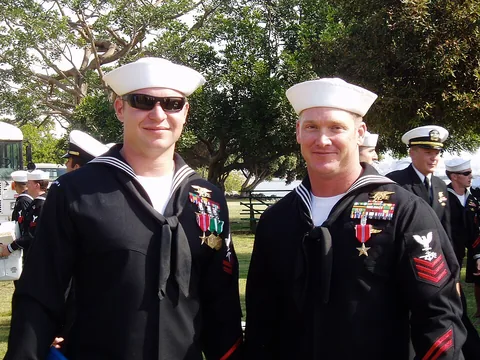
Kyle (right) with Kevin Lacz at a SEAL Team 3 awards ceremony in Coronado, California, October 2007.2007-10-07Photo: · CC BY-SA 4.0 · Wikimedia Commons Kyle signing a copy of American Sniper at Camp Pendleton, California, in January 2012.2012-01-13Photo: · Public domain · Wikimedia Commons 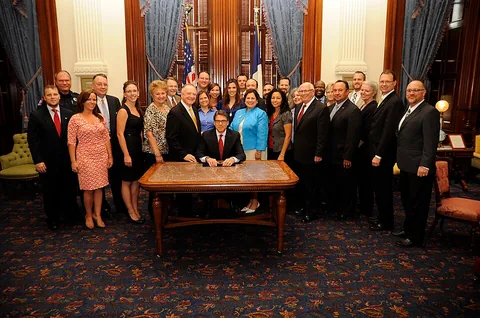
Texas Gov. Rick Perry with legislators and supporters at the ceremonial signing of the Chris Kyle Bill, August 2013.2013-08-28Photo: · Public domain · Wikimedia Commons 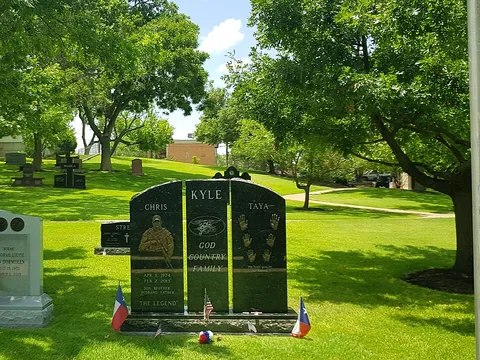
Kyle's headstone at the Texas State Cemetery in Austin.2018-07-05Photo: · CC BY-SA 4.0 · Wikimedia Commons


Watch and listen
Read
Notes
- "Chris Kyle," Wikipedia, accessed November 26, 2026 (used for the dates, places, training and service record, Craft International, the memoir's publication and bestseller run, the Ventura case history, the Navy's 2016 correction, the death, burial, and legacy, and the Navy's Silver Star citation, which the article reproduces). https://en.wikipedia.org/wiki/Chris_Kyle↩1↩2↩3↩4↩5↩6↩7↩8↩9↩10↩11↩12↩13↩14↩15↩16↩17↩18↩19↩20↩21↩22↩23↩24↩25↩26↩27↩28↩29↩30↩31↩32↩33↩34↩35↩36↩37↩38
- Christopher Klein, "The Real-Life Story Behind 'American Sniper,'" HISTORY, accessed November 26, 2026 (cited for his parents, the tours, Taya's ultimatum, the post-service struggles, FITCO Cares, the donation of profits, and quotations it attributes to American Sniper and D Magazine; not cited for its medal and kill counts, which the Navy later corrected). https://www.history.com/news/the-real-life-story-behind-american-sniper↩1↩2↩3↩4↩5↩6↩7↩8↩9↩10↩11↩12↩13↩14↩15
- David Greene interviewing Nicholas Schmidle, "Tragic Result: Sniper Tries To Help Troubled Veteran," NPR, May 28, 2013. https://www.npr.org/2013/05/28/186861868/tragic-result-sniper-tries-to-help-troubled-veteran↩1↩2↩3↩4↩5↩6↩7
- Belinda Luscombe, "Read the Full Interview With American Sniper Chris Kyle That Didn't Make it to Press," TIME (interview conducted in late 2011, before the book's release; transcript edited for clarity and repetition), accessed November 26, 2026. https://time.com/3674546/chris-kyle-american-sniper-interview/↩1↩2↩3↩4↩5↩6↩7↩8↩9↩10↩11↩12↩13↩14↩15↩16↩17↩18↩19
- "Jury backs Ventura, awards $1.8 million in defamation suit over SEAL fight," MPR News, July 29, 2014. https://www.mprnews.org/story/2014/07/29/ventura-verdict↩1↩2↩3↩4↩5
- "Ventura's defamation award tossed, new trial ordered," MPR News, June 13, 2016. https://www.mprnews.org/story/2016/06/13/venturas-defamation-award-tossed-new-trial-ordered↩1↩2↩3↩4
- "Ventura, estate of 'Sniper' author agree to dismiss case," MPR News, December 2, 2017. https://mprnews.org/story/2017/12/02/ventura-estate-of-sniper-author-agree-to-dismiss-case↩1↩2↩3
- "Ventura 'vindicated' after settling lawsuit against 'Sniper' author," FOX 9 Minneapolis-St. Paul, December 4, 2017. https://www.fox9.com/news/ventura-vindicated-after-settling-lawsuit-against-sniper-author↩1↩2↩3
- "Navy says 'American Sniper' Chris Kyle had fewer medals than claimed," CBS News and the Associated Press, July 11, 2016. https://www.cbsnews.com/amp/news/navy-american-sniper-chris-kyle-medals-investigation↩1↩2↩3↩4↩5
- "Guilty Verdict Returned In 'American Sniper' Murder Trial," NPR, February 24, 2015. https://www.npr.org/sections/thetwo-way/2015/02/24/388851647/guilty-verdict-returned-in-american-sniper-murder-trial↩1↩2
- Brian D. Sweany, "Being a Navy SEAL Sniper," Texas Monthly, January 2012 (Kyle's remarks in the first person; the page's header lists claims about his kills and medals that later reporting disputes, and they are not cited here), accessed November 26, 2026. https://www.texasmonthly.com/the-culture/being-a-navy-seal-sniper/↩1↩2↩3↩4↩5↩6↩7↩8↩9↩10↩11
- Jeffrey Brown interviewing Melissa Repko of The Dallas Morning News, "Chris Kyle, Among Deadliest American Military Snipers, Shot by Fellow Veteran," PBS NewsHour, February 4, 2013, accessed November 26, 2026. https://www.pbs.org/newshour/show/chris-kyle-among-deadliest-american-military-snipers↩1↩2
- Blake Stilwell, "Everything You Need to Know About the Life and Death of Chris Kyle," Military.com, accessed November 26, 2026. https://www.military.com/military-life/everything-you-need-know-about-life-and-death-chris-kyle.html↩1↩2↩3↩4↩5↩6↩7↩8↩9
- "Chris Kyle," Biography.com, accessed November 26, 2026 (cited only for the attendance estimate at the public memorial service). https://www.biography.com/military-figure/chris-kyle↩
- "Taya and Chris Kyle Foundation," accessed November 26, 2026. https://chriskylefrogfoundation.org/↩
- "Kyle, Christopher Scott (1974–2013)," Texas State Cemetery, accessed November 26, 2026 (the obituary text on the Cemetery's plotholder page). https://cemetery.texas.gov/locate-a-plot/plotholder/christopher-scott-kyle↩
- "Why 'American Sniper' Chris Kyle Struggled With Retirement," Inside Edition, accessed November 26, 2026 (video page; the 2012 interview with Chris and Taya Kyle). https://www.insideedition.com/media/videos/why-american-sniper-chris-kyle-struggled-with-retirement-59205↩
- Matthew Cole and Sheelagh McNeill, "'American Sniper' Chris Kyle Distorted His Military Record, Documents Show," The Intercept, May 25, 2016. https://theintercept.com/2016/05/25/american-sniper-chris-kyle-distorted-his-military-record-documents-show/↩1↩2↩3↩4↩5
- "New questions cast doubt on 'American Sniper' Chris Kyle's combat record," Navy Times, May 25, 2016. https://www.navytimes.com/news/your-navy/2016/05/25/new-questions-cast-doubt-on-american-sniper-chris-kyle-s-combat-record/↩1↩2